
Navy says 12 arrested over alleged ₦660m crude theft in Akwa Ibom
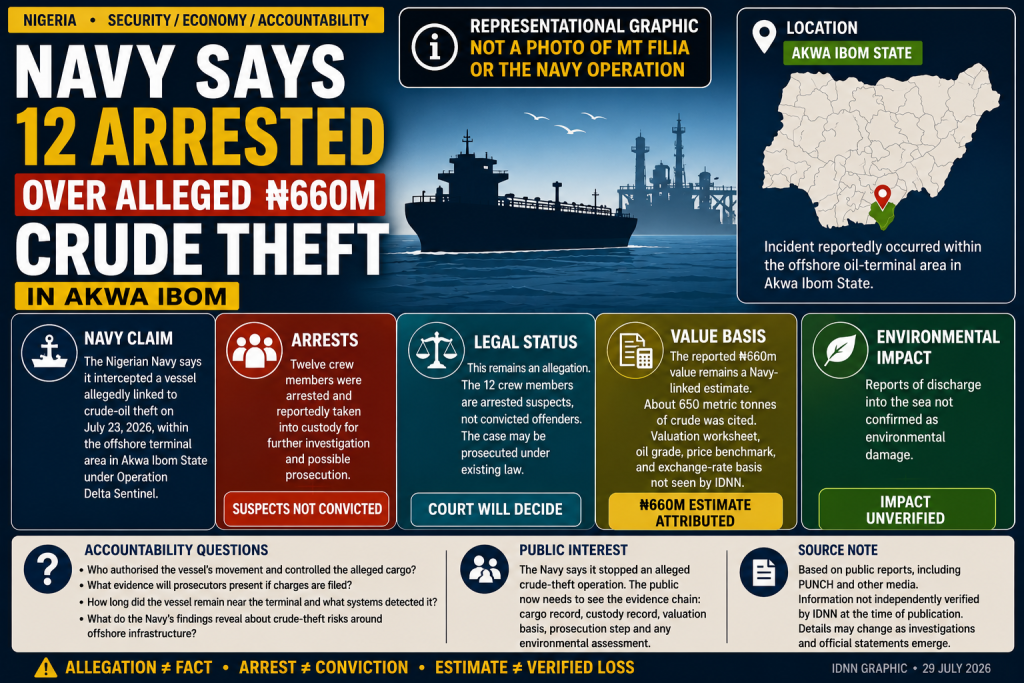
The Nigerian Navy says it intercepted a vessel allegedly involved in crude oil theft in Akwa Ibom State and arrested 12 crew members, but the suspects have not been convicted of any offence.
The vessel, identified in reports as MT FILIA, was said to have been intercepted on July 23, 2026, within the offshore oil-terminal area in Akwa Ibom State under Operation Delta Sentinel.
Navy announces vessel interception
Reports monitored say that the Nigerian Navy intercepted an oil tanker allegedly conveying stolen crude oil valued at more than ₦660m and arrested 12 crew members.
Other reports identified the vessel as MT FILIA, with IMO number 8662684, and said it was intercepted within the offshore terminal area in Akwa Ibom State.
The reports attributed the operation to the Eastern Naval Command and Operation Delta Sentinel.
Navy claim and legal status
The Navy’s claim is that the vessel was allegedly involved in illegal crude-oil activity. That remains an allegation unless prosecutors establish the case in court.
The 12 crew members should be described as arrested suspects or crew members in custody, not as convicted oil thieves.
The vessel, crew and alleged cargo were reportedly taken into custody for further investigation and possible prosecution under existing law.
Value basis still needs scrutiny
The reported ₦660m value remains a Navy-linked estimate.
IDNN has not seen the valuation worksheet, oil-grade basis, benchmark price, exchange-rate basis or independent cargo verification.
Reports said preliminary investigation and the captain’s alleged confession indicated that the vessel had loaded about 650 metric tonnes of crude oil, estimated to be worth more than ₦660m.
IDNN has not independently verified the volume, valuation formula, oil grade, price benchmark, exchange-rate basis or whether the alleged cargo value was calculated before or after any reported discharge into the sea.
Accountability questions
The case raises two layers of accountability.
The first is criminal accountability: who authorised the vessel’s movement, who controlled the alleged cargo, and what evidence will prosecutors present if charges are filed?
The second is institutional accountability: how long the vessel remained near the terminal, what surveillance detected, whether terminal security protocols held, and what the Navy’s findings reveal about crude-theft risks around offshore infrastructure.
For Akwa Ibom and the wider Niger Delta, the consequence is not only the alleged theft value. It is also the public cost of oil loss, maritime pollution risk, enforcement credibility and whether arrests lead to transparent prosecution.
The Navy says it stopped an alleged crude-theft operation. The public now needs to see the evidence chain: cargo record, custody record, valuation basis, prosecution step and any environmental assessment.
Response status: IDNN is seeking further confirmation from the Nigerian Navy, relevant maritime and petroleum regulators, terminal operators and prosecuting authorities on the vessel’s status, cargo record, valuation basis, pollution assessment, custody chain, charges and next legal step.
