
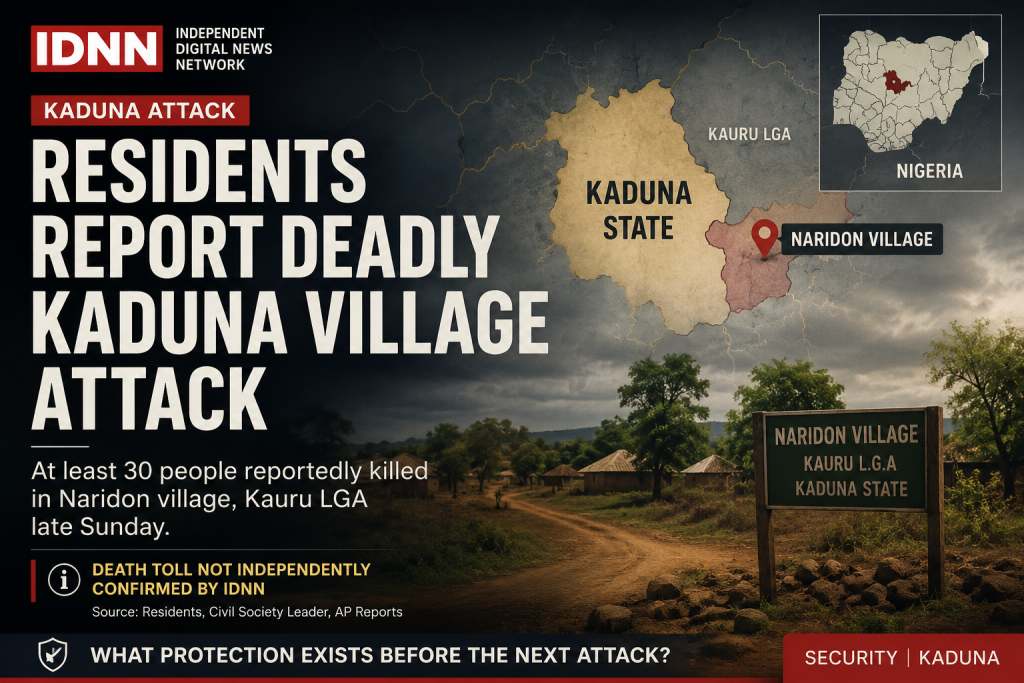
A Kaduna village that had already lived with the memory of past attacks is counting its dead again after residents and government accounts said about 30 people were killed in Naridon, Kauru Local Government Area.
The attack happened between late Sunday night and the early hours of Monday, according to available accounts. The Associated Press reported that residents and a civil society leader said gunmen attacked Naridon village, killing about 30 people and injuring several others.
The presidency also referred to about 30 deaths while announcing President Bola Tinubu’s condemnation of the attack.
Tinubu ordered security agencies to intensify operations in the area and pursue those responsible. The Kaduna State Government also condemned the attack, describing it as a deadly assault along the Kaduna–Plateau border axis.
For Naridon, the official words come after the damage. AP quoted Derek Christopher, chairman of the Southern Kaduna Peace and Security Network, as saying the same community had suffered an attack around the same period last year. A resident, Raphael Joshua, told AP that victims’ bodies had been taken to a nearby hospital while burial arrangements were being made.
Nigerian reports also said houses were burnt during the attack. Punch reported that children were among those killed, but IDNN has not independently verified the full casualty breakdown.
The strongest publishable frame is clear but narrow: a deadly attack occurred in Naridon; residents and official accounts put the death toll at about 30; the president has ordered a security response; and the identity of the attackers has not been confirmed by IDNN.
No group has been established as responsible. The story must therefore remain inside the evidence: gunmen attacked a rural community; residents are burying victims; officials have condemned the killing; and security agencies have been ordered to act.
The unanswered question is no longer only who pulled the trigger. It is what protection existed before the attack, whether warnings were missed, how quickly help arrived, and what changes after another presidential order.
For the families in Naridon, the consequence is immediate: deaths, injuries, damaged homes, burials and fear. For the state, the test is whether official condemnation becomes protection on the ground — or whether Naridon becomes another community remembered only after the killing is done.
