
Nigeria Pushes Local Mineral Processing as Africa Rethinks Raw Exports
Nigeria is intensifying its push to process more minerals locally before export as the Federal Government argues that African countries lose economic value when raw resources leave the continent without further processing.
Vice President Kashim Shettima, speaking on behalf of President Bola Tinubu at the Africa Minerals Strategy Group high-level roundtable in New York, said African countries should move away from exporting mineral wealth without capturing more value through processing, manufacturing and industrialisation.
The message reflects Nigeria’s broader mining-policy direction.
But it should not be read as evidence that Nigeria has imposed a blanket legal ban on every raw-mineral export.
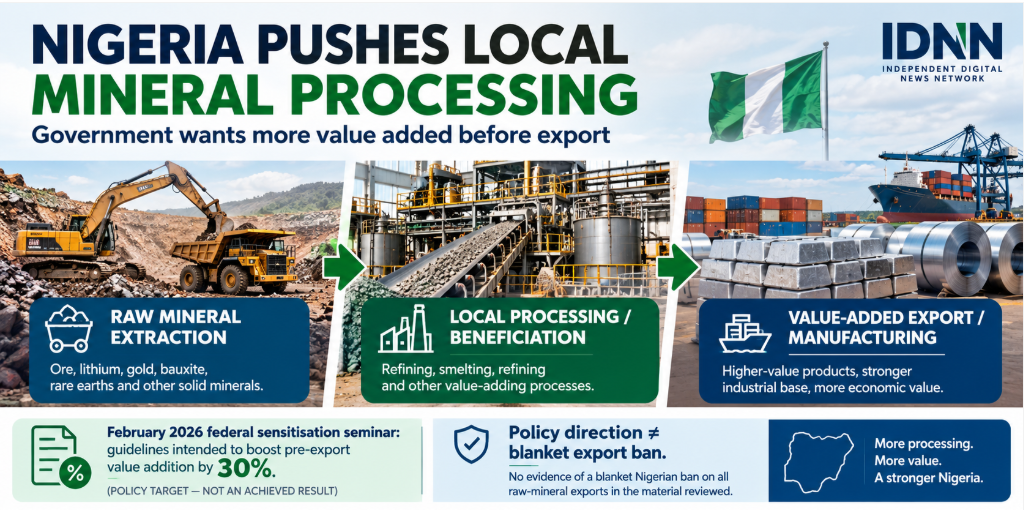
Government wants more value retained locally
Shettima said African countries should build regional processing hubs, strengthen local-content rules and develop cross-border mineral corridors capable of supporting larger industrial markets.
He also pointed to Nigeria’s own mining reforms, including greater emphasis on local value addition, improved geological information and formalisation of artisanal miners.
President Tinubu has made a similar case, arguing that African countries should retain more value from their mineral resources through processing, technology transfer and industrial development.
Government argues that local processing can retain more value, support industrialisation and create jobs.
Those are policy objectives.
They are not yet demonstrated nationwide outcomes.
Nigeria is tightening its value-addition policy
Nigeria’s domestic policy direction increasingly favours pre-export processing.
A federal sensitisation seminar in February 2026 said the solid-minerals export guidelines were intended to boost pre-export value addition by 30% while strengthening Certificates of Origin, export governance and action against illegal mining.
The Ministry of Solid Minerals Development has also said the administration wants mineral resources to undergo more value addition before export.
Those statements show a clear policy direction.
They do not, by themselves, establish that every unprocessed mineral is prohibited from leaving Nigeria under one blanket rule.
Policy push is not the same as a universal ban
That distinction matters.
The Presidency has said some members of the Africa Minerals Strategy Group have already banned raw-mineral exports.
It has not said Nigeria has imposed the same blanket prohibition across all minerals.
Any commodity-specific export restriction must be documented separately and should not be generalised across the solid-minerals sector.
For miners, exporters and investors, the practical questions are therefore more specific:
Which minerals are subject to particular export requirements?
What level of processing is required?
How is compliance measured?
And what licences, certificates or approvals must exporters obtain?
Jobs and industrialisation remain promises to test
The Federal Government says local processing can generate jobs, deepen manufacturing and retain more economic value inside Nigeria.
Those are important policy aims.
The stronger test is whether the policy leads to operating processing plants, sustained employment, higher local procurement, increased tax and royalty receipts, technology transfer and measurable benefits for communities around mining areas.
Without those outcomes, value-addition policy can remain stronger on paper than in the communities and industries it is meant to change.
Community benefit is part of the accountability test
Shettima also argued that African countries cannot describe themselves as mineral-rich while communities around mineral deposits remain poor.
That makes local processing more than an export-policy question.
It is also a question of who benefits from mineral development.
If processing expands inside Nigeria, the accountability issues include where facilities are built, who gets the jobs, whether local businesses participate, how environmental risks are managed and whether mining communities receive durable economic benefits.
What to watch next
The next phase is implementation.
Government agencies need to clarify the enforceable rules behind the value-addition policy, including commodity-specific requirements, export documentation and any minimum processing standards.
Investors also need to show whether announced processing projects move into sustained production.
Nigeria’s policy direction is increasingly clear:
the government wants more minerals processed before they leave the country.
What remains to be proven is how consistently that policy is enforced — and how much value it actually keeps inside Nigeria.
