
Nigeria’s GBV justice gap: why prosecution remains so difficult
Zipporah Peter
Government figures show 2,755 reported GBV/IPV cases in four months, but only 4% were successfully prosecuted. Survivors and advocates say the gap is about more than law.
ABUJA — For many Nigerian women and girls, surviving gender-based violence is only the beginning of another ordeal: proving what happened, enduring stigma, and waiting for a justice system that too often moves slowly or not at all.
That gap is now written in government figures.
Women Affairs Minister Imaan Sulaiman-Ibrahim disclosed that Nigeria recorded 2,755 cases of gender-based violence and intimate-partner violence between January and April 2026, but only 4% were successfully prosecuted. The disclosure was made during the signing of a memorandum of understanding for a survivor rehabilitation centre, according to reports by The Guardian and other outlets.
The figure does not describe every case of abuse in Nigeria. It describes reported cases captured within the referenced period. But even within that limited frame, the gap between reporting and prosecution is stark.
The Justice Gap Behind The Numbers
A 4% successful prosecution rate means most reported cases do not end in the kind of accountability survivors are often promised when they are urged to speak out.
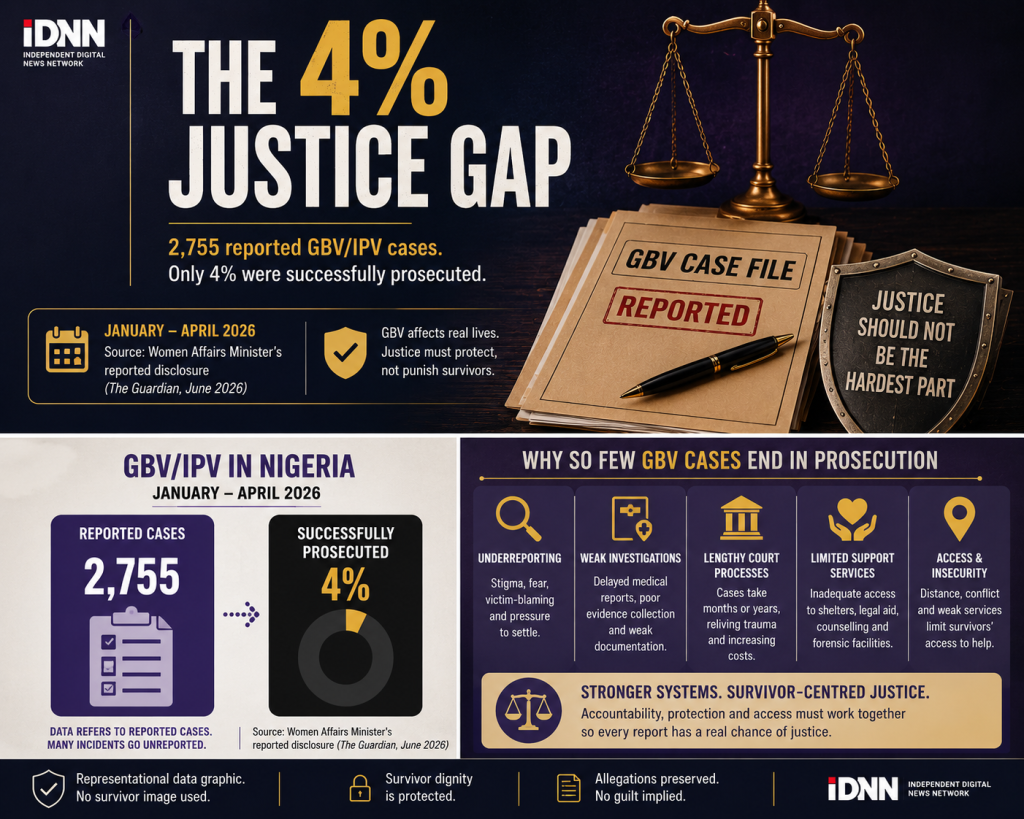
The reasons are not simple.
Survivors may face family pressure, community stigma, fear of retaliation, victim-blaming or pressure to settle matters privately. Some cases weaken before trial because evidence is not collected early, medical examinations are delayed, witnesses withdraw, or police documentation is incomplete.
Court delays add another burden. A survivor may have to retell the same traumatic experience repeatedly while also paying for transport, legal support and medical care.
For many survivors, the legal process can become another punishment.
Cases That Reignited Public Anger
Recent cases have pushed the issue back into national debate.
In Delta State, the death of 20-year-old Favour Agbro triggered outrage after rape allegations were made against a content creator. The Delta State Police Command said the suspect, Ifeanyi Ogbonna, also known as Odogwu of Asaaba, had been arrested and would be prosecuted. No guilt has been established by a court.
Another case involved TikTok user Mirabel, who publicly alleged sexual assault. The Lagos State Domestic and Sexual Violence Agency responded to the matter before referring the case to authorities in Ogun State after officials said the alleged incident occurred there. The investigation status must not be overstated beyond what authorities have confirmed.
These cases drew attention because they became public. Advocates say many others never do.
Why Prosecution Is So Difficult
GBV cases often depend on evidence that must be collected quickly and handled carefully.
Medical reports, forensic samples, witness statements, digital records, scene documentation and survivor testimony can all matter. When any part of that chain breaks, the case becomes harder to prove in court.
There is also the problem of access.
Survivors in rural or conflict-affected communities may be far from police stations, hospitals, Sexual Assault Referral Centres, shelters or lawyers. In areas affected by insecurity, reporting can be even harder because displacement, fear and weak institutional presence limit access to help.
That means a survivor’s chance of justice can depend not only on what happened, but also on where it happened, who believed them first, whether evidence was preserved, and whether the case survived pressure from family, community or alleged perpetrators.
What Government Must Prove Next
Nigeria has laws and programmes aimed at responding to gender-based violence, including the Violence Against Persons (Prohibition) Act, Sexual Assault Referral Centres and survivor-support initiatives.
But the prosecution figure shows the harder problem: implementation.
A survivor-centred justice system would require stronger GBV police units, better forensic capacity, faster courts, wider legal aid, more shelters, trauma counselling, witness protection and clearer case tracking from report to prosecution.
It would also require public institutions to answer a direct accountability question: when a survivor reports violence, who is responsible for ensuring the case does not disappear?
More Than Statistics
The 2,755 cases recorded between January and April 2026 are not just entries on a dashboard. They represent women, girls and other survivors whose lives may have been altered by rape, domestic violence, sexual assault, harmful practices or other forms of abuse.
But the true scale is likely larger than any official count, because many survivors never report at all.
Until investigations become stronger, courts move faster and survivors trust that reporting will not expose them to more harm, Nigeria’s GBV crisis will remain both a violence problem and a justice problem.
For survivors, justice delayed is not a slogan. It is often the difference between protection and abandonment.
Zipporah Peter
