
Nigeria steps up Ebola surveillance as DRC outbreak expands
Nigeria has stepped up Ebola surveillance and preparedness as the Bundibugyo virus disease outbreak continues in the Democratic Republic of the Congo.
The Nigeria Centre for Disease Control and Prevention said in a September 23 advisory that the country was on high alert and had strengthened measures against the possible importation of the virus.
The agency said the decision followed a fresh risk assessment and consultations with public-health experts and the Federal Ministry of Health and Social Welfare.
The alert is a preparedness measure. It does not, by itself, establish that Ebola transmission has been confirmed in Nigeria.
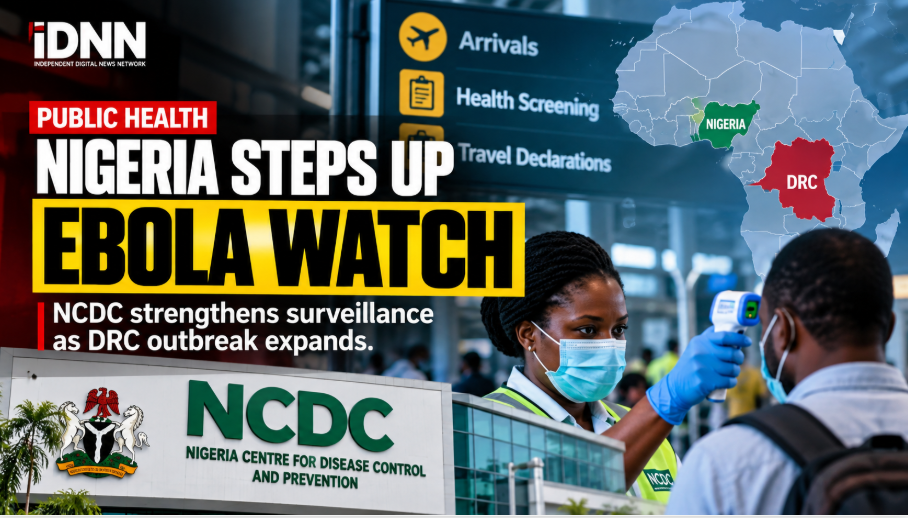
Travellers face enhanced monitoring
NCDC said travellers arriving from countries with active or relevant Ebola transmission should complete Nigeria’s Health Declaration Form as part of enhanced surveillance.
But the agency’s public guidance is not fully aligned.
The September 23 Ebola advisory said passengers arriving from other countries were exempt from that Ebola-specific requirement at the time of the advisory.
NCDC’s online Health Declaration Portal, however, separately describes the form as mandatory for all international arrivals and refers to post-arrival monitoring.
IDNN could not reconcile those two instructions from the available official material.
Travellers should therefore confirm the current requirement with NCDC or Port Health before travelling.
DRC remains the regional pressure point
Nigeria’s heightened preparedness comes as the outbreak continues to spread in the Democratic Republic of the Congo.
The World Health Organization recorded 7,733 confirmed cases and 3,732 deaths in the DRC as of September 20, with 63 health zones affected.
WHO has warned that the outbreak’s geographical expansion increases the importance of surveillance, cross-border coordination and preparedness in neighbouring and connected countries.
What Nigeria is preparing for
For Nigeria, the immediate challenge is readiness.
Health authorities must be able to detect a possible imported case quickly, identify relevant travel or exposure history, isolate suspected cases safely and prevent further transmission if the virus enters the country.
NCDC has urged Nigerians to remain vigilant and advised anyone with symptoms consistent with Ebola and relevant travel or exposure history to seek medical attention promptly and disclose that history to health workers.
The agency lists 6232 as a public-health surveillance and emergency contact number.
The key distinction remains clear: Nigeria is strengthening its defences against possible Ebola importation. The high-alert advisory is not evidence, on its own, of domestic Ebola transmission.
