
Airlines Issue Shutdown Warning as Fuel Prices Surge
Nigeria aviation cost crisis has entered a critical phase, with domestic airline operators warning they may halt operations within days if urgent intervention is not made on rising aviation fuel costs.
Industry insiders say airlines are nearing operational limits after prolonged engagement with government authorities and fuel marketers failed to deliver a breakthrough.
The warning introduces immediate uncertainty for passengers and signals a potential disruption across Nigeria’s domestic travel network.
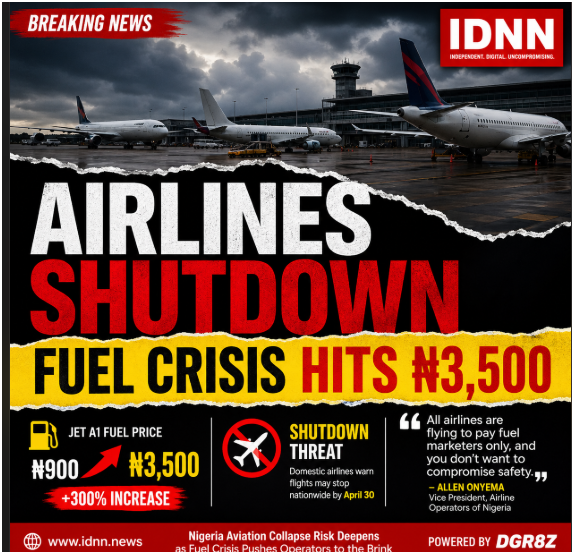
🟨 Fuel Prices Jump Over 300% as Cost Pressure Peaks
At the centre of the crisis is a sharp increase in Jet A1 fuel prices.
According to airline operators, fuel costs have surged from about ₦900 per litre to between ₦2,700 and ₦3,500, representing an increase of more than 300 per cent.
Allen Onyema, Vice President of the Airline Operators of Nigeria, said the spike is unsustainable:
“All the airlines in Nigeria have been flying to pay fuel marketers only… and you don’t want to compromise safety.”
He warned that without urgent action:
“No airline will be flying… not because they don’t want to fly, but because fuel may not be available at sustainable pricing.”
🟥 Government Relief Fails to Address Core Structural Problem
In response to mounting pressure, the Federal Government approved a 30 per cent reduction in aviation-related debts owed by airlines.
While the move was welcomed, industry analysts say it does not address the deeper cost challenges embedded in the system.
Muda Yusuf, Chief Executive Officer of the Centre for the Promotion of Private Enterprise, said:
“While the debt discount offers short-term respite, it does not address the deeper structural cost challenges confronting the aviation sector.”
🟨 Multiple Charges Consume Up to 35% of Airline Revenue
A major structural concern is the burden of multiple taxes, fees and levies imposed by aviation agencies.
According to CPPE estimates, these charges account for as much as 35 per cent of airline revenue, a level described as incompatible with the industry’s thin profit margins.
Affected charges include:
- ticket and cargo sales levies
- passenger service charges
- landing and parking fees
- inspection and administrative costs
Operators argue that this fragmented cost structure is eroding profitability and weakening competitiveness.
🟥 Forex Pressure and Cost Imbalance Deepen Crisis
Beyond fuel and charges, airlines face a structural mismatch:
- revenues are largely in naira
- key expenses are denominated in foreign currency
This imbalance exposes operators to exchange rate volatility and further inflates operating costs.
Industry stakeholders say this combination of pressures is pushing airlines into survival mode.

08112935565, 08161558757
🟥 Not Just Fuel, But a Broken Cost Structure
The Nigeria aviation cost crisis is no longer defined by fuel prices alone.
Instead, it reflects a layered structural failure:
- extreme fuel cost volatility
- multiple regulatory charges
- forex constraints
- dependency on foreign maintenance systems
Together, these factors create a cost environment that operators say is increasingly unsustainable.
🟥 Sector Faces Real Risk of Disruption
If current conditions persist:
- domestic flights could be suspended
- passenger movement may be severely disrupted
- airline viability could weaken further
- safety standards may come under pressure
Industry stakeholders warn that without comprehensive reforms, the aviation sector could face a broader operational and economic breakdown.
🟥 This is IDNN. Independent. Digital. Uncompromising.
