
Inside Dangote’s ₦2.11tn IPO proceeds: ₦841bn for infrastructure, ₦686bn for refinery equipment
Dangote Refinery plans to direct all of its estimated ₦2.11tn net IPO proceeds into a $14.3bn expansion programme, with ₦841bn earmarked for infrastructure, ₦686.5bn for refinery equipment and ₦583.5bn for construction and installation.
Dangote Petroleum Refinery plans to allocate all of its estimated ₦2.11 trillion net IPO proceeds to expansion, giving investors a clearer view of what the money raised from its public offer is intended to finance.
The biggest allocation is ₦841 billion, or 39.8% of net proceeds, for utilities, offsites and associated infrastructure.
Another ₦686.5 billion, representing 32.5%, is earmarked for refinery process units and major equipment.
The remaining ₦583.5 billion, or 27.6%, is allocated to construction, installation and other expansion works.
Together, those allocations account for approximately ₦2.111 trillion in expected net proceeds after estimated offer expenses of about ₦41.5 billion are deducted from the ₦2.1525 trillion gross raise.
None of the stated use-of-proceeds allocations is for debt repayment or payments to selling shareholders.
The IPO is therefore not simply a story about buying shares.
It is a capital-allocation story.
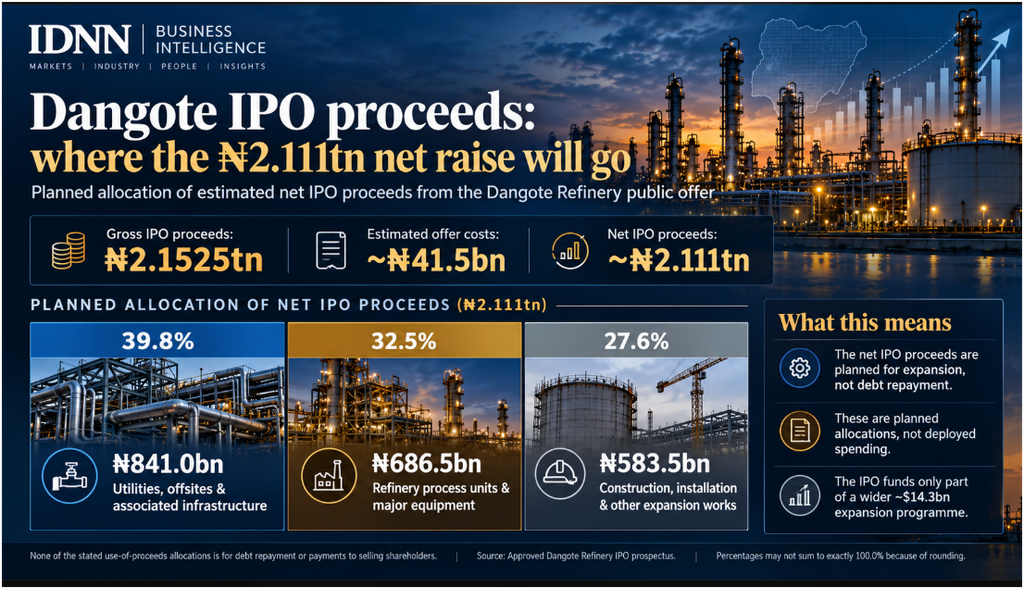
Where Dangote’s ₦2.11tn IPO proceeds will go
The spending plan breaks the net proceeds into three major categories:
- ₦841bn — 39.8%: utilities, offsites and associated infrastructure
- ₦686.5bn — 32.5%: refinery process units and major equipment
- ₦583.5bn — 27.6%: construction, installation and other expansion works
The infrastructure allocation is the largest.
That gives investors and the wider market a measurable money trail after the capital is raised:
capital raised → equipment ordered → infrastructure built → capacity installed → capacity commissioned → production delivered.
An allocation is not implementation.
And capital raised is not the same as expansion completed.
₦2.11tn is only part of a $14.3bn expansion
Dangote Refinery estimates that its wider expansion programme will cost approximately $14.3 billion.
The programme is intended to add roughly 700,000 barrels per day of refining capacity to the refinery’s current estimated 700,000-barrel-per-day capacity, potentially taking total processing capacity to around 1.4 million barrels per day.
The IPO proceeds will finance only part of that programme.
That means the ₦2.11tn raised from investors should not be confused with the full expansion cost.
The balance is expected to be funded progressively through internally generated cash flows and other financing sources, including debt, trade financing and project financing.
The broad funding architecture is therefore disclosed.
What remains unresolved is the eventual mix.
How much will come from operating cash?
How much additional debt will be required?
What will the currency, tenor and cost of that financing be?
And how much project or trade finance will sit alongside the new equity capital?
Those questions now matter more than the mechanics of subscribing to the IPO.
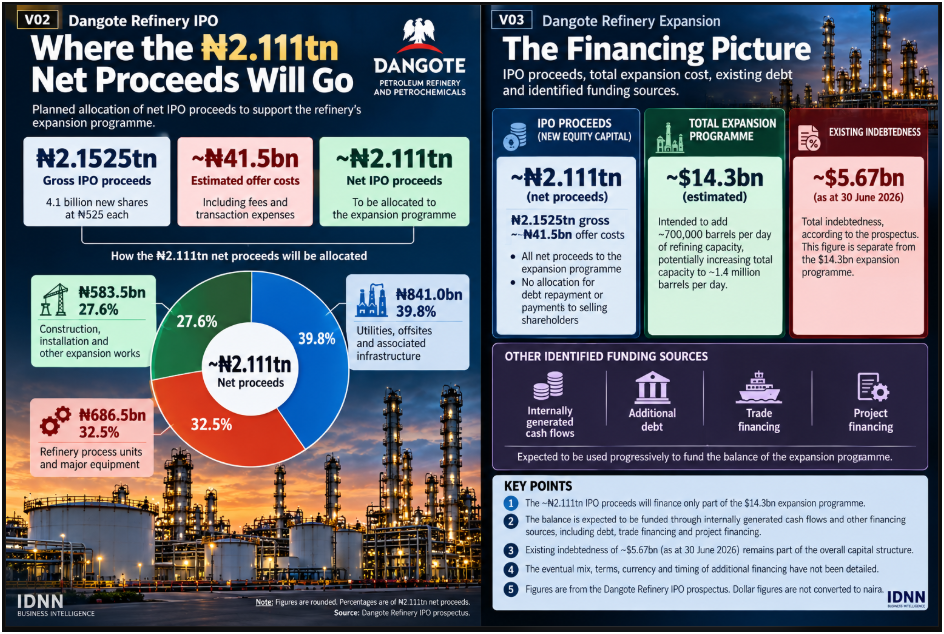
Existing debt remains part of the financing equation
Dangote Refinery enters the expansion cycle with substantial existing borrowings.
Its prospectus reports total indebtedness of approximately $5.67 billion as of June 30, 2026.
That figure matters because additional debt remains one of the financing options identified for the wider expansion.
The size of the debt does not by itself establish financial distress.
The more useful questions concern cash generation, interest costs, repayment schedules, currencies, security arrangements and the amount of additional leverage required as expansion progresses.
The financing question is therefore not simply whether Dangote Refinery has debt.
It is:
How much more external capital will the expansion require, and on what terms will that capital sit beside the existing balance sheet?
Investors are funding expansion, but buying a small new slice
The IPO comprises 4.1 billion new ordinary shares at ₦525 each.
Against approximately 120.13 billion shares outstanding before the offer, the new shares would represent about 3.3% of enlarged issued share capital if all 4.1 billion shares are issued.
That figure should not be confused with total free float.
It measures only the size of the new issuance relative to the enlarged share count.
That distinction matters because an IPO can introduce new shareholders without substantially changing overall ownership control.
After listing, the more important questions will include ownership concentration, actual trading liquidity and the volume of shares available in the market.
₦525 points to an indicative ₦65.22tn valuation
The IPO also contains a much larger number than the ₦2.15tn being raised.
The prospectus gives an indicative post-offer market capitalisation of about ₦65.22 trillion at the ₦525 offer price.
That means two numbers must be kept separate.
₦2.15tn is the new capital being raised.
₦65.22tn is the indicative value of the enlarged equity base at the offer price.
The first tells investors how much money the company is seeking.
The second gives context to the implied valuation of the whole business.
The ₦525 offer price therefore does not, by itself, establish whether the shares are cheap, expensive or fairly valued.
That assessment requires earnings, cash flow, debt, refining margins, crude supply, operating reliability, capital expenditure and risk to be examined together.
Profit has turned sharply positive
The financial backdrop to the IPO has also changed.
The prospectus reports approximately ₦19.135 trillion in revenue and ₦2.504 trillion in profit after tax in the first half of 2026.
That follows losses after tax reported for both 2024 and 2025, making H1 2026 a significant earnings turnaround.
But one strong reporting period does not remove the risks attached to refining.
Profitability can move with crude prices, product prices, foreign exchange, utilisation, maintenance, financing costs and refining margins.
The expansion will also introduce another major capital-spending cycle.
The more important question is whether cash generation can remain strong enough to help finance the $14.3bn programme while the refinery services existing obligations and potentially raises additional financing.
Prospectus carries a 2029–2030 timing conflict
One important timetable question remains unresolved.
The prospectus carries different references to 2029 and 2030 around completion of the expansion programme.
IDNN is therefore not treating either year as a definitive completion deadline until the issuer reconciles the difference.
That matters because an expansion of this scale should ultimately be judged against measurable milestones rather than a single headline date.
The IPO creates a trackable money trail
The first phase of the Dangote Refinery IPO news cycle focused on the ₦525 share price, the ₦5,250 minimum subscription and how investors could participate.
Those are the access numbers.
The capital-allocation numbers tell a more consequential story:
₦841bn for utilities and infrastructure.
₦686.5bn for refinery process units and major equipment.
₦583.5bn for construction and installation.
₦2.111tn net from the IPO.
A wider expansion estimated at $14.3bn.
And existing indebtedness of about $5.67bn.
The prospectus has therefore answered one important question: where the IPO money is intended to go.
It has also exposed the next one:
How will Dangote balance internally generated cash, existing debt and additional financing as it turns ₦2.11tn of IPO capital into part of a $14.3bn expansion programme?
That is the money trail IDNN will now follow.

Soludo Says Sit-at-Home Suspension Is Driving Monday Trade Rebound in Onitsha