
NSC Director General Bukola Olopade says Nigeria must build stronger facilities, competitions and athlete pathways if recent sporting success is to become sustainable.
By IDNN Sports Desk
National Sports Commission Director General, Hon. Bukola Olopade, says Nigeria must move beyond celebrating sporting success and build a system capable of producing elite athletes consistently.
His Independence Day message placed facilities, competitions, athlete pathways and opportunity at the centre of that argument, as he challenged the country’s sports establishment to create structures capable of turning Nigeria’s abundance of talent into sustained international performance.
“Our responsibility is not only to celebrate champions after they emerge, but to build the systems, facilities, competitions and opportunities that allow more young Nigerians to become champions.”
The statement places the spotlight not only on Nigeria’s medals and record-breaking athletes, but on the machinery required to produce the next generation.
Glasgow showed what is possible
Team Nigeria’s performance at the Glasgow 2026 Commonwealth Games provides Olopade with his strongest recent example.
Nigeria finished seventh overall and as the highest-ranked African country, winning 24 medals — 10 gold, seven silver and seven bronze.
The campaign delivered significant performances across athletics, weightlifting and para sport.
Nigeria also had three athletes set world records during the Games.
Folashade Oluwafemiayo broke the women’s +86kg para-powerlifting world record twice, first lifting 172kg before pushing the mark to 175kg.
Rita Ferdinand set a 158kg world record in the women’s +79kg category while taking silver. Goodness Nwachukwu later retained her Commonwealth para discus title with an F42 world-record throw of 39.66 metres.
The performances demonstrated the level Nigerian athletes can reach.
The more difficult question is whether the sporting structure around them can consistently discover, prepare and support those capable of following.
From results to a system
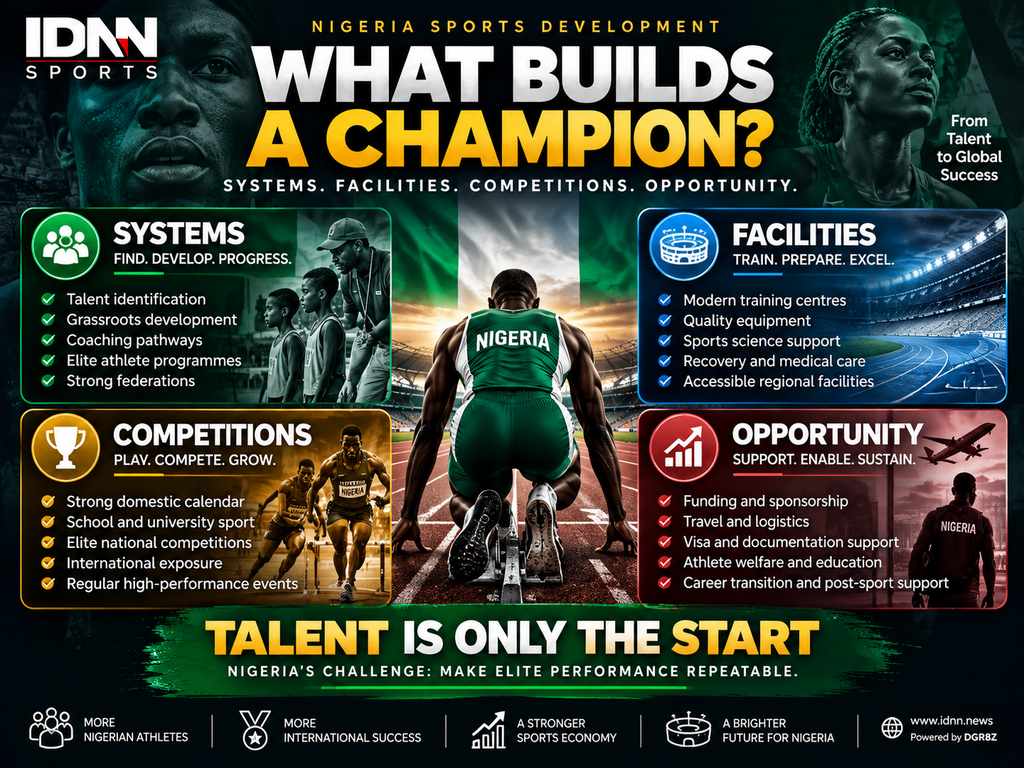
Olopade’s Independence message effectively identifies four areas central to that challenge:
Systems. Facilities. Competitions. Opportunities.
Together, they cover much of the athlete-development chain — from talent identification and grassroots participation to elite preparation, competition exposure and high-performance support.
A strong international result can demonstrate athletic quality.
A sustainable system has a different test: whether those results can be reproduced across athletes, disciplines and competition cycles.
Olopade’s argument is that Nigeria must increasingly build toward the latter.
The objective cannot simply be to wait for exceptional athletes to emerge. It must include creating environments in which more athletes have a realistic route from potential to elite performance.
RHINSE becomes part of the test
Olopade linked the Commission’s current direction to the Federal Government’s Renewed Hope Initiative for Nigeria Sports Economy — RHINSE.
Official government material describes RHINSE as part of an effort to strengthen Nigeria’s sports economy and infrastructure, including upgrades to major sporting facilities.
Olopade said the policy direction under President Bola Ahmed Tinubu is intended to create stronger pathways for athletes while positioning sport as a vehicle for youth development, economic activity and international visibility.
For the sports sector, however, the critical distinction remains between policy intention and measurable outcome.
The existence of a programme does not, by itself, demonstrate that the system is delivering.
The stronger test will be whether those policies result in functioning facilities, regular competition, improved athlete support, better preparation and more reliable pathways into international sport.
The flag-football warning
One recent episode illustrates why the system around athletes matters as much as sporting qualification itself.
Nigeria’s men’s and women’s flag-football teams won African titles and qualified for the 2026 IFAF Flag Football World Championships.
But both teams later withdrew after the travelling delegation was unable to secure the required visas in time for the championships in Germany. The withdrawal was confirmed in a joint statement involving IFAF, the National Sports Commission and the Nigerian Federation of American Football.
Sporting performance secured qualification.
Visa and travel constraints ultimately prevented participation.
The episode demonstrates that qualification alone does not guarantee an athlete or team reaches the international stage. Logistics, documentation and institutional coordination are also part of a functioning high-performance environment.
The African titles remain an achievement.
But the inability to take those qualifications onto the world stage provides a reminder of how much sporting performance depends on structures beyond the field of play.
D’Tigress show both dominance and the next level of the challenge
Nigeria’s senior women’s basketball team provides another important case.
D’Tigress defeated Mali 78–64 in the 2025 Women’s AfroBasket final, becoming the first national team to win the championship five consecutive times.
The victory extended Nigeria’s AfroBasket winning streak to 29 games and secured the country’s place at the 2026 FIBA Women’s Basketball World Cup.
At the World Cup in Berlin in September 2026, Nigeria finished with an 0–3 record and placed 16th.
That contrast reinforces the broader systems question.
Sustained dominance at one competitive level does not automatically produce the same outcome against a deeper global field.
For Nigerian sport, the useful question is therefore not simply how to celebrate D’Tigress’ unprecedented continental run, but what lessons can be drawn from coaching continuity, player development, international exposure, preparation and federation management — and what additional structures are required when the competitive level rises.
The objective is not to copy one sport’s model wholesale into another.
It is to understand what helps elite performance become repeatable.
Nigeria’s talent is already visible
Nigeria’s sporting history provides substantial evidence of elite talent.
Recent performances across athletics, para sport, basketball, weightlifting and emerging disciplines have continued to demonstrate the country’s competitive potential.
The harder question is how much of that talent ultimately reaches its ceiling.
For every athlete who reaches a Commonwealth podium, world championship or Olympic stage, there are wider questions about how talent is identified, supported and moved through the system.
That is where facilities, domestic competition, coaching, athlete welfare and development pathways become critical.
Beyond Independence celebration
Olopade’s remarks came as Nigeria marked its 66th Independence Anniversary, and he linked recent sports progress to what he described as the current administration’s development agenda.
But the most consequential part of the statement was the standard he set for the sports sector itself.
“The task before us is to ensure that more Nigerians have that opportunity.”
That proposition can ultimately be measured.
If stronger systems are built, Nigeria should see deeper talent pools, more regular quality competition, better athlete preparation and fewer instances where logistical or institutional constraints prevent athletes from converting qualification into participation.
Glasgow demonstrated what Nigerian athletes can deliver at a major Games.
D’Tigress demonstrated how continental success can be sustained over multiple cycles — and how much harder the next competitive level can be.
Flag football demonstrated that qualification itself is only one part of reaching the global stage.
Nigeria’s sporting talent is already visible. The harder test is whether the system surrounding that talent can become strong enough to make elite performance repeatable.
