
Michael Olise is not Zinedine Zidane. He is not Michel Platini. He does not need to be either to matter for France.
That was the strongest line running through IDNN Sports reader reaction after Olise became one of the faces of France’s World Cup fallout following the 2-0 semi-final defeat to Spain.
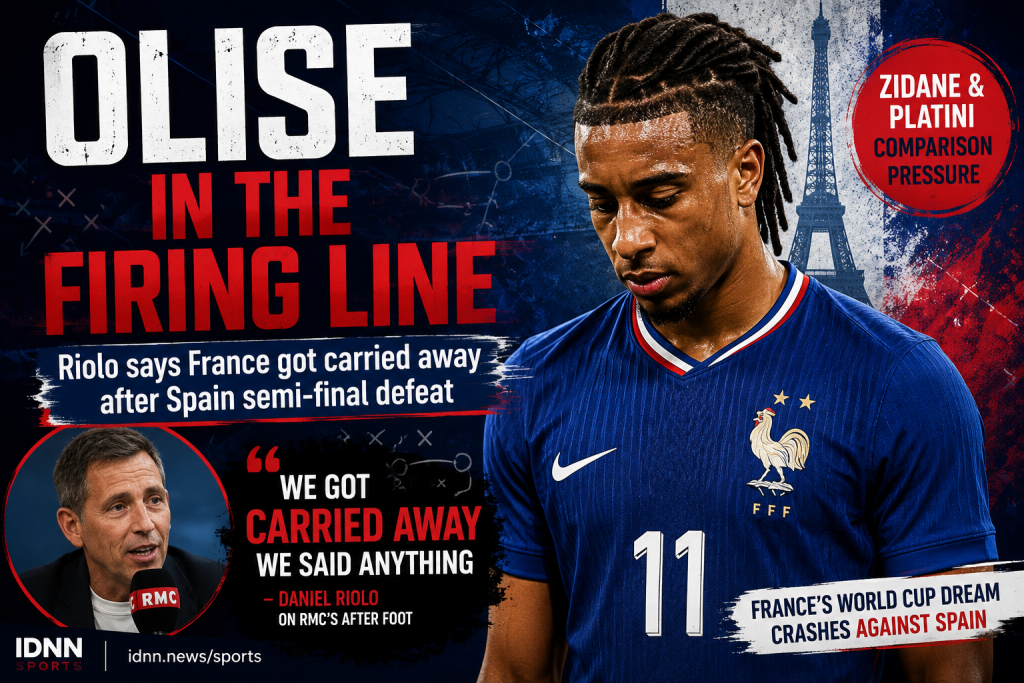
The first wave of criticism was sharp. Daniel Riolo’s comments on RMC’s After Foot became a major talking point after French reporting carried his claim that the excitement around Olise and France’s attacking structure had gone too far.
Le10Sport reported Riolo’s line that Olise had been placed “at the table of Zidane and Platini” even though he was “not even in the kitchen at the moment.”
But the reaction from IDNN Sports readers pushed the debate in another direction.
For them, the real issue was not whether Olise had reached the level of France’s greatest playmakers. It was whether France were using one player to carry the weight of a collective failure.
Readers push back on the Zidane and Platini comparison
IDNN Sports reader Tare Kragha argued that Olise may not yet be at the level of Zidane and Platini, but that the comparison itself misses the point.
For Tare, Olise is already one of the best players in his position. The issue is not whether he belongs in the same sentence as Zidane or Platini today. It is whether France are judging him by an impossible historical standard too early.
That matters because Olise is still building his international story. This was his first World Cup, and before the semi-final collapse, his tournament had carried enough quality to make him one of France’s most talked-about attacking players.
One poor semi-final does not erase that.
France looked for one player to blame
IDNN Sports reader Uche Uzorka pushed the argument harder.
He said France may have been “drunk all tournament” and that Spain only sobered them up, leaving them to blame one player for the wider collapse.
That line cuts through because it captures the emotional swing around France. Before Spain, the mood around Les Bleus was confidence. After Spain, the conversation turned quickly to blame.
Olise became a convenient symbol of that crash.
But France did not lose because one player had a quiet match. They lost because Spain controlled the rhythm, forced discomfort, and exposed the limits of France’s attacking balance.
Olise struggled, yes. French reporting said he was substituted in the 72nd minute, had only one touch in Spain’s penalty area, and did not complete a pass into the dangerous zone for a teammate.
Those details explain why he was criticised. They do not prove he was the whole problem.
Spain made the argument bigger than Olise
IDNN Sports reader Waze Charlie Randle widened the debate even further.
He argued that even if France had been asked to replay the match several times, they would still have had a hard time beating Spain.
That is the uncomfortable part of the fallout for France.
This was not a random bad night against a weaker team. Spain were better in the key areas that decide elite knockout football: control, timing, pressure and structure.
France’s attack carried big names and heavy expectation. Spain made it look disconnected.
That is why making Olise the centre of the blame risks simplifying the story. France’s issue was not only that Olise failed to produce. It was that the team did not create the conditions for its creators to breathe.
Olise does not need to be Zidane
The Zidane and Platini comparison is powerful because it touches French football memory.
Zidane and Platini are not just former greats. They represent authority, imagination and national identity. When a young or rising player is dragged into that frame, the pressure changes immediately.
But Olise does not need to be Zidane. He does not need to be Platini. He needs to be Michael Olise.
That means judging him by his own development curve, his role in this France team, and the way he responds to a painful semi-final failure.
The criticism is part of elite football. So is the reset.
France must face the deeper question
The bigger question now belongs to France.
Was the four-man attacking formula too exposed against a side with Spain’s control? Did France sacrifice too much midfield security? Did the excitement around the front line hide weaknesses that were always waiting to be punished?
Riolo’s own criticism pointed in that direction. French reporting said he questioned how much France had believed in the attacking formula and whether the hype around it had pulled observers in too strongly.
That is where the debate should go next.
Olise can be criticised for his semi-final performance. But France also have to ask why one of their most talented players ended up isolated, quiet and then blamed.
Spain did not only stop Olise.
Spain exposed France.
