🟥 Trigger Moment: Wike’s Remark on Live Political Discourse
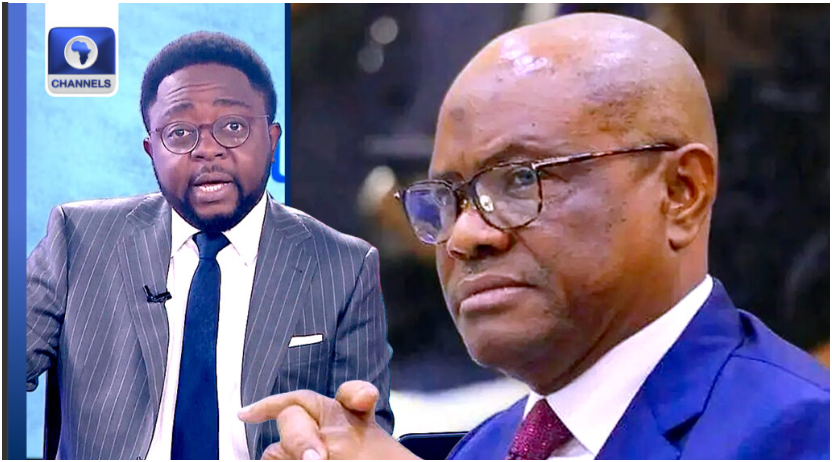
Nigeria’s Minister of the Federal Capital Territory, Nyesom Wike, has come under intense criticism after stating during a media interaction in Abuja that he “would have shot” Channels Television anchor Seun Okinbaloye.
The remark followed comments made by Okinbaloye on Politics Today, where the anchor warned about the risk of Nigeria drifting toward a one-party state amid the ongoing crisis within the African Democratic Congress and wider opposition politics ahead of the 2027 elections.
“If there was any way to break the screen, I would have shot him,” Wike said, expressing anger at what he viewed as the journalist’s deviation from professional neutrality.
🟨 Backlash Builds Across Political and Civic Space
The comment quickly triggered reactions across Nigeria’s political and civic landscape.
The African Democratic Congress described the remark as “irresponsible and unacceptable,” while former Vice President Atiku Abubakar condemned it as “reckless and dangerous,” warning that such rhetoric could undermine democratic norms.
“When those entrusted with authority begin to speak the language of violence against the press, democracy itself is under attack,” Atiku’s media office said.
🟥 Media and Rights Groups Warn of Press Freedom Risks
Media organisations and civil society groups also raised concerns about the implications of the statement.
Amnesty International described the remark as “reckless and violent,” warning it could normalise hostility toward journalists.
The Nigeria Union of Journalists (NUJ) called for an immediate retraction and apology, describing the statement as a dangerous signal in an already tense political environment.
A coalition of media and rights organisations, including the International Press Institute and Media Rights Agenda, similarly warned that such language from public officials could erode trust in democratic institutions and embolden attacks on journalists.
🟨 Minister’s Camp Frames Comment as Figurative Expression
In response, Wike’s aide, Lere Olayinka, said the minister’s comment was not intended as a literal threat but rather a figurative expression of frustration.
According to the aide, Wike had clarified that he did not intend physical harm and had subsequently spoken with Okinbaloye.
The explanation, however, has not halted criticism, with observers noting that public statements from senior officials carry weight regardless of intent.
🟥: Political Tension Meets Media Scrutiny
The controversy is unfolding against a backdrop of heightened political tension ahead of the 2027 elections, with opposition parties facing internal crises and increasing scrutiny of Nigeria’s democratic space.
At the centre of the debate is the role of the media in interrogating power and the responsibility of public officials to respond within the bounds of democratic norms.
As political rhetoric intensifies, analysts warn that confrontations between state actors and the press could become flashpoints in shaping public perception and institutional trust.
🟨 Why This Moment Matters
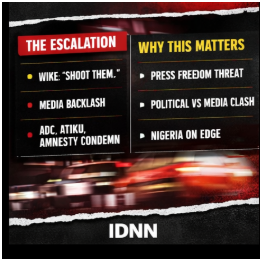
This incident reflects a deeper structural tension within Nigeria’s political environment — where rising electoral stakes, fragile opposition dynamics, and heightened media scrutiny are converging.
Even when framed as figurative, statements suggesting violence against journalists introduce risk into an already sensitive ecosystem, where perception can influence behaviour, and rhetoric can redefine the limits of acceptable public discourse.
If left unaddressed, the fallout from the Wike threat to Seun Okinbaloye could extend beyond a single controversy — reinforcing concerns about press intimidation, setting a precedent for political rhetoric, and testing the resilience of Nigeria’s democratic and media institutions at a critical moment.
This is IDNN. Independent. Digital. Uncompromising.
