
When the backlash refused to fade
Mounting public pressure over changes to the Electoral Act has forced a procedural pivot inside the Red Chambers. On Tuesday, the Senate constituted a 12-member conference committee to harmonise its version of the Electoral Act (Amendment) Bill with that passed by the House of Representatives, amid sustained criticism of amendments touching electronic transmission of results.
The decision came during an emergency plenary session convened against the backdrop of protests, legal warnings, and widening political unease over the credibility of future elections.

A committee expanded — and a timeline declared
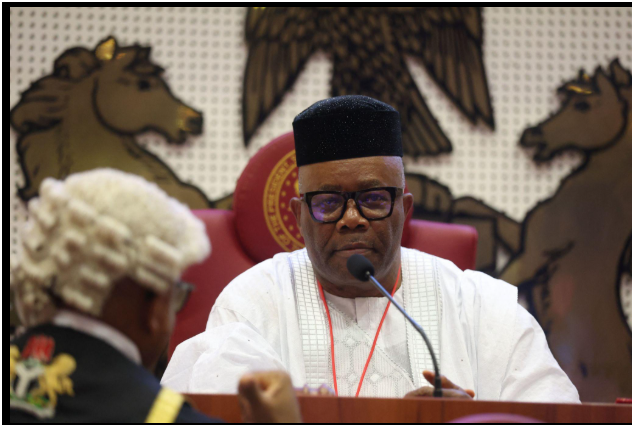
Announcing the decision, Senate President Godswill Akpabio said the leadership had expanded the committee from nine to 12 members to fast-track consensus.
The committee is chaired by Simon Bako Lalong and includes senators Mohammed Tahir Monguno, Adamu Aliero, Orji Uzor Kalu, Abba Moro, Asuquo Ekpenyong, Aminu Iya Abbas, Tokunbo Abiru, Niyi Adegbonmire (SAN), Jibrin Isah, Ipalibo Banigo, and Onyekachi Nwebonyi.
Akpabio urged the panel to treat the task as urgent, expressing confidence that harmonisation could be completed within days, allowing transmission to President Bola Tinubu for assent before the end of February.
Clause 60(3) and the fight over ‘real time’
At the centre of the controversy is Clause 60(3) of the Electoral Act (Repeal and Re-enactment) Bill, 2026. Last week, the Senate removed the phrase “real-time” electronic transmission, reverting to the 2022 framework that grants the Independent National Electoral Commission discretion to determine transmission methods.
That move triggered criticism from civil society groups and opposition figures, who argue it weakens transparency and reopens space for post-poll manipulation.
Rowdy plenary, shifting positions
Tuesday’s emergency session reflected the strain. Proceedings were intermittently rowdy as lawmakers clashed over procedure and substance. A motion by Senator Tahir Monguno proposing a reconsideration of Clause 60(3) reopened debate, with Akpabio aligning with a proposal that recognises electronic transmission as the primary method, while allowing manual submission via Form EC8A only in cases of technical failure.
Senator Enyinnaya Abaribe briefly called for individual voting on the clause before withdrawing the request, underscoring divisions within the chamber.
Protests outside, pressure inside
Outside the National Assembly, pressure had already spilled into the streets. The Occupy National Assembly protest in Abuja drew civil society organisations, opposition parties and prominent political figures, including Peter Obi, demanding mandatory real-time electronic transmission to restore electoral credibility.
Inside the Senate, Akpabio sought to narrow the dispute, insisting lawmakers had not rejected electronic transmission itself but merely removed “real time” to avoid legal complications arising from network failures and to preserve INEC’s operational flexibility.
Administrative discretion under public scrutiny
This is not a technical drafting dispute. It is a stress test of how Nigeria balances electoral transparency against administrative discretion under public scrutiny. The decision to constitute a conference committee marks the first formal concession that the Senate’s initial position carried political cost — and that February’s assent timeline now depends on compromise, not insistence.
What happens if the wording holds
If the harmonised bill retains INEC’s discretion without a clear statutory mandate for real-time transmission, the legal ambiguity exposed during the 2023 elections could persist into 2027. Conversely, tightening the language risks binding the system to infrastructure it may not always support. Either outcome will shape litigation risk, public trust, and the credibility of the next general election.
This is IDNN. Independent. Digital. Uncompromising.
