
The Central Bank of Nigeria has reset its benchmark interest rate to 23%, opening a new phase for the cost of money. The critical test now is whether that reset travels through banks, government debt markets and businesses to reach borrowers.
Nigeria’s 350bp rate reset puts borrowing costs, bond returns and bank pricing in play
The Central Bank of Nigeria has reset its benchmark interest rate to 23%, opening a new phase for the cost of money after months of restrictive monetary policy.
But the critical test is no longer the size of the reset.
It is whether the change travels through banks, government debt markets and businesses to reach borrowers.
Nigeria has entered a markedly different interest-rate environment after the Central Bank of Nigeria reset its Monetary Policy Rate to 23%, setting up a wider repricing battle across loans, government securities, bank funding and investment returns.
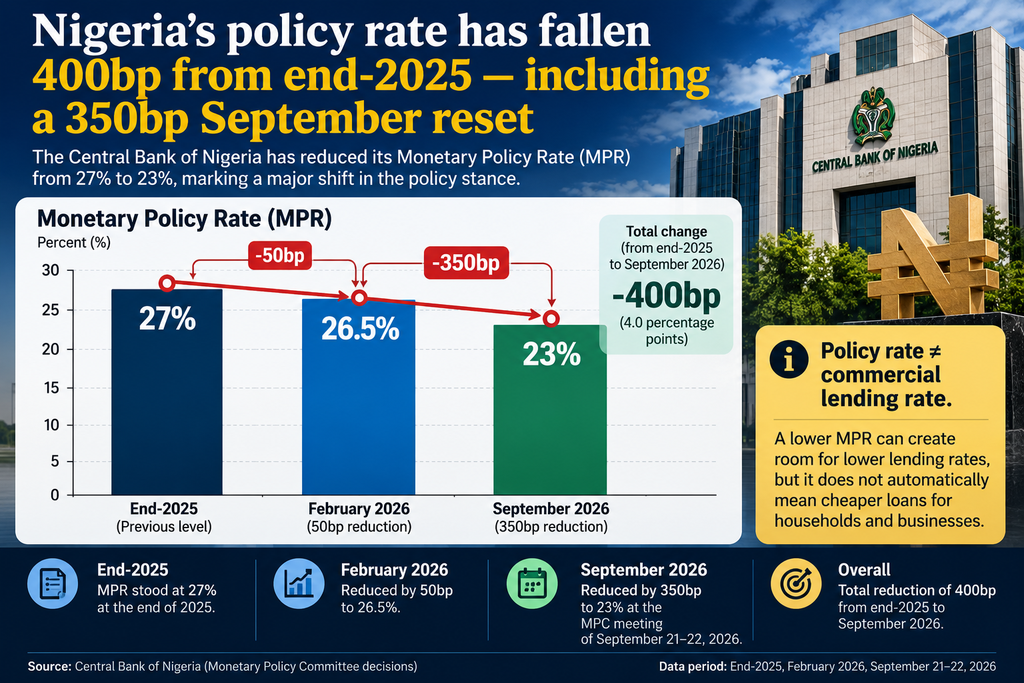
The CBN’s Monetary Policy Committee reset the MPR from 26.5% to 23% at its September 21–22 meeting — a reduction of 3.5 percentage points, or 350 basis points.
It also recalibrated its standing facilities corridor to +50/-300 basis points around the MPR, while retaining the Cash Reserve Requirement at 45% for deposit money banks, 16% for merchant banks and 75% for non-TSA public-sector deposits.
The central bank framed the adjustments as part of an operational realignment intended to strengthen monetary-policy transmission.
The September move followed an earlier 50-basis-point reduction to 26.5% in February and leaves the policy rate four percentage points below the 27% level in place at the end of 2025.
That makes the September decision much more than another MPC headline.
The next question is transmission.
The price of money has changed — but borrowers may not feel it immediately
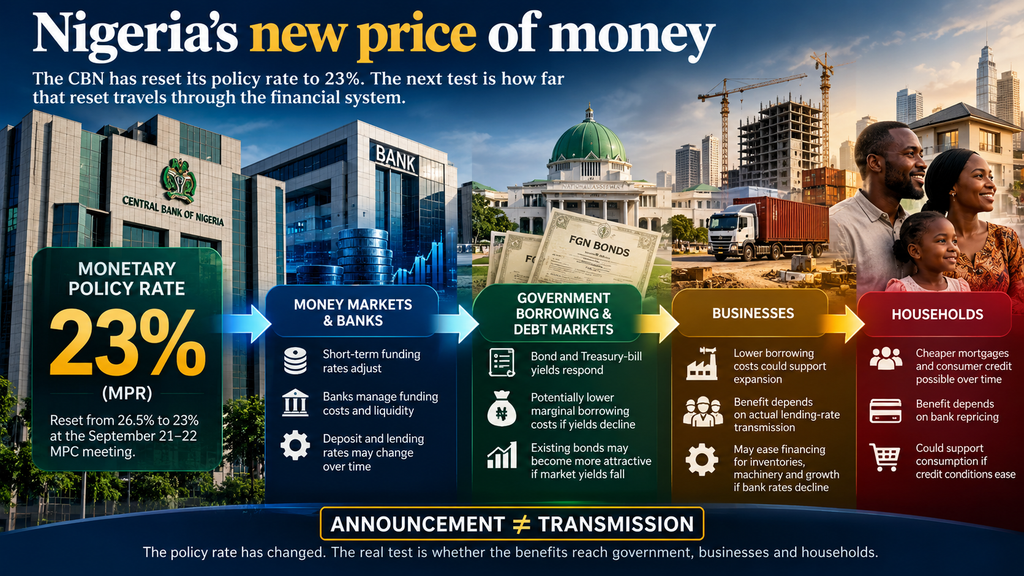
An MPR reset changes the central policy benchmark around which much of the financial system is priced.
If broader financial conditions follow, it can create room for lower money-market rates, softer government borrowing costs and eventually cheaper lending.
But a lower MPR does not automatically mean cheaper loans for households and companies.
Commercial banks still face funding costs, credit risk, operating expenses and regulatory constraints.
The CBN also kept the CRR for deposit money banks at 45%, meaning a substantial proportion of qualifying deposits remains tied up as regulatory reserves.
That combination could slow the speed at which the policy reset turns into significantly lower lending rates.
For businesses already financing inventories, machinery and expansion at elevated rates, the difference between a policy announcement and actual bank repricing will determine whether the change reaches the real economy.
The central question is therefore not simply whether the policy rate has fallen.
It is whose rates fall, by how much and how quickly.
Government debt enters the repricing equation
Nigeria’s sovereign debt market is another immediate pressure point.
The Debt Management Office has continued publishing monthly FGN bond auction results, including its September auction, giving investors a live test of how demand and borrowing costs respond as monetary conditions change.
When benchmark interest rates decline, newly issued government securities can eventually clear at lower yields if market expectations, liquidity and inflation conditions support that adjustment.
For government, sustained lower yields could reduce the marginal cost of new domestic borrowing.
For investors, however, the same shift changes the return available from Treasury bills, bonds and other fixed-income instruments.
That creates a redistribution effect.
What can ease pressure on the government’s financing bill can simultaneously reduce future yields for investors who became accustomed to exceptionally high returns during the tightening cycle.
Existing fixed-rate bonds may also become more attractive if market yields fall, but the scale of that repricing depends on maturity, liquidity and market expectations.
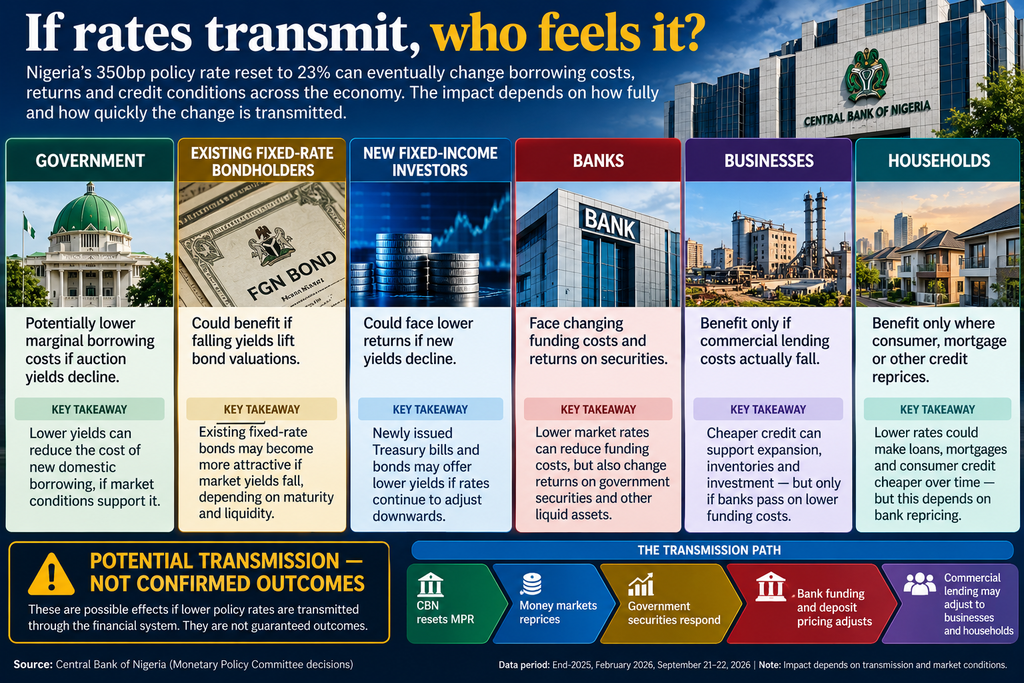
Panel structure:
Government — possible lower marginal borrowing cost
Existing bondholders — potential valuation benefit
New fixed-income investors — potentially lower future yields
Banks — changing returns on liquid assets
Borrowers — possible benefit only if lending-rate transmission occurs
Money-market rates show the transmission battle has started
CBN market data provide an early indication of movement around the policy decision.
The Nigerian Overnight Financing Rate — a transaction-based benchmark for secured overnight naira funding — recorded a weighted average rate of 22% on September 22 and 20% on September 23, immediately around the MPC decision.
The central bank’s published data also showed the 30-day NOFR index rate at 22.12% on September 24.
Those figures do not by themselves prove that the entire financial system has repriced.
They do show why the transmission question now matters.
The policy rate has moved sharply.
The market must now determine how much of that adjustment flows through short-term funding, government securities, deposits and eventually commercial lending.
Investors now face a different return equation
The rate reset changes the calculation for investors who have benefited from elevated fixed-income returns during the tightening cycle.
As monetary conditions change, investors must compare nominal yields not only with competing assets but with inflation and expectations about where rates move next.
If fixed-income yields continue falling, some capital may search for alternatives offering higher potential returns, including equities or longer-duration assets.
That is a possibility — not an automatic outcome.
Equity-market performance will still depend on company earnings, valuation, liquidity, sector conditions and broader investor confidence.
A rate reset alone cannot establish the direction of stock prices.
Banks sit at the centre of the transmission test
Banks are positioned on both sides of the reset.
Falling market rates can change the returns they earn on government securities and other liquid assets.
At the same time, lower funding rates can eventually reduce their own cost of money and create room for cheaper credit.
How banks respond will matter for companies and consumers.
If lending rates remain stubbornly high while money-market and sovereign yields fall, questions will intensify over how effectively monetary-policy changes are reaching the productive economy.
If bank lending rates decline materially, highly leveraged firms and businesses dependent on working-capital financing could gain breathing room.
That makes bank pricing one of the clearest indicators to watch over the coming weeks.
FX stability remains part of the bargain
A large downward reset in the policy rate is not without risk.
Higher interest rates can help support a currency by making domestic financial assets relatively attractive and restraining liquidity.
Lower rates can reduce that support if investors begin to see insufficient compensation for inflation, currency or policy risk.
The important question is therefore whether authorities can preserve currency stability while pushing monetary conditions toward stronger transmission and growth support.
If the naira remains relatively stable and inflation continues to moderate, policymakers could have more room to sustain a less restrictive stance.
If currency or inflation pressure returns, that room could narrow.
This is a conditional outlook, not a forecast that either outcome is assured.
The real-economy test comes next
For ordinary Nigerians, the MPR itself is abstract.
The consequences are not.
Lower borrowing costs could eventually affect business expansion, mortgage affordability, consumer credit, employment decisions and the cost of financing goods through supply chains.
But none of those benefits should be treated as delivered simply because the policy rate has fallen.
Announcement is not transmission.
Nigeria will only have moved into genuinely cheaper money when changes become visible in the rates paid by government, companies and households — not merely on the MPC decision sheet.
The September decision therefore opens a measurable test for the months ahead.
Watch government auction yields.
Watch interbank funding.
Watch deposit and lending rates.
Watch whether businesses report improved credit conditions.
And watch the naira and inflation for evidence of whether the CBN can loosen monetary conditions without surrendering the stability it is trying to preserve.
The 350-basis-point reset has changed the policy price of money.
The next story is who actually gets the discount.
