
The First Institution
Ramadan Reflection Day 9 reminds us of a truth often overlooked:
The nation is shaped long before it reaches parliament.
It is shaped in living rooms.
Before leadership is public, it is domestic.
Before discipline is national, it is personal.
And before reform is political, it is familial.
Allah says in Qur’an 66:6:
“O you who believe, protect yourselves and your families from a Fire…”
The command is not abstract. It is specific. Families carry responsibility.
Ramadan begins reform inside the home.
The Father as Moral Example
In many Nigerian homes, authority is visible. But moral leadership is not automatic.
Ramadan places responsibility on fathers and guardians:
- To model patience
- To moderate anger
- To prioritise prayer
- To demonstrate integrity
Children learn fasting not only through instruction — but through observation.
If the home witnesses honesty, restraint and fairness, it internalises discipline.
If it witnesses contradiction, discipline weakens.
Ramadan is not only taught.
It is transmitted.
The Mother as Moral Anchor
Ramadan also highlights the quiet strength within households.
Mothers often carry unseen burdens during the month — organising suhoor, preparing iftar, maintaining order.
Yet beyond logistics, the home requires spiritual anchoring.
Compassion in speech.
Calm in tension.
Consistency in worship.
The home becomes a classroom of character.
When mercy governs interaction, discipline becomes natural.
Children and Early Conscience
Ramadan Reflection Day 9 must address the younger generation.
Children experience hunger differently. They observe routines, altered schedules and heightened spirituality.
What do they learn?
Do they learn ritual without reflection?
Or discipline with meaning?
When a child sees a parent pray consistently, speak gently while fasting and give quietly in charity, a moral blueprint forms.
The home is the first school of integrity.
Domestic Justice Before Public Justice
It is easy to demand justice from institutions. Harder to practice fairness within the household.
Ramadan asks:
Are responsibilities shared?
Is speech respectful?
Is authority compassionate?
If discipline collapses inside the home, public discipline becomes fragile.
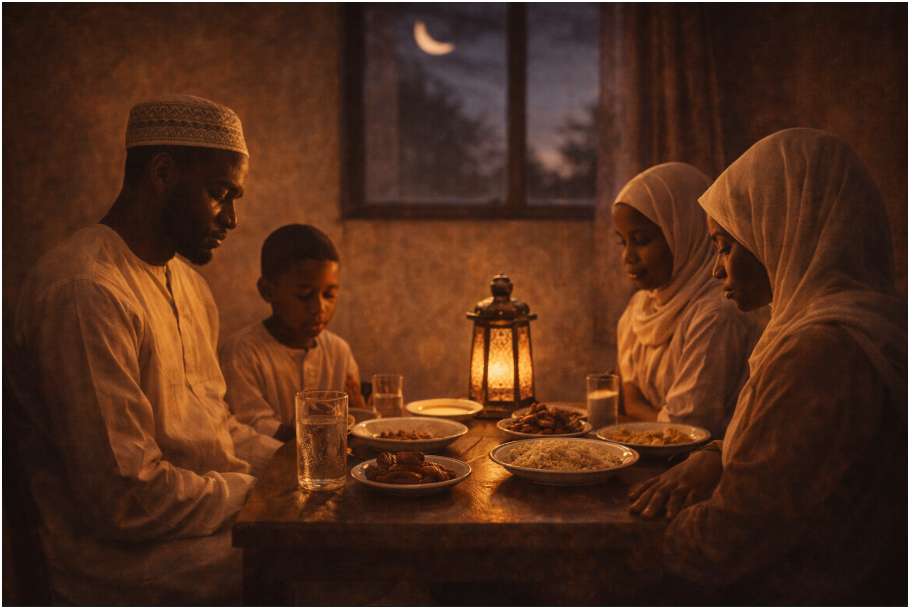
National character is not manufactured in headlines. It is cultivated at dining tables.
The Quiet Revolution
Ramadan Reflection Day 9 offers a quiet but powerful insight:
Reform does not begin with policy.
It begins with parenting.
If families strengthen conscience, society stabilises.
If homes nurture responsibility, institutions inherit integrity.
The crescent moon that marks Ramadan also marks opportunity.
An opportunity for homes to become moral units.
Because when the home is disciplined —
the nation follows.
