
An allegation that moved beyond politics
What began as a televised political claim has widened into a question about the integrity of Nigeria’s intelligence command structure.
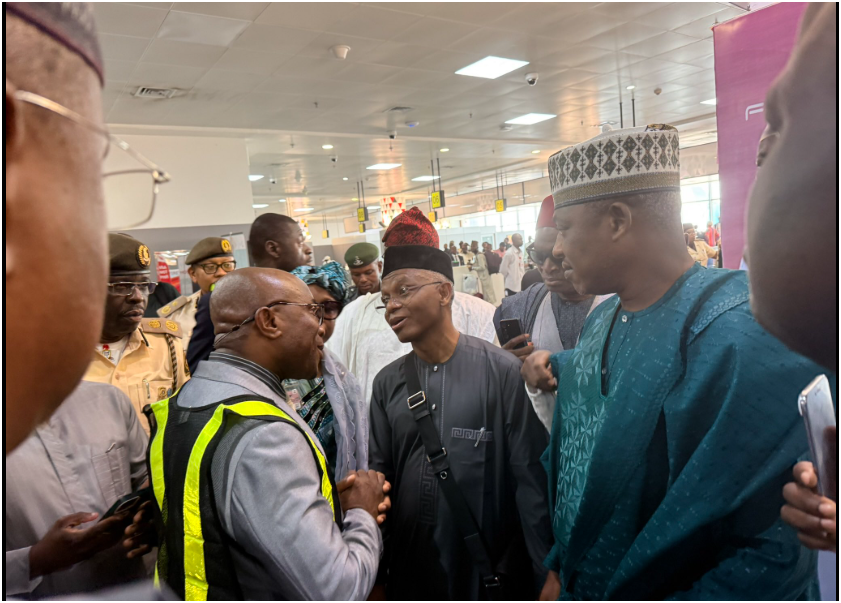
Speaking on Arise TV, former Kaduna State governor Nasir El-Rufai alleged that he became aware of a plan to arrest him upon arrival at an airport through what he described as intercepted communication involving the National Security Adviser, Nuhu Ribadu.
“Ribadu made the call because we listened to their calls… He gave the order that they should arrest me.”
He added:
“Someone tapped his phone and told us that he gave the order. That technically is illegal. I know.”
The remark did more than spark reaction. It shifted the conversation from political rivalry to institutional exposure.
A claim that strikes at the top of the chain
The Office of the National Security Adviser sits at the centre of Nigeria’s intelligence coordination framework. It connects domestic agencies, military intelligence structures and international security partnerships.
If the El-Rufai wiretap claim were substantiated, it would imply that communication at the highest tier of national security was vulnerable to interception.
Retired DSS director Abdulrasaq Salami described the allegation as:
“Extremely grave.”
He warned that intercepting the NSA’s communication could expose “operational plans, sources and methods.”
In intelligence ecosystems, exposure at the top reverberates downward.

The presidency responds with legal urgency
Senior presidential aides reacted swiftly.
Bayo Onanuga wrote on X:
“El-Rufai confesses to wire-tapping Nigeria’s NSA on TV… This should be thoroughly investigated.”
Temitope Ajayi added:
“El-Rufai admitted on national television that someone tapped the phone of the NSA… By the time he is picked up… he would say President Tinubu is a ‘tyrant’.”
The language framed the issue not as political dispute, but as a matter potentially requiring formal inquiry.
The law draws a narrow boundary
Nigeria’s constitutional and statutory framework offers little ambiguity on interception.
Section 37 of the 1999 Constitution guarantees the privacy of telephone communications.
Section 146(1) of the Nigerian Communications Act prohibits interception except under lawful authority.
The Cybercrime Act criminalises unauthorised technical interception of non-public transmissions.
Constitutional lawyer AbdulAzeez Rahman noted that unlawful interception could trigger criminal investigation and render any obtained material inadmissible in court.
If accurate, the allegation would collide directly with these safeguards.
If inaccurate, it raises questions about the source and motive of the information.

Intelligence systems rely on quiet trust
Security analyst Kabiru Adamu observed that interception technology exists but is typically restricted to government-level actors operating within legal parameters.
“The technology… is highly sophisticated… usually in the domain of governments or very high-level actors.”
Even the perception of compromise can unsettle intelligence-sharing frameworks. Foreign partners depend on secure channels. Domestic agencies depend on compartmentalisation. Once doubt enters the chain, cooperation tightens.
In security systems, trust is infrastructure.
When politics meets protocol
The alleged airport arrest plot introduces an additional layer of tension. If security action was contemplated, questions arise about process and authorisation. If no such action existed, the narrative itself becomes a political accelerant.
The El-Rufai wiretap claim surfaces at a politically sensitive moment, as alignments shift ahead of 2027.
Any investigation risks being interpreted through partisan lenses.
Any silence risks institutional erosion.
Neither path is neutral.
What happens when the top is questioned
This episode now sits beyond individual personalities.
It touches the resilience of Nigeria’s intelligence architecture, the credibility of its legal safeguards and the balance between security operations and political contestation.
Allegations at this altitude do not dissipate quickly.
They either crystallise into inquiry — or settle as residue inside the system.
In national security structures, residue can be as destabilising as proof.
This is IDNN. Independent. Digital. Uncompromising.
