
A detention that reshapes the political battlefield
El-Rufai EFCC detention and cybercrime charges took a decisive turn Monday night when the former Kaduna State governor was held at the Economic and Financial Crimes Commission headquarters in Abuja after hours of interrogation.
Multiple sources within the anti-graft agency confirmed he arrived earlier in response to an invitation linked to allegations arising from a 2024 Kaduna State House of Assembly report. That report accused his administration of misappropriating loans, breaching due process in contract awards and plunging the state into heavy debt.
By late evening, officials indicated he would not be released.
The EFCC spokesman confirmed he honoured the invitation but declined further comment on next steps.
The N423bn allegation at the centre
The legislative report presented last year alleged that approximately N423bn was siphoned during El-Rufai’s eight-year tenure between 2015 and 2023.
According to the committee’s findings, loans obtained under his administration were not fully applied to their stated purposes. Additional references were made to disputed cash payments and contracts, including funds earmarked for a light rail project.
The House endorsed petitions to both the EFCC and the Independent Corrupt Practices and Other Related Offences Commission, recommending investigation and possible prosecution.
El-Rufai has repeatedly denied wrongdoing, describing the probe as politically motivated and insisting that all borrowings were duly appropriated for infrastructure, healthcare and security reforms.
The EFCC investigation appears to have now moved beyond preliminary review into active interrogation.

A second front opens in court
Parallel to the financial probe, El-Rufai faces separate criminal charges before the Federal High Court in Abuja under the Cybercrimes (Prohibition, Prevention, etc.) Amendment Act and the Nigerian Communications Act.
The three-count charge alleges that during a televised interview, he admitted that he and unnamed associates unlawfully intercepted communications belonging to National Security Adviser Nuhu Ribadu.
One count alleges admission of unlawful interception. Another references alleged association with an individual who intercepted communications without reporting it. A third alleges use of technical systems that compromised national security.
No arraignment date has yet been fixed.
During the interview cited in the charge sheet, El-Rufai stated that he learned of an alleged plan to arrest him through a leaked conversation from the NSA’s phone, acknowledging that such interception would be illegal.
Institutions converge under election pressure
The convergence of EFCC detention and cybercrime prosecution marks one of the most consequential confrontations involving a former governor in recent years.
Anti-graft proceedings typically unfold independently from national security litigation. However, in this case, financial misconduct allegations and alleged unlawful interception of security communications are unfolding simultaneously.
Such institutional overlap raises broader governance questions: whether the matters remain strictly prosecutorial or acquire political overtones as Nigeria approaches another election cycle.
Opposition figures have questioned procedural sequencing, while presidential aides insist the processes are lawful and grounded in statutory authority.
At stake is not merely one individual’s legal exposure, but public confidence in enforcement agencies and judicial independence.
Protests spill into the streets
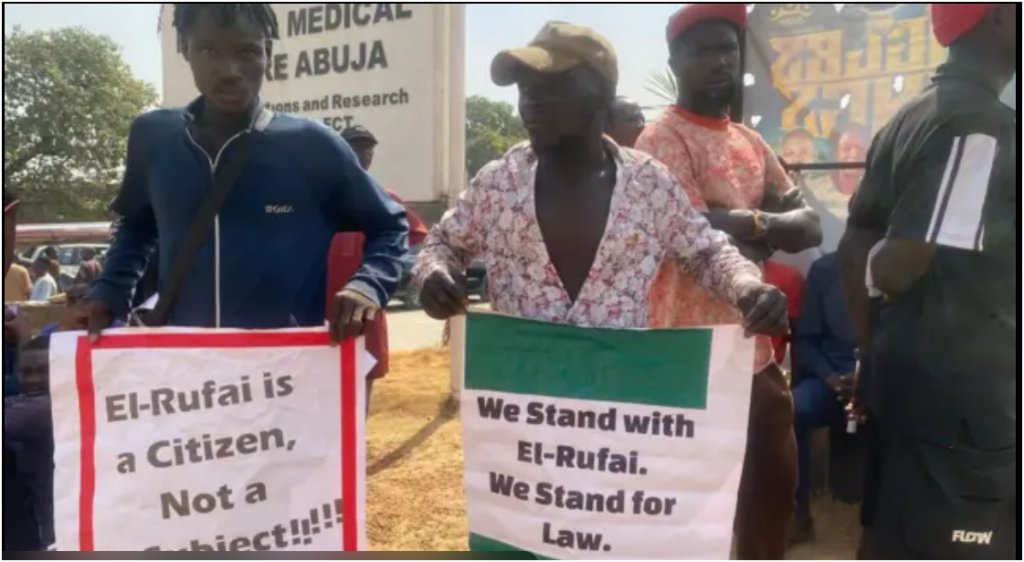
Demonstrations erupted outside the EFCC headquarters in Abuja and at the Kaduna State House of Assembly.
Groups demanding accountability cited the legislative findings and urged that “no one is above the law.” Supporters of the former governor gathered separately, holding placards asserting his rights as a citizen and condemning what they described as political targeting.
The EFCC reiterated recognition of the right to peaceful protest, stating that due process would be followed.
What prosecution could mean beyond the courtroom
If charges proceed to trial, the legal consequences could extend beyond personal liability. Conviction under cybercrime statutes carries custodial sentences and financial penalties. Financial crime convictions could entail asset forfeiture and political disqualification implications.
Conversely, failure to secure convictions after high-profile detention would likely intensify claims of selective enforcement.
The stakes therefore extend beyond immediate custody. They touch institutional credibility, inter-party trust and the political stability of a system already entering pre-election recalibration.
For now, El-Rufai remains in custody as the legal machinery advances.
The next courtroom appearance may determine whether this moment becomes a precedent in accountability—or a flashpoint in Nigeria’s evolving power contest.
This is IDNN. Independent. Digital. Uncompromising.
