
An Anambra State High Court in Ogidi has sentenced choirmaster James Onuorah to 25 years’ imprisonment after convicting him of raping a child.
Justice Chudi Nwankwo also imposed a seven-year sentence for offensive conduct, with both prison terms ordered to run concurrently. The court further awarded ₦5 million in compensation to the survivor.
The judgment followed a three-count prosecution under the Anambra State Violence Against Persons Prohibition and Protection Law and the Criminal Code.
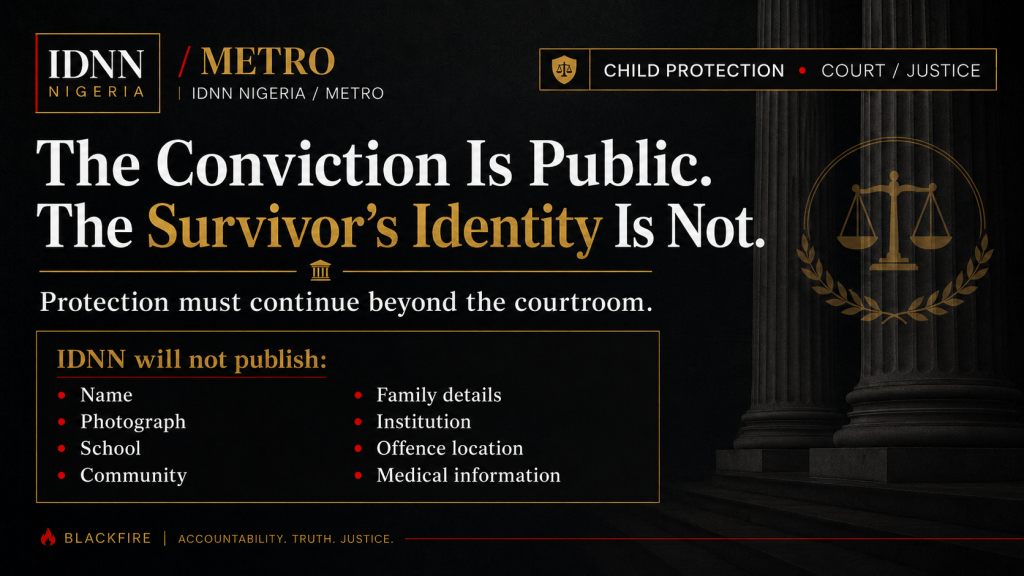
Because the survivor was a child when the offence occurred, IDNN is withholding her identity and all details capable of exposing her directly or indirectly.
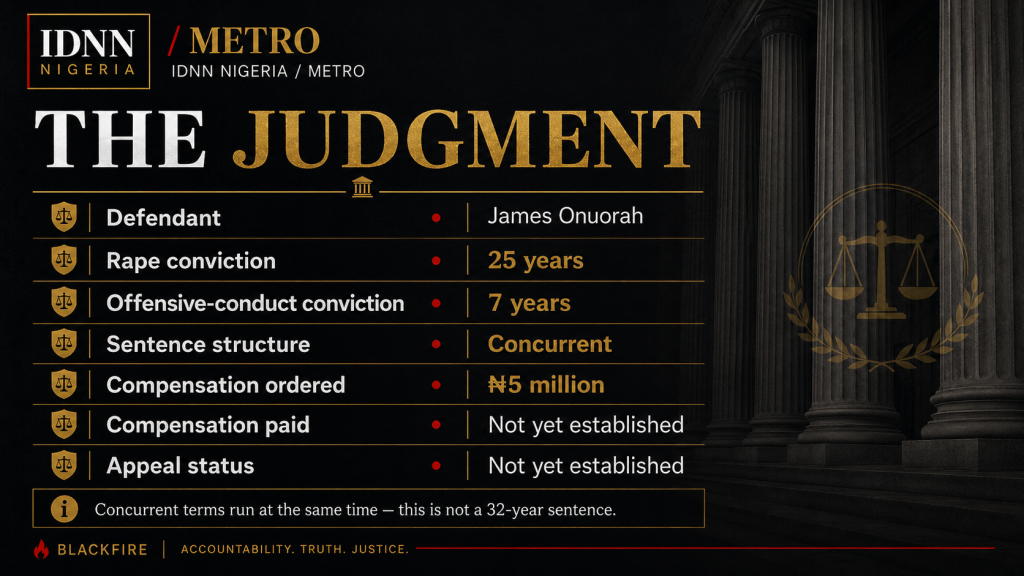
Court Convicts Onuorah on Two Counts
The prosecution charged Onuorah with rape, offensive conduct and a third offence under the Criminal Code.
The court convicted him on the rape and offensive-conduct counts and imposed prison terms of 25 years and seven years respectively.
Both sentences will be served at the same time.
The judgment must therefore not be reported as a combined 32-year prison term.
IDNN has not yet obtained the complete certified judgment and is not expanding on the precise disposition of the third count beyond the verified finding that Onuorah was convicted on two of the three charges.
It was not immediately clear whether he would appeal the conviction or sentence.
SENTENCING DATA PANEL
- Defendant: James Onuorah
- Court: Anambra State High Court, Ogidi
- Rape conviction: 25 years
- Offensive-conduct conviction: Seven years
- Sentence structure: Concurrent
- Compensation ordered: ₦5 million
- Compensation paid: Not established
- Appeal status: Not established
- Certified judgment: Not yet obtained by IDNN
₦5 Million Compensation Ordered
The court ordered Onuorah to pay ₦5 million in compensation to the survivor.
The order is an important part of the judgment, but compensation ordered by a court is not the same as compensation paid.
Further reporting will be required to establish:
- whether the compensation is paid;
- how the order will be enforced;
- whether the survivor has access to legal and welfare support;
- what safeguards are protecting her privacy and long-term welfare.
The survivor should not become the subject of public curiosity simply because the criminal trial ended in conviction.
Protection Must Continue Beyond the Courtroom
A prison sentence provides legal consequence for the offender, but public responsibility does not end with conviction.
Children who survive sexual violence may require sustained access to:
- medical care;
- psychological support;
- confidential legal assistance;
- protection from stigma or retaliation;
- long-term welfare services.
Those measures must be delivered without exposing the survivor’s identity or turning her experience into sensational public content.
Safeguarding Questions Remain
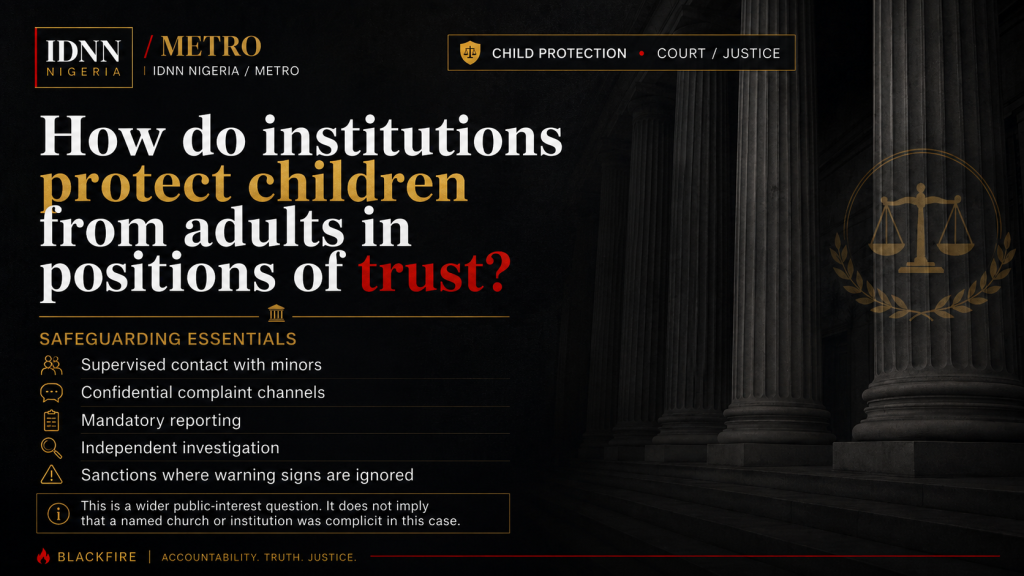
The case also raises wider questions about how religious, educational and community organisations protect children who come into contact with adults occupying trusted positions.
Such institutions should maintain:
- clear child-protection policies;
- supervised contact with minors;
- confidential reporting channels;
- mandatory escalation procedures;
- independent investigation systems;
- sanctions where warning signs are ignored.
The conviction establishes Onuorah’s criminal responsibility.
It does not, by itself, establish that a church, religious organisation or other institution participated in, concealed or enabled the offence.
Any institutional failure would require separate evidence and investigation.
Justice Is More Than a Sentence
The 25-year prison term marks the legal conclusion of the prosecution at trial level.
The deeper test is whether:
- the compensation ordered by the court is paid;
- the survivor receives sustained protection and support;
- her identity remains secure;
- institutions strengthen safeguards against similar abuse.
A conviction closes one stage of the criminal case.
It does not close society’s duty to protect the survivor or prevent another child from suffering similar harm.
