
⚖️ Legal Battle Erupts Over Control of ADC
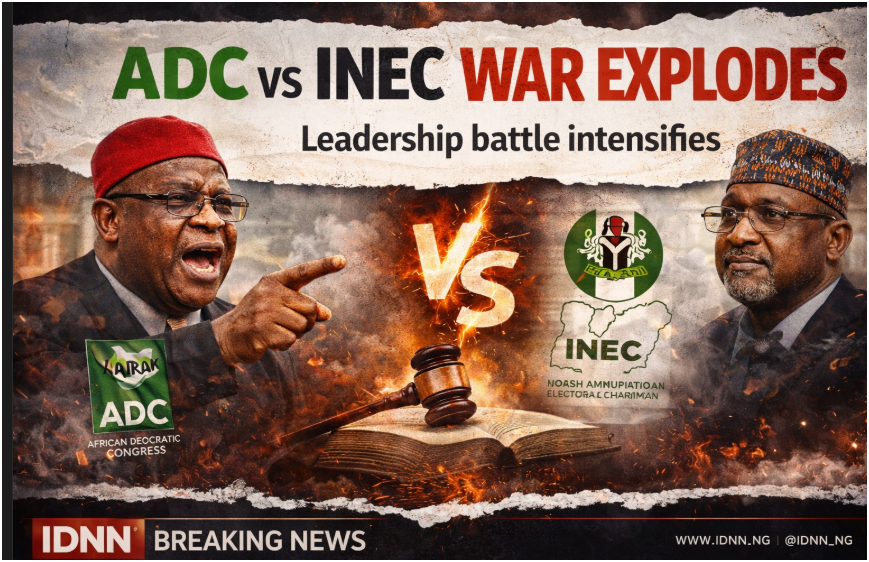
The ADC vs INEC crisis has entered a critical phase, with the faction led by former Senate President David Mark initiating legal proceedings to overturn its derecognition by the Independent National Electoral Commission (INEC).
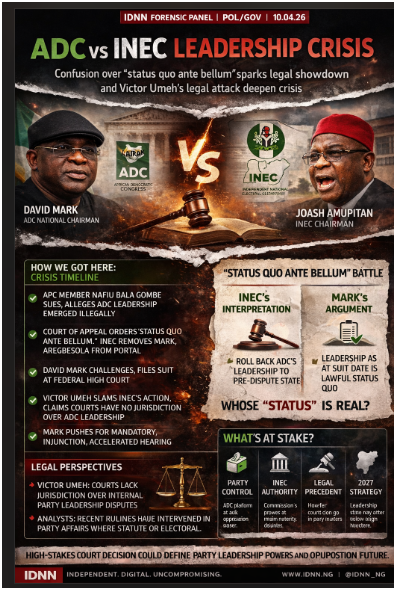
The move follows INEC’s decision to remove the names of Mark and his National Working Committee from its official records, citing a Court of Appeal directive to maintain the “status quo ante bellum.”
INEC, however, based its action on its interpretation of that directive, though it has yet to provide a detailed public clarification on how that interpretation led to the removal of the previously recognised leadership.
🧩 Court Order Sparks Confusion and Competing Claims
At the centre of the dispute is the legal meaning of “status quo ante bellum”—a principle referring to the last uncontested state before a dispute.
Legal filings by the Mark-led faction argue that the phrase refers to the leadership structure as it existed at the time the suit was initiated, not a retroactive nullification of that structure.
However, INEC’s application of the ruling effectively displaced that leadership, triggering competing claims and deepening internal fractures within the party.
The result is a growing vacuum over who legitimately controls the ADC platform—an uncertainty now spilling into the courts.
⚔️ Umeh Escalates Legal Attack on INEC
The crisis intensified after Senator Victor Umeh challenged both INEC’s action and the role of the courts, arguing that disputes over party leadership fall outside judicial authority.
Umeh cited Supreme Court precedents, maintaining that internal party affairs are non-justiciable and should not be determined by the courts.
He also accused INEC Chairman Joash Amupitan of misinterpreting the law by acting on a court order in a matter he described as constitutionally outside judicial reach.
However, legal analysts note that while courts traditionally avoid internal party disputes, exceptions have emerged in cases involving statutory compliance and electoral processes, leaving room for judicial interpretation.
🧭 Power Stakes Behind the Crisis
Beyond the legal arguments, the dispute carries significant political weight.
Control of the ADC platform could influence emerging opposition alignments, particularly at a time when coalition conversations are quietly gaining traction across Nigeria’s political space.
The leadership question is therefore not just administrative—it is strategic, with implications for future electoral positioning and alliance-building.
🏛️ Electoral Authority Under Scrutiny
INEC’s role in the unfolding crisis is now under heightened scrutiny.
By withdrawing recognition and declining to monitor party activities, the commission has effectively frozen key internal processes within the ADC, raising questions about the extent of its discretionary powers in politically sensitive disputes.
“What is unfolding is not just a party dispute—it is a legal contest over the limits of electoral authority,” a senior political analyst familiar with the case said.
The absence of a definitive institutional interpretation has allowed multiple narratives to compete, further complicating the situation.
Why This Crisis Matters Now
This crisis represents a broader institutional stress test.
Three critical pillars are now in focus:
- Electoral Authority: The scope of INEC’s power in interpreting and enforcing court rulings
- Judicial Boundaries: Whether courts can intervene in internal party leadership disputes
- Political Stability: The ability of opposition parties to function amid legal uncertainty
The outcome will shape how political authority is defined and exercised within Nigeria’s democratic system.
🚨 What Comes Next
With the Federal High Court now seized of the matter and motions for accelerated hearing already filed, the coming days are expected to provide crucial legal clarity.
Until a definitive ruling is delivered, the ADC vs INEC crisis will continue to cast uncertainty over opposition politics, test institutional boundaries, and raise deeper questions about who ultimately controls the levers of party legitimacy in Nigeria’s democratic system
This is IDNN. Independent. Digital. Uncompromising.
