
NGX falls for fifth straight session as market capitalisation drops ₦256bn
Nigeria’s equities market has declined for five straight sessions, but the pullback remains modest against a 60.83% year-to-date gain. Wednesday’s close will show whether the weakness is extending, reversing or broadening.
The Nigerian equities market has extended its losing streak to five consecutive trading sessions, with the NGX All-Share Index falling another 0.16% to 250,273.50 points on Tuesday as market capitalisation dropped by about ₦256 billion.
Market capitalisation closed at roughly ₦162.50 trillion, down from about ₦162.75 trillion in the previous session.
The five-session run matters, but it should not be confused with a collapse in the broader market.
The NGX remained up 60.83% year-to-date at Tuesday’s close.
That wider context changes the question.
The immediate issue is whether the current pullback remains a contained correction inside a much stronger year-to-date advance, or whether selling pressure is beginning to broaden across sectors and larger stocks.
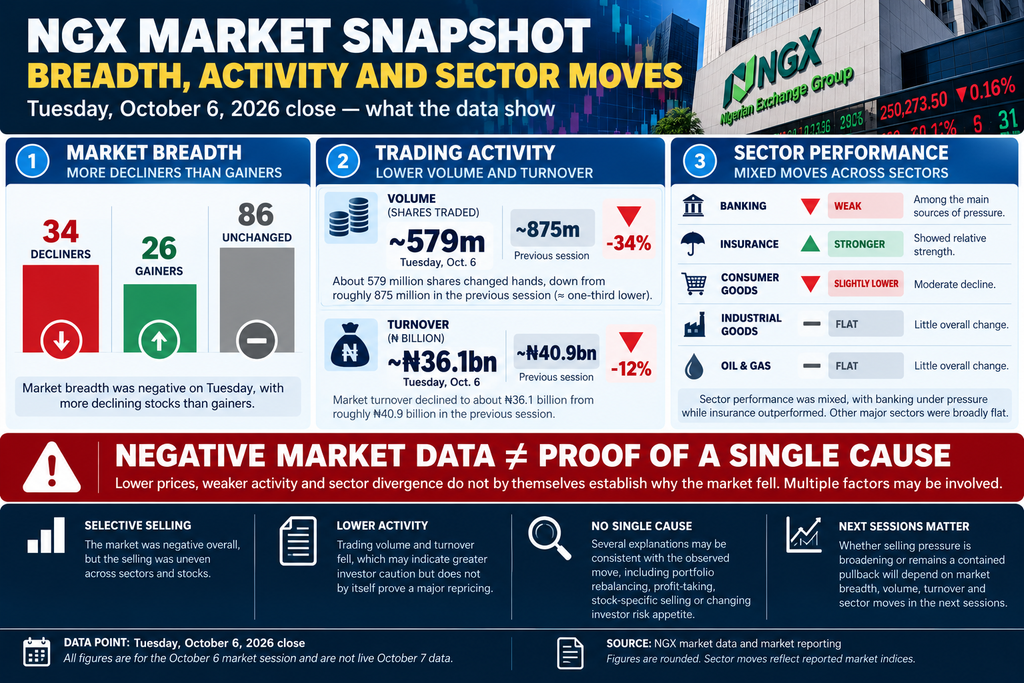
Tuesday’s market was weak, but not uniformly weak
Market breadth was negative on Tuesday, with more declining stocks than gainers.
The weakness was also uneven across sectors.
Banking stocks were among the main sources of pressure, while insurance showed relative strength.
That divergence matters because it argues against treating Tuesday’s decline as one uniform market move driven by a single factor.
Some prominent banking stocks fell, while others recorded gains or marginal positive moves.
The market was therefore negative overall, but the selling was selective rather than universal.
Trading activity also weakened
About 579 million shares changed hands on Tuesday, compared with roughly 875 million shares in the previous session.
Trading volume therefore fell by roughly one-third, while turnover declined to about ₦36.1 billion from roughly ₦40.9 billion.
Lower activity can be read in different ways.
It may indicate greater investor caution after a strong market run.
But weaker turnover can also mean the decline lacks the broad, heavy-volume selling that would provide stronger evidence of a major repricing.
Tuesday’s figures do not settle that question.
The next sessions will show whether participation expands as prices fall, or whether the pullback remains relatively contained.
Banking carried more of the pressure
Banking was one of the main weak areas on Tuesday.
Some prominent banking stocks declined, while others recorded gains or marginal positive moves.
That distinction is important.
A weak banking segment does not mean every bank stock is being sold, just as five negative market sessions do not establish a single market-wide cause.
Five losses need to be read against the year’s gains
The five-session decline is material for short-term momentum, but it is occurring inside a market that remained up 60.83% year-to-date at Tuesday’s close.
Several explanations may be consistent with the observed move: portfolio rebalancing, profit-taking after earlier gains, stock-specific selling, changing liquidity or shifts in investor risk appetite.
Current market data alone do not establish which one is dominant.
Claims that the market is falling because of one specific macroeconomic or policy catalyst therefore require additional evidence.
What Wednesday’s close will tell us
The October 7 session is the next important checkpoint.
If the All-Share Index falls again with deteriorating breadth, heavier turnover and losses spreading across more sectors, that would provide stronger evidence that selling pressure is broadening.
If the market stabilises or rebounds while breadth improves, the five-session decline may look more like a contained correction than the beginning of a deeper retreat.
Several indicators matter more than the headline index alone:
- whether the losing streak extends to a sixth session;
- market breadth — gainers versus losers;
- value and volume traded;
- banking-sector performance;
- movement in large-cap stocks;
- whether losses spread beyond the sectors currently under pressure.
The market has now fallen for five straight sessions.
But with the NGX still carrying a substantial year-to-date gain, Wednesday’s close will be more useful than a dramatic label in determining whether this is a routine pullback or a wider market shift
