
Nigeria’s downstream petroleum regulator has ordered filling stations across the country to immediately calibrate and verify their pumps after observing incidents of under-dispensing at retail outlets nationwide.
NMDPRA orders nationwide fuel-pump checks over under-dispensing
Nigeria’s downstream petroleum regulator has ordered filling stations across the country to immediately calibrate and verify their pumps after observing incidents of under-dispensing at retail outlets nationwide.
The Nigerian Midstream and Downstream Petroleum Regulatory Authority has intensified scrutiny of filling stations after observing incidents of under-dispensing at retail outlets across the country.
In an industry circular issued on Tuesday, the NMDPRA directed retail outlet operators nationwide to immediately calibrate and verify all fuel dispensers and totalisers.
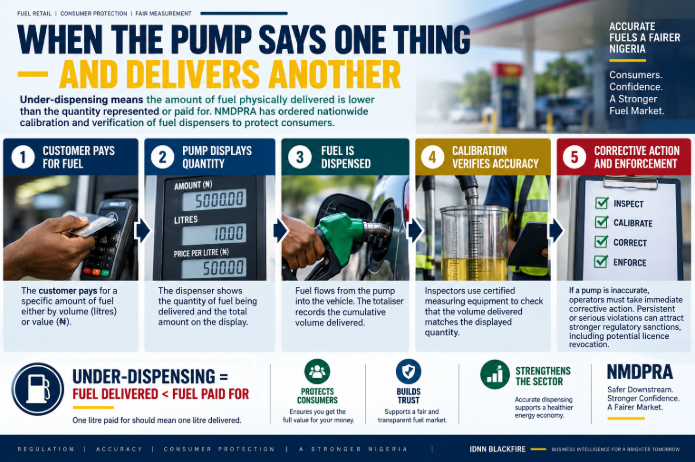
A dispenser measures the quantity delivered to a customer, while the totaliser records the cumulative volume passing through the equipment.
The regulator said accurate calibration was necessary to ensure consumers receive the full quantity of petroleum products they purchase.
It described under-dispensing as a serious breach of consumer trust and said inspections and enforcement activities had been intensified nationwide.
Stations face sanctions for serious violations
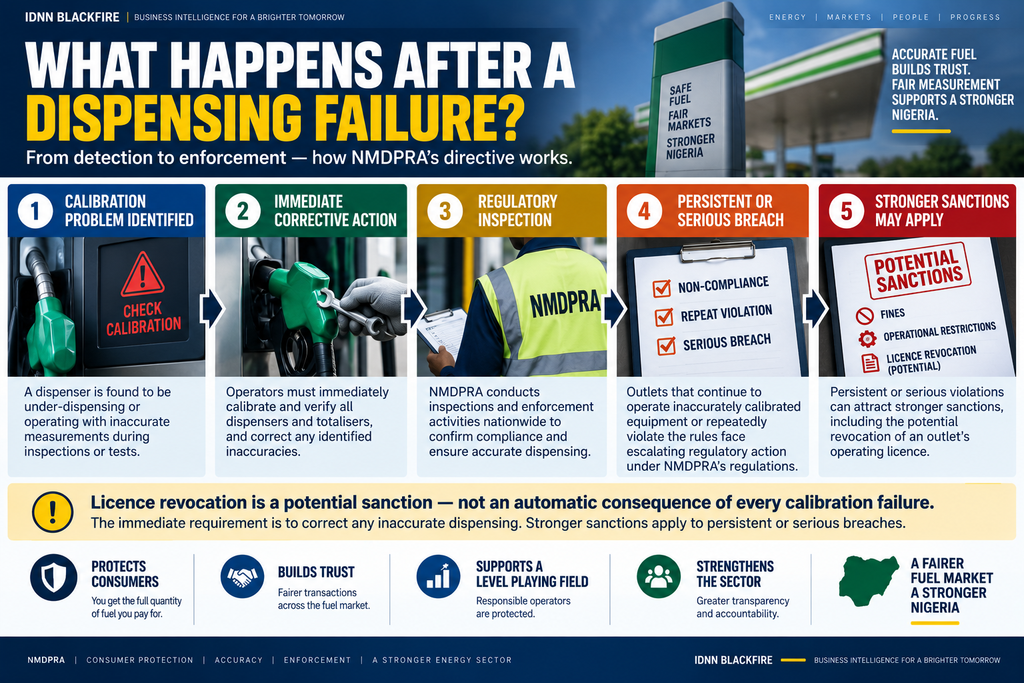
The regulator said outlets found under-dispensing, operating improperly calibrated equipment or otherwise compromising dispensing accuracy would be required to take immediate corrective action.
More serious consequences could follow for persistent offenders.
The NMDPRA warned that persistent or serious violations could attract sanctions extending to the revocation of an outlet’s operating licence under its regulations.
That means inaccurate dispensing triggers an immediate corrective requirement, while licence revocation is a potential sanction for persistent or serious breaches rather than an automatic consequence of every calibration failure.
The warning is also not evidence that licences have already been revoked under the new nationwide directive.
The authority did not disclose in the circular how many filling stations had been found under-dispensing, the volume of petroleum products affected or the estimated financial loss to consumers.
Those gaps matter because the scale of the consumer impact cannot yet be quantified from the regulator’s announcement alone.
Why small pump shortages can become a big consumer issue
Under-dispensing means the quantity physically delivered by a pump is lower than the quantity represented or paid for.
For an individual transaction, the difference may be relatively small.
Across large numbers of transactions, however, dispensing inaccuracies can shift value away from motorists, transport operators, businesses and households — particularly when petroleum prices are already placing pressure on budgets.
The immediate consumer question is therefore not simply the displayed pump price.
It is whether one litre paid for is one litre delivered.
That makes dispenser accuracy both a technical regulatory issue and a household-cost issue.
But the NMDPRA has not published enough information in the latest directive to calculate how much consumers may have lost nationally through under-dispensing.
Any estimate of nationwide financial losses would therefore go beyond the available evidence.
Regulator puts marketer associations on notice
The NMDPRA also asked major petroleum-industry associations to notify their members and support compliance with the directive.
They include the Major Energies Marketers Association of Nigeria, the Depot and Petroleum Products Marketers Association of Nigeria, the Independent Petroleum Marketers Association of Nigeria and the Petroleum Products Retail Outlets Owners Association of Nigeria.
The instruction pushes compliance beyond individual stations to the industry bodies representing major marketers, depot operators, independent marketers and retail-outlet owners.
The regulator said its objective was to protect consumers, improve transparency and maintain the integrity of petroleum-product transactions.
Enforcement will determine whether the order works
The nationwide directive establishes the regulatory requirement.
It does not establish that every pump has now been recalibrated or that under-dispensing has stopped.
The next test is enforcement.
That includes how many outlets inspectors check, how many pumps fail calibration tests, how many operators are ordered to correct their equipment, what sanctions are imposed and whether persistent offenders actually lose their licences.
Those numbers would turn the current warning into measurable evidence of regulatory impact.
For consumers, enforcement also needs to be visible enough to answer a simple question at the pump:
Are they receiving the full quantity of fuel they paid for?
Until inspection and compliance data are published, that remains the central accountability test.
