
Nigeria has begun talking about football in the language of a reset.
New structures.
New accountability.
New leadership arrangements.
A new commercial era for the domestic league.
And, above all, a promise that the institutions running the country’s most popular sport must finally work better.
Then comes the referee question.
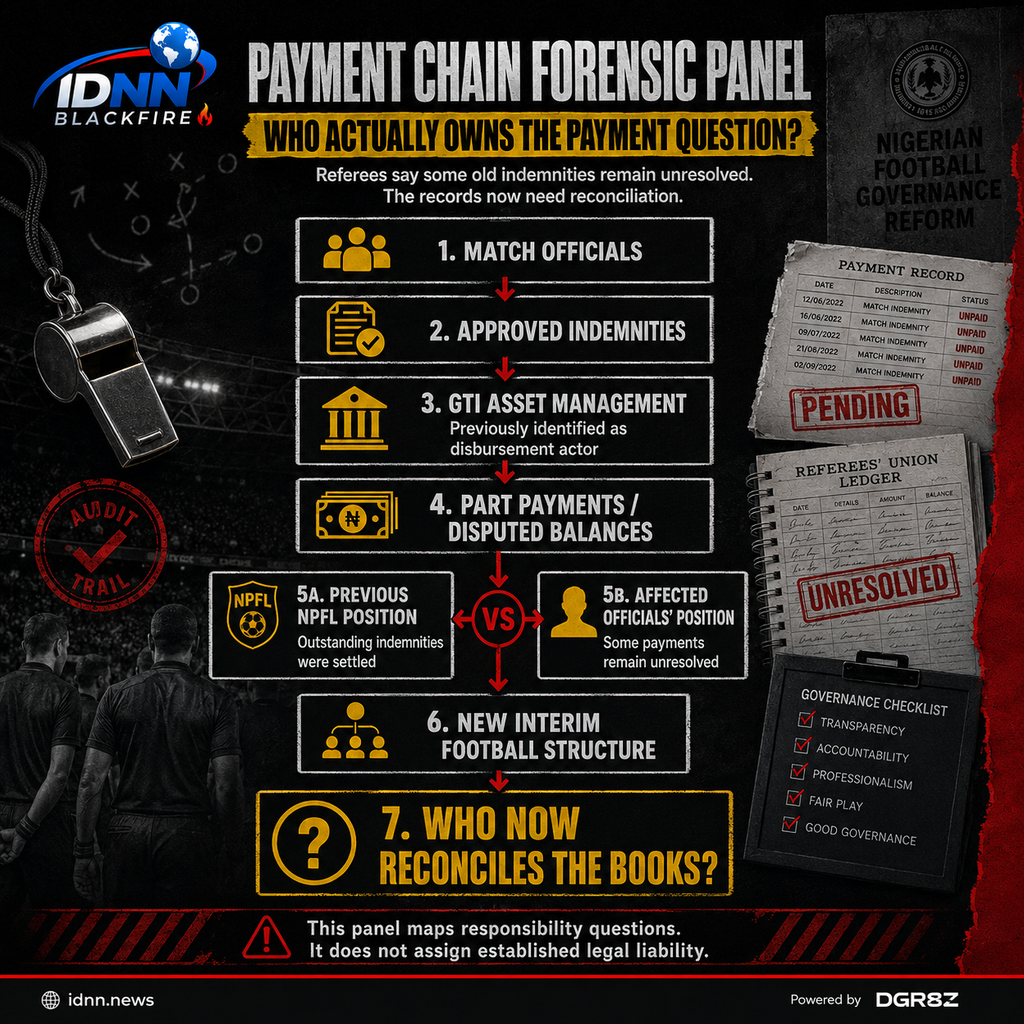
Affected match officials say indemnities and other payments from the 2025/26 Nigeria Premier Football League season remain outstanding, including obligations connected to NPFL fixtures and the President Federation Cup.
Some officials say they are still expecting payments dating back to Matchday 26.
The previous NPFL administration, however, maintained that outstanding referee indemnities had been settled.
That contradiction is now sitting inside a much bigger transition.
On August 27, President Bola Tinubu ordered what the Presidency described as a comprehensive reform of Nigerian football, specifically calling for stronger governance, administration, domestic competitions and accountability.
The National Sports Commission, NFF Secretariat and other stakeholders were directed to preserve essential administration while a new football structure is developed.
So the first serious governance test of the new order may not arrive through a World Cup qualifier or another boardroom dispute.
It may begin with something much more basic.
What was owed?
What was paid?
What remains disputed?
And who now has the authority to establish the answer?
The Reset Inherited an Unfinished Payment Question
Nigeria’s football shake-up was substantial.
NFF President Ibrahim Gusau, General Secretary Mohammed Sanusi and members of the Executive Committee left their positions.
Dr Emmanuel Ikpeme was installed to oversee the NFF Secretariat as interim General Secretary.
At league level, chairmen, directors and chief executives of the national leagues were instructed to transfer administrative responsibility to Chief Operating Officers or other officials deployed within the interim structure.
The stated purpose was continuity.
But administrative continuity also raises an unavoidable question about unresolved obligations:
Who now has the authority and responsibility to reconcile them?
That question becomes more complicated because match-official payments were not simply a straight line between the NPFL board and referees.
Earlier reporting identified GTI Asset Management as the organisation responsible for disbursing match officials’ indemnities under the league’s payment structure.
That means the accountability chain must include more than the former league leadership.
It must also establish what GTI was authorised to pay, what it actually disbursed, what remained pending and whether that responsibility has changed under the new structure.
The Payment Problem Did Not Start With the Reset
The warning signs were already visible months earlier.
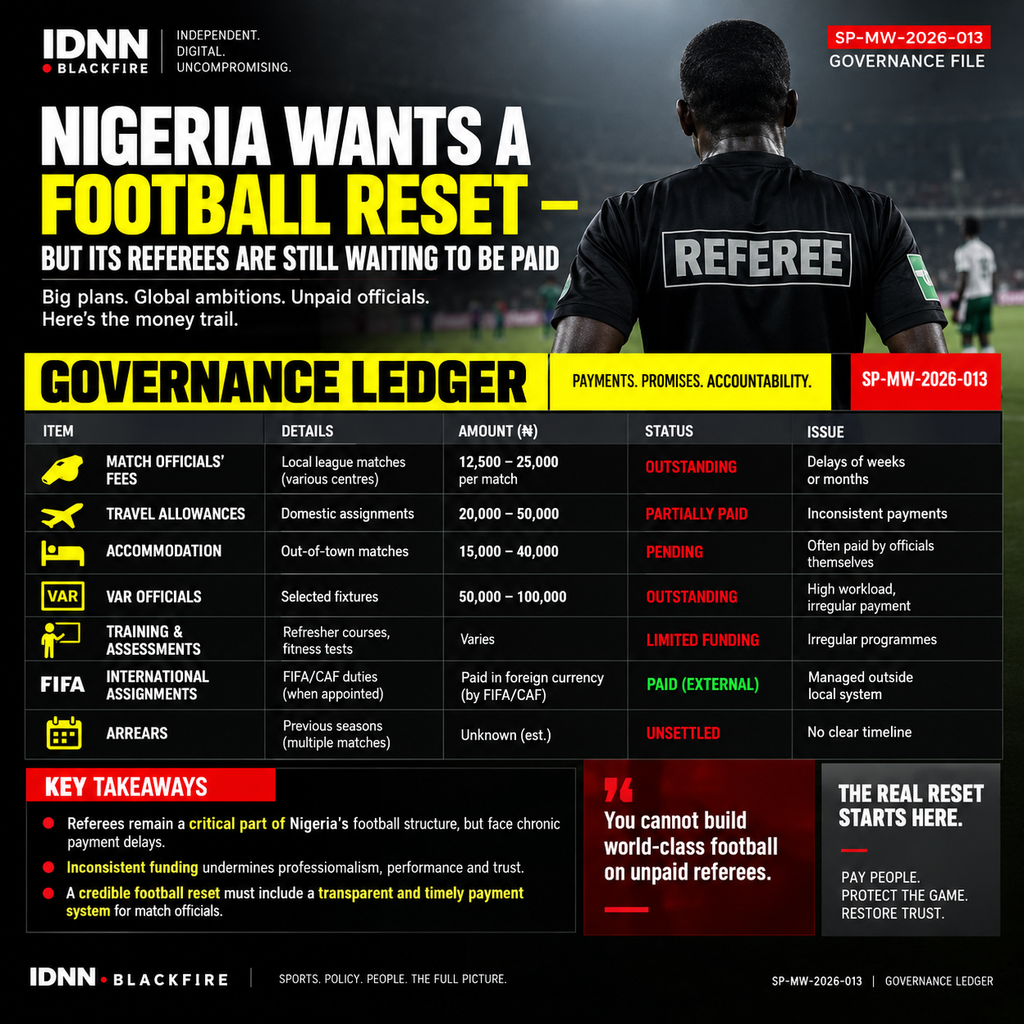
In January, referees and other match officials complained that indemnity payments had stalled for roughly 11 matchdays.
Officials said basic matchday allowances ranged between ₦60,000 and ₦90,000, excluding some transportation and accommodation costs.
The complaints extended beyond referees to match commissioners and referee assessors.
At the time, GTI Asset Management, which had been responsible for disbursing match-official indemnities since 2023, acknowledged outstanding payments and said they were being cleared.
By January 12, some officials confirmed receiving part payment.
That matters because it gives the dispute a clearer chronology:
Arrears were acknowledged.
Some payments were made.
The previous league administration later said the outstanding indemnities had been settled.
Affected officials are now saying some payments remain unresolved.
That is no longer simply a claim about an unpaid Matchday 26.
It is a reconciliation problem.
The NPFL Said It Had Paid — Referees Say Otherwise
This distinction must remain central.
The unpaid-indemnity allegation cannot be presented as though no competing institutional position exists.
There is one.
The previous league administration said outstanding referee indemnities had been settled.
Affected officials say they had not.
The appropriate response is therefore not accusation.
It is documentation.
The Accountability Test Should Be Simple
Which fixtures remain disputed?
Which officials are affected?
What amounts were approved?
Which entity was responsible for disbursement?
What did GTI transfer?
What was received?
What remains outstanding?
Do NPFL and President Federation Cup payments sit under the same payment structure?
Which institution now has authority to reconcile the records?
Those questions are measurable.
A football system promising stronger administration should be able to answer them.
Once the records are reconciled, either the officials’ complaints are substantiated, the previous league administration’s position is substantiated, or the truth lies somewhere between both accounts.
That is precisely what accountability is supposed to establish.
Then Came the $7.5m New Era
The timing makes the dispute more significant.
On August 26, only a day before the football leadership shake-up, the NPFL unveiled a three-year, $7.5 million title sponsorship agreement with EuroMatch.
The agreement is worth $2.5 million per season, with league officials saying 60 per cent of the annual value would go to the 20 clubs.
The competition has since begun operating publicly as the EuroMatch-NPFL.
That is significant progress.
A domestic league that spent years struggling to establish consistent commercial value now has a major title partner.
Clubs have been promised a substantial share of the new income.
The league is talking about improved player welfare.
Broadcast visibility is expanding.
But the sponsorship deal should not be confused with the source from which old referee obligations must necessarily be settled.
There is no public evidence establishing that EuroMatch sponsorship money is contractually responsible for those payments.
Its relevance is different.
The new money demonstrates the scale of the league’s commercial ambition.
And greater commercial ambition raises the standard expected of the administration behind it.
A richer league should also become a more transparent one.
The ₦1bn Ambition Makes Administrative Credibility Matter More
The scale of the new ambition is striking.
Nigeria’s football authorities have announced that the champions of the 2026/27 NPFL season will receive a minimum ₦1 billion prize.
Add that to the $7.5m title sponsorship and the message is unmistakable:
Nigeria wants a more valuable league.
A better marketed league.
A competition capable of attracting stronger investment, players, audiences and commercial partners.
But financial credibility does not begin with giant numbers.
It begins with systems.
Can payments be traced?
Can disputes be reconciled?
Can officials know who is responsible?
Can obligations survive leadership changes without disappearing into institutional fog?
Those are less glamorous questions.
They are also the questions that determine whether commercial growth becomes institutional growth.
Why Referee Welfare Is a Governance Issue — Not a Side Issue
Refereeing sits at the centre of any league’s credibility.
Nigeria has spent years debating officiating standards.
Bad decisions become national arguments.
Appointments are scrutinised.
Integrity is questioned.
Referees themselves operate under enormous public pressure.
That makes payment discipline more than a welfare issue.
It is part of the administrative environment in which officials are expected to perform professionally.
A referee who has travelled, officiated and completed an authorised assignment should not remain uncertain about whether the approved compensation for that assignment will arrive.
That principle does not imply corruption.
It does not accuse any official of compromised integrity.
It establishes something simpler:
Professional standards are harder to demand when professional obligations are uncertain.
If Nigerian football wants better officiating, it must also build predictable systems around the officials being asked to deliver it.
A Reset Cannot Ignore the Question of Old Obligations
Incoming administrators routinely inherit problems they did not create.
Contracts.
Disputes.
Pending payments.
Court cases.
Operational failures.
Promises.
That does not automatically determine legal liability.
But it does create an institutional responsibility to establish what remains unresolved and who has authority to deal with it.
The same applies here.
The football reform has been built around continuity while a new framework is developed.
Continuity means fixtures must continue.
Player registrations must continue.
Appointments must continue.
League administration must continue.
It should also mean that disputed obligations do not become impossible to trace simply because the administrative chart has changed.
There is no evidence that Nigeria’s current football authorities intend to abandon valid referee claims.
But that is precisely why this dispute offers such a useful early test.
Resolve it transparently and the reform demonstrates that accountability has practical meaning.
Allow uncertainty to continue indefinitely and the reform inherits the credibility problem.
The Reform Has Set Its Own Standard
Tinubu’s August directive did not merely demand better results from Nigerian teams.
It called specifically for stronger:
governance
administration
stakeholder representation
development pathways
domestic competitions
and
accountability.
That final word matters.
Accountability is not only about removing officials or investigating old structures.
It is also about maintaining records.
Tracing decisions.
Reconciling competing claims.
Identifying responsibility.
And ensuring an institutional dispute can still be resolved after leadership changes.
The referee-payment question therefore gives the reform something useful.
A measurable problem.
Not philosophy.
Not another committee.
Not another public declaration.
A ledger.
Either money remains outstanding or it does not.
If some was paid, establish what.
If some remains disputed, establish how much.
If GTI was responsible for disbursement, establish what it received and transferred.
If President Federation Cup liabilities sit elsewhere, identify where.
Then establish which institution now closes the file.
Blackfire Governance Ledger
January 2026
Match officials complain that indemnity payments had stalled across roughly 11 NPFL matchdays.
Payment Structure
GTI Asset Management is identified in reporting as the organisation responsible for disbursing match-official indemnities.
January Response
GTI acknowledges outstanding payments and says the arrears are being cleared.
January 12
Some match officials confirm receiving part payment.
Later NPFL Position
The previous league administration says outstanding referee indemnities have been settled.
Referee Position
Affected officials continue to say some obligations remain unresolved.
September 2026
Officials say some payments dating back to Matchday 26 remain outstanding, alongside reported President Federation Cup obligations.
August 26
NPFL unveils a three-year $7.5m EuroMatch title sponsorship.
August 27
Federal Government orders comprehensive football reform built around governance and accountability.
August 27
NFF and league administration move into interim transition structures.
2026/27 Season
The new EuroMatch-NPFL season begins.
The Bigger Question Is Bigger Than the Money
There is a temptation to compare referee indemnities with a $7.5m sponsorship and conclude that the disputed amounts are comparatively small.
That misses the point.
Precisely because this is a narrower administrative issue, resolving it should be less complicated than many of the problems Nigerian football says it is trying to solve.
World Cup qualification.
Grassroots development.
League commercialisation.
Federation governance.
Infrastructure.
Player development.
Those are enormous structural challenges.
Determining whether identifiable officials received authorised payments for identifiable matches should be considerably more straightforward.
And that is exactly why the issue matters.
IDNN Governance Test
Nigeria’s football reset has made a large promise:
stronger institutions.
The referee-indemnity dispute offers a smaller test of whether that promise can survive contact with administration.
The new season can carry a sponsor’s name.
The champions can chase a billion-naira prize.
Officials can announce structural transformation.
But institutions earn credibility differently.
They earn it when records survive leadership changes.
When payments can be traced.
When conflicting claims are reconciled.
When responsibility is identifiable.
And when “accountability” becomes something more tangible than a word in a reform statement.
Nigeria can replace boards.
It can redesign structures.
It can open a new commercial chapter.
But a credible football reset cannot leave unresolved obligations buried inside the system it is trying to replace.
If affected officials are owed, establish the amount and settle it through the responsible structure.
If they are not, publish the reconciliation that demonstrates it.
Either answer is stronger than uncertainty.
Governance File
Issue: Disputed outstanding referee and match-official indemnities
Competition: Nigeria Premier Football League / reported President Federation Cup obligations
Officials’ position: Some payments from the 2025/26 season remain outstanding
Previous NPFL position: Outstanding referee indemnities had been settled
Known payment actor: GTI Asset Management previously responsible for disbursement of NPFL match-official indemnities
Administrative status: Nigerian football and league administration operating under interim transition arrangements
Commercial context: $7.5m EuroMatch title sponsorship over three years
Reform context: Presidential football reform directive of August 27, 2026
Core accountability question:
Who owes what, who was responsible for disbursement, what was actually paid — and who now has authority to close the books?
