
Jigawa State Governor Umar Namadi has suspended the renovation of Gumel General Hospital after an inspection found what he described as poor progress, substandard workmanship and failure to meet approved specifications.
Published reports identifying the contractor as Yasmeen Automobile Nigeria Limited said the project was awarded in December 2025 with an eight-month delivery period and a value exceeding ₦1.3 billion.
The contract value does not establish how much money has been released or paid. Those financial details have not yet been publicly confirmed.
Namadi directed the Jigawa State Ministry of Health to halt the contractor’s work and take steps to protect public funds after inspecting sections of the hospital, including the male and female wards, General Out-Patient Department and isolation centre.
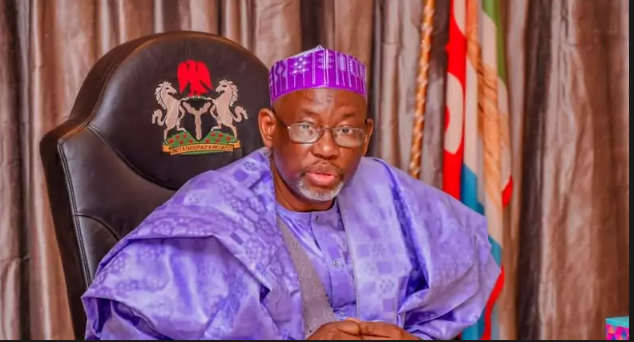
“The progress is very poor. We approved a complete renovation and remodelling of this hospital, but what I have seen is not what we asked for,” the governor was quoted as saying.
The suspension has raised immediate questions about how the project was supervised, whether any stages were certified and how much money had been released or paid before the governor intervened.
Governor Questions Quality and Progress
The renovation was intended to modernise Gumel General Hospital and improve healthcare delivery for residents of Gumel and surrounding communities.
Namadi said the work he observed did not reflect the scope and standard approved by the government.
His criticism covered the pace of construction, the quality of the workmanship and the materials reportedly used on the project.
The state government has not yet published a detailed technical report identifying every defect, the percentage of work completed or the remedial work now required.
It is also unclear whether the project passed any formal inspection or received interim certification from supervising officials before the governor’s visit.
That gap is central to the accountability question.
Where previous inspections occurred, the public needs to know what those inspections found and whether any payment was authorised on the strength of project certificates.
Contract Value Is Not Amount Paid
IDNN has not yet obtained:
- the signed contract;
- the bill of quantities;
- mobilisation-payment records;
- interim payment certificates;
- supervision reports;
- variation orders;
- the formal suspension letter.
Without those records, it would be inaccurate to state that ₦1.3 billion was spent, lost or wasted.
The immediate financial questions are therefore narrower:
- What was the exact contract sum?
- How much was approved?
- How much was released?
- How much was paid?
- What work was certified before any payment?
- Was a performance bond provided?
- Can the state recover money if a contract breach is eventually established?
The Ministry of Health and relevant procurement authorities should disclose those records in the public interest.
Who Supervised the Project?
The suspension also shifts scrutiny beyond the contractor.
Public construction projects ordinarily pass through approval, monitoring and certification stages before payments are made.
The identities of the supervising consultant, project-monitoring officials and officers responsible for any interim certificates have not yet been made public.
It is also unclear whether concerns were raised before the governor’s inspection or whether the work continued for months without a documented warning.
That raises a broader institutional question:
Why did it require an unscheduled visit by the governor for the reported problems to become public?
The answer will help establish whether the issue was limited to contractor performance or reflected a wider breakdown in procurement, supervision and quality control.
Patient Consequence Still Unclear
The condition of hospital services during the renovation remains another major gap.
IDNN has not yet independently established whether:
- wards were closed;
- patients were relocated;
- outpatient or emergency services were disrupted;
- health workers were operating around construction;
- the suspension will delay access to improved facilities.
The state government has also not publicly announced a revised completion timetable or explained how hospital operations will be protected while the contract remains suspended.
For residents, those questions may matter more immediately than the contract dispute itself.
A failed hospital-renovation process is not merely a construction problem. It can become a healthcare-access problem where patients, staff and surrounding communities are left with incomplete, unsafe or disrupted facilities.
Contractor Yet to Respond
No verified public response from Yasmeen Automobile Nigeria Limited had been established at the time of this report.
The company should be given the opportunity to explain:
- its assessment of the work;
- the percentage completed;
- the amount received;
- whether government delays or design changes affected delivery;
- whether any stages were certified;
- whether it disputes the governor’s assessment;
- whether it will undertake remedial work or challenge the suspension.
The absence of a response does not establish wrongdoing.
It leaves a material part of the public record incomplete.
IDNN Opens Accountability File
IDNN has opened an accountability file on the Gumel General Hospital renovation.
The file will track:
- the contract award;
- procurement process;
- payment trail;
- project supervision;
- certification;
- hospital-service consequences;
- contractor response;
- sanctions or recovery action.
At this stage, the evidence establishes that the governor suspended the project after criticising its progress and quality.
It does not yet establish fraud, diversion, collusion or proven loss of public funds.
Those conclusions can only follow the examination of documents, field evidence and responses from the institutions and company involved.
The first question has been answered: the project has been stopped.
The deeper question is who allowed it to reach that point.
