
🟥 Tinubu Turns NADECO Event Into High-Stakes Defence of His Reform Agenda
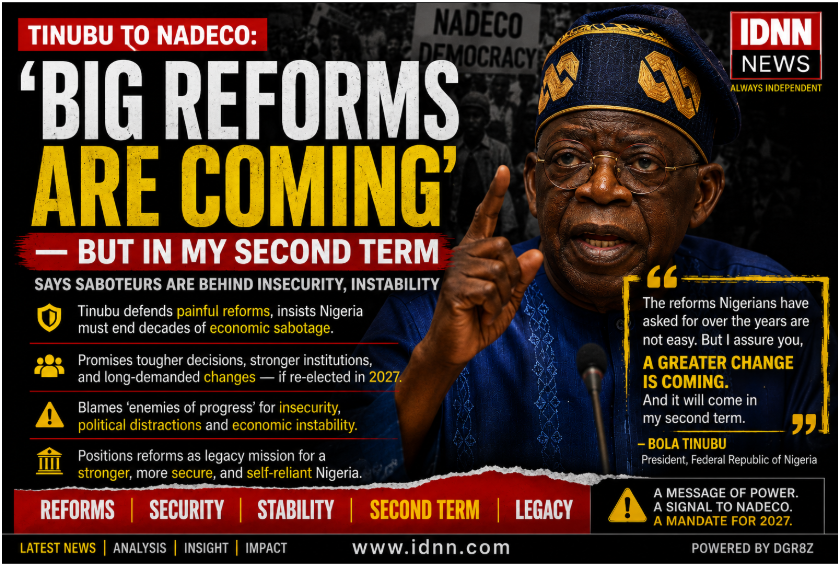
President Bola Ahmed Tinubu has delivered one of his clearest political signals yet ahead of the 2027 elections, promising to implement long-demanded governance reforms if re-elected while alleging that individuals hurt by his economic policies are deliberately working to destabilise Nigeria.
The President made the remarks in Lagos during the public presentation of The NADECO Story, authored by former National Democratic Coalition secretary Ayo Opadokun, transforming what began as a symbolic democracy gathering into a high-stakes political defence of his administration’s controversial reform programme.
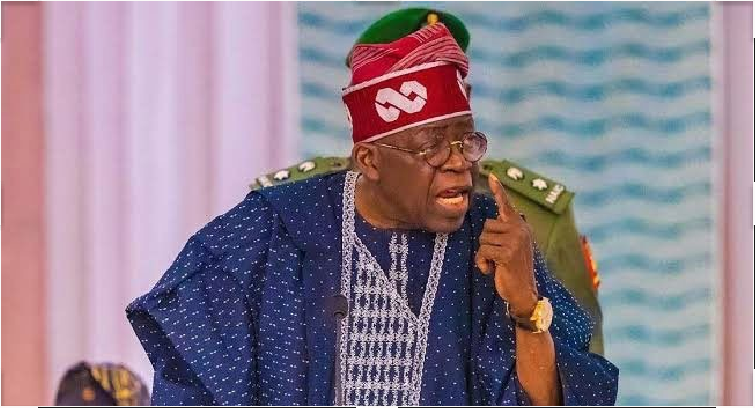
Represented by former Ogun State governor Olusegun Osoba, Tinubu told leading pro-democracy figures that many of the structural and political reforms long demanded by NADECO veterans would begin to materialise if Nigerians granted him another term in office.
“By the grace of God, many of the things that you people have been asking him to do will begin to be implemented when he gets a second term,” Osoba said on behalf of the President.
The statement immediately shifted attention beyond the book launch itself, placing Tinubu’s reform agenda, political survival strategy, and 2027 positioning at the centre of national political conversation.
🟨 Tinubu Links Insecurity to Resistance Against Subsidy and FX Reforms
At the heart of the President’s message was a forceful defence of two of the administration’s most controversial decisions — fuel subsidy removal and exchange-rate unification.
Tinubu argued that the reforms had disrupted entrenched financial networks and blocked long-standing systems of economic exploitation, insisting that some of those affected were now attempting to frustrate his government and destabilise the country.
“There is a deliberate attempt to disrupt the peace of this country by people who he knew he has offended by canceling multiple exchange rate, or by canceling oil subsidy,” Osoba quoted the President as saying.
The President further suggested that some of those allegedly affected by the reforms had become desperate following the collapse of opportunities linked to arbitrage and subsidy-era profits.
“Those cabal who are doing round tripping, they wish him dead anytime but he is determined,” Osoba added.
The remarks represent one of the strongest attempts yet by the administration to politically frame Nigeria’s worsening insecurity and instability as part of a broader backlash against economic restructuring.
That framing carries enormous political implications.
It effectively positions Tinubu’s presidency as a direct confrontation with entrenched interests benefiting from old economic systems — while simultaneously asking Nigerians for more time to endure the hardship triggered by the reforms.
🟥 Economic Hardship Now Sits at the Centre of Tinubu’s Political Gamble
Tinubu’s comments arrive at a time of deep economic frustration across the country.
Since the removal of fuel subsidy and the floating of the naira, Nigerians have battled:
- soaring inflation
- rising transportation costs
- food price shocks
- shrinking purchasing power
- mounting business pressure
While the administration insists the reforms were unavoidable and necessary to stabilise the economy, critics argue that ordinary Nigerians continue to bear the heaviest consequences without immediate relief.
Against that backdrop, Tinubu’s appearance before NADECO veterans carried a deeper political message:
the President is increasingly framing his reforms not as short-term popularity projects, but as painful structural changes he believes history will eventually justify.
He also attempted to project signs of economic stabilisation, particularly in the foreign exchange market.
“You can see that the difference between the parallel market and the official market is virtually zero now,” Osoba quoted him as saying.
But even as the government points to macroeconomic adjustments and fiscal reforms, public anger over living conditions remains one of the biggest threats hanging over the administration ahead of 2027.
🟨 NADECO Symbolism Gives Tinubu’s Message Historical and Political Weight
The venue and audience added extraordinary symbolism to the President’s remarks.
Tinubu did not make the statements at a partisan rally or campaign gathering.
He made them before veterans of the June 12 struggle and some of the most influential figures associated with Nigeria’s fight against military rule and democratic repression.
That setting gave the event an unmistakable democratic legacy undertone.
Wole Soyinka, who chaired the event, praised the publication for preserving the truth about the pro-democracy struggle and restoring recognition to individuals whose sacrifices helped shape Nigeria’s democratic journey.
Soyinka stressed that the struggle against military rule was a collective effort that could never be reduced to one personality or political actor.
“So many things happen, we run into individuals who don’t disappear from our lives completely, they just play their roles, and that is it,” Soyinka said.
Former Oyo State governor and Olubadan of Ibadanland, Rashidi Ladoja, also noted that many contributors to the NADECO movement operated quietly behind the scenes and should not be forgotten in the country’s democratic history.
The symbolism was impossible to ignore:
Tinubu was effectively defending his current presidency before the same democratic movement that shaped much of his political identity.
🟥 2027 Is Quietly Emerging as a Referendum on Tinubu’s Reforms
Beyond the historical remembrance and democratic symbolism, the Lagos event exposed a larger political reality already taking shape beneath Nigeria’s political surface.
Tinubu’s message increasingly suggests that the 2027 election may evolve into a referendum on:
- subsidy removal
- exchange-rate reforms
- economic restructuring
- governance credibility
- national stability
Supporters of the administration argue the reforms are painful but necessary to prevent long-term economic collapse.
Critics, however, insist the hardship facing Nigerians has deepened under the current policies and that insecurity continues to expand despite repeated government assurances.
By linking instability to resistance against his reforms, Tinubu appears to be constructing a broader political narrative:
that the turbulence currently facing Nigeria is the price of dismantling entrenched economic interests and restructuring the system.
Whether Nigerians ultimately accept that argument may become one of the defining political battles heading into 2027.
This is IDNN. Independent. Digital. Uncompromising.
