
🟥 Tinubu Defends Borrowing as Nigeria’s Debt Nears ₦159 Trillion
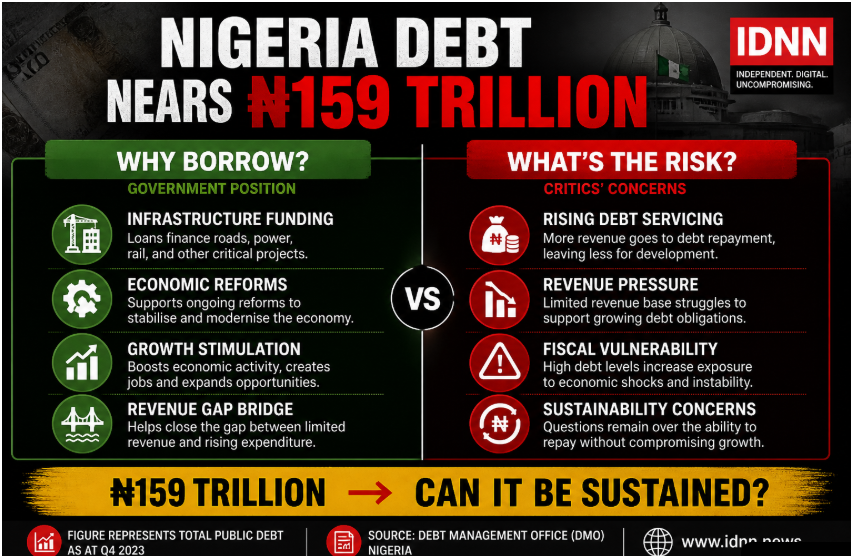
Nigeria’s debt has climbed toward ₦159 trillion, intensifying debate over the government’s borrowing strategy as President Bola Ahmed Tinubu defends continued loans to fund economic reforms and infrastructure development.
At the centre of the Nigeria debt borrowing debate is a policy position that borrowing remains essential to bridge funding gaps and accelerate long-term growth.
🟨 Government Position: Borrowing as a Growth Strategy
The administration maintains that borrowing is a necessary tool for development, particularly given Nigeria’s infrastructure deficit and limited revenue base.
Officials argue that external and domestic loans are being directed toward:
- energy and power infrastructure
- transportation networks
- public sector reforms
- economic stabilisation efforts
The administration maintains that without borrowing, key infrastructure projects may stall, potentially slowing economic expansion.
🟥 Opposition Pushback: Sustainability Concerns Intensify
However, critics have raised concerns over the pace and scale of borrowing.
Among them, Peter Obi has argued that rising debt without corresponding output growth could weaken the economy’s long-term capacity.
Opposition figures warn that:
- debt servicing is consuming a growing share of government revenue
- borrowing without measurable returns may increase fiscal vulnerability
- long-term repayment pressures could constrain future policy options
Nigeria’s challenge is not just borrowing, but its ability to generate enough revenue to sustain that debt.

🟨 Debt vs Growth: Competing Economic Paths
This is not just a policy debate — it is a question of economic sustainability.
The Nigeria debt borrowing debate reflects a fundamental divide between two economic approaches:
- Expansion Model: Borrow to invest and stimulate growth
- Conservative Model: Limit borrowing and prioritise fiscal stability
The balance between growth and debt is now central to Nigeria’s economic future.
🟥 System Explanation: Fiscal Model Under Pressure
The country’s fiscal model remains under pressure, with borrowing increasingly filling the gap between revenue and expenditure.
Key structural issues include:
- a limited revenue base relative to national spending needs
- dependence on borrowing to finance budgets
- rising cost of debt servicing
- exposure to external economic shocks
These pressures continue to shape the trajectory of Nigeria’s economic policy.
⚠️Sustainability Question Takes Centre Stage
The implications of the current trajectory are significant.
- borrowing may support infrastructure expansion
- but increases long-term fiscal obligations
- revenue constraints may limit repayment flexibility
- economic resilience depends on maintaining balance
For Nigeria, the question is no longer whether to borrow, but how long the current trajectory can be sustained.
This is IDNN. Independent. Digital. Uncompromising.
