
🟥 This is no longer a rumour wave — the numbers have landed
House defections 2027 realignment is now a measurable power shift after 27 members of the House of Representatives formally changed parties during plenary. Speaker Tajudeen Abbas read the notices, turning what had looked like scattered movement into one of the biggest single-day realignment bursts in the 10th House.
🟧 The hard count: who gained, who bled
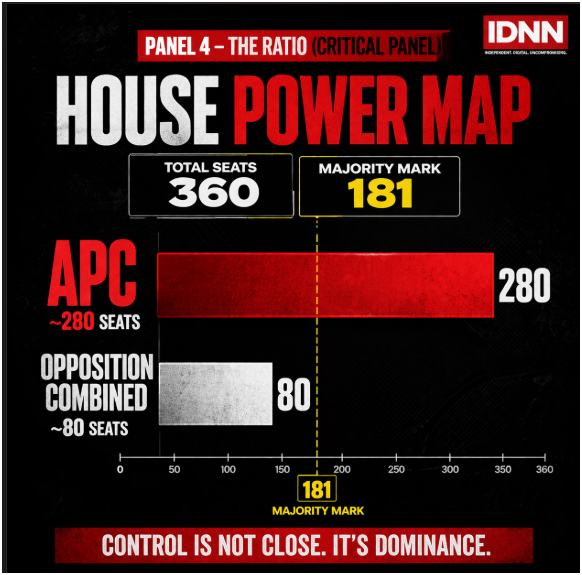
The biggest winner was the APC, which gained 14 members even after losing two, helping push its strength to about 280 seats in the 360-member House. The ADC gained eight lawmakers, while the Accord Party and the Action Peoples Party each added two. On the other side of the ledger, the PDP fell to 38 seats, the Labour Party to 12, and the NNPP to five.
🟨 The ratio tells the real story
The majority mark in the House is 181 seats. At roughly 280 seats, the APC is not just ahead; it is operating far above the control threshold. That means the new wave of defections is not merely symbolic. It tightens ruling-party dominance inside the chamber and shrinks the opposition’s room to resist, negotiate, or frame itself as a credible counterweight.
🟥 House Power Ratio
| Party | Seats / Strength | Status |
|---|---|---|
| APC | ~280 | Dominant majority |
| PDP | 38 | Main opposition, weakened |
| ADC | 15 | Rising alternative bloc |
| LP | 12 | Reduced minority |
| NNPP | 5 | Sharp decline |
| Accord | 2 | Small bloc |
| APP | 2 | Small bloc |
House total: 360 | Majority threshold: 181
🟦 The names make the shift more dramatic
Among the most politically striking moves were Deputy Minority Leader Aliu Madaki from NNPP to APC, Deputy Minority Whip George Ozodinobi from LP to ADC, and Philip Agbese from APC to LP. Also notable was Ikenga Ugochinyere’s move from PDP to APP. These were not anonymous backbench shifts. They hit leadership positions, party visibility, and media attention all at once.
🟥 Kano, crisis, and the opposition fracture line
A major slice of the APC’s gain came from eight Kano lawmakers who moved from the NNPP to the APC, with Governor Abba Yusuf, Deputy Senate President Barau Jibrin, and Abdullahi Ganduje present to witness the moment. The stated reasons across several defections were familiar but politically explosive: internal party crises, unresolved litigations, and deep factional conflict. That is why this story is bigger than cross-carpeting. It exposes how party weakness is being converted into ruling-party advantage.
🟥 Why this is really a 2027 story
This wave lands in a wider context of opposition fragmentation ahead of the next general election. Reporting and analysis around the 2027 cycle already point to a divided opposition struggling to form a unified front against the APC. What happened in the House now gives that broader argument hard parliamentary evidence. The realignment is no longer theoretical; it is visible in seat arithmetic.
The chamber is moving before the campaign starts
The most dangerous thing for the opposition is not the headline count. It is the message behind it: power is attracting more power. If this pace continues, the 2027 contest may begin with the parliamentary balance already tilted long before Nigerians vote. The question now is brutal and simple: can the opposition still organise, or is the House already showing the future?.
This is IDNN. Independent. Digital. Uncompromising.
