
The Strength That Does Not Shout
Ramadan Reflection Day 3 confronts a difficult truth: hunger does not create anger — it reveals it.
The Prophet (peace be upon him) said:
“The strong man is not the one who overpowers others, but the one who controls himself when angry.”
— Sahih al-Bukhari, Sahih Muslim
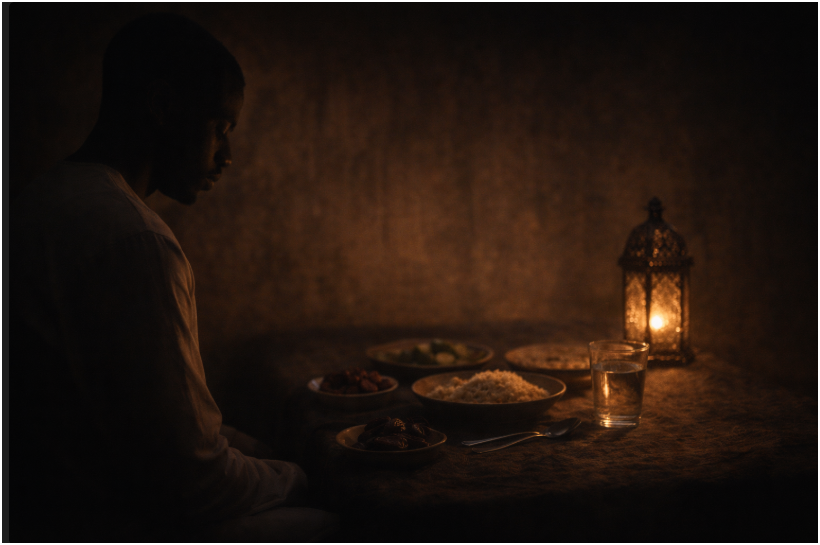
Fasting weakens the body. Yet it is meant to strengthen control.
When appetite is restrained, ego should follow. When thirst is endured, reaction should be measured. But Ramadan often exposes how thin our emotional discipline truly is.
The test of fasting is not silence of the stomach alone.
It is silence of uncontrolled reaction.
When Discomfort Meets Character
Allah says in Qur’an 3:134:
“Those who restrain anger and pardon people — and Allah loves the doers of good.”
Restraint is not passivity. It is calibrated power.
Ramadan is designed to bring us to the edge of discomfort — then observe what we do at that edge.
Do we lash out?
Do we intimidate?
Do we excuse harshness because we are fasting?
Or do we elevate ourselves?
In homes, workplaces, markets and institutions, fasting becomes visible in tone before it becomes visible in ritual.
A fasting tongue that wounds has not understood the fast.
Emotional Governance and Public Responsibility
Ramadan Reflection Day 3 must extend beyond personal conduct.
Emotional discipline is the foundation of institutional discipline.
A leader who cannot govern temper cannot govern policy. A public official who reacts impulsively cannot legislate thoughtfully. A citizen who responds to provocation with aggression cannot demand stability from institutions.
Ramadan trains reaction time.
It inserts pause between impulse and response.
That pause is civilisation.
When fasting, the Prophet instructed believers to say:
“I am fasting.”
This is not weakness.
It is a declaration of restraint.
It is a reminder that identity governs behaviour.
The Politics of Temper
Nigeria is no stranger to heated rhetoric. Public discourse often descends into hostility faster than it ascends into reason.
Ramadan offers correction.
If hunger increases irritation, it also increases opportunity — the opportunity to practice restraint deliberately.
Strength is not volume.
Authority is not aggression.
Influence is not intimidation.
Controlled speech is leadership. Controlled reaction is maturity.
Ramadan exposes the gap between claim and character.
The Hard Question
As Day 3 unfolds, the reflection becomes unavoidable:
When tested — do I react, or do I respond?
Fasting is not passive endurance. It is active refinement.
If anger remains unexamined, fasting has remained incomplete.
Ramadan Reflection Day 3 reminds us:
The strongest person in the room is not the loudest.
It is the one who governs himself.
