
Relief on the Roads — For Now
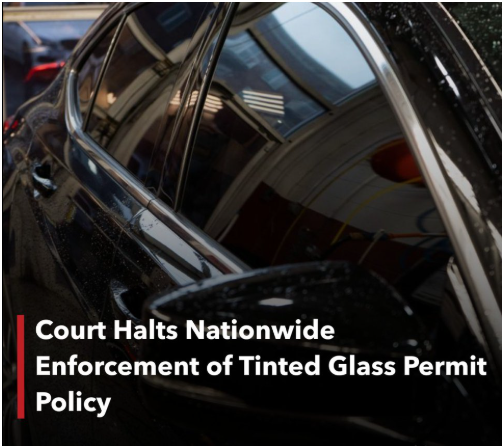
The Nigeria Police Force has announced a nationwide suspension of the enforcement of tinted glass regulations, acting on a court order that temporarily restrains further action.
For millions of motorists, the decision brings immediate relief from routine stops, arguments at checkpoints, and allegations of extortion that have trailed tinted glass enforcement for years.
But the pause also opens a legal grey zone.
What the Court Ordered
According to police statements, the suspension follows an order from a Federal High Court directing law enforcement agencies to halt enforcement pending the determination of a substantive suit challenging the process and scope of the regulation.
While the police did not publish the full ruling, officials confirmed that all commands have been instructed to comply until further notice.
Legal practitioners note that a suspension is not a repeal.

Why Tinted Glass Became a Flashpoint
Tinted glass rules were introduced to aid security operations, allowing law enforcement to identify occupants of vehicles more easily amid rising crime concerns.
In practice, however, enforcement became one of the most controversial aspects of traffic policing—often criticised for:
- Inconsistent application
- Unclear exemptions
- On-the-spot fines without receipts
- Alleged harassment of motorists
Civil rights groups have repeatedly argued that the absence of uniform guidelines turned the regulation into a tool for abuse.

08112935565, 08161558757
Police Response and Assurances
Senior police officials said the suspension demonstrates institutional respect for the rule of law, adding that officers found violating the directive would face disciplinary action.
They also reiterated that motorists with valid permits remain protected, while promising that any future enforcement would be guided by clearer rules and public sensitisation.
What This Means for Motorists
For now:
- Motorists cannot be penalised solely for tinted glass
- Police checkpoints are expected to desist from related stops
- Existing permits remain valid
However, lawyers caution drivers against assuming the issue is settled permanently.
Once the court delivers a final ruling—or if regulations are reissued—enforcement could return, potentially in revised form.
A Familiar Pattern
The episode mirrors a recurring governance problem: regulations introduced for legitimate reasons but enforced without sufficient clarity, oversight, or accountability.
Suspension provides relief.
Resolution requires reform.
What to Watch Next
- The court’s substantive ruling on the legality of enforcement
- Whether the police issue revised, simplified guidelines
- Possible legislative intervention to clarify exemptions and penalties
Until then, motorists are advised to stay informed and retain documentation for any vehicle permits they hold.
