
⚖️ New Parliamentary Balance
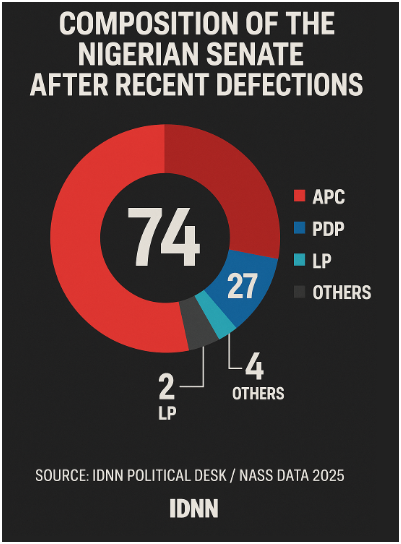
The All Progressives Congress (APC) now commands an estimated 74 of 109 Senate seats, officially crossing the two-thirds threshold that secures its dominance in the upper chamber.
The realignment follows the defection of eight PDP senators, two NNPP members, and one LP senator, who cited “irreconcilable divisions” in their parties and a desire to support “national reform alignment.”
Senate President Godswill Akpabio announced the new configuration at Tuesday’s plenary, declaring that the development “positions the 10th Senate to fast-track reforms critical to national stability.”
“We are no longer a divided chamber; we are a reform chamber,”
Akpabio said, receiving applause from the APC caucus.
🧭 Executive Confidence and Legislative Velocity
With the two-thirds mark achieved, the APC can now pass constitutional amendments, judicial confirmations, and fiscal reform bills without seeking cross-party consensus.
Presidential aides described the new configuration as “a turning point in Nigeria’s governance efficiency.”
The ruling party’s majority is expected to accelerate several key items on President Tinubu’s legislative agenda, including:
- The Electoral Act (Amendment) Bill 2026,
- The Fiscal Responsibility (Reform) Bill, and
- The Niger Delta Infrastructure Trust Fund Act.

Analysts warn, however, that such dominance could reduce institutional checks if opposition voices remain fragmented.
Political scientist Dr. Hassan Idris told IDNN:
“A supermajority gives policy speed, but it also tests internal discipline. APC must now balance unity with democratic pluralism.”
📊 Impact Snapshots
| Metric | Value | Context |
|---|---|---|
| Senate Composition | 74 APC, 19 PDP, 6 LP, 5 NNPP, 5 Others | Official plenary record |
| Majority Threshold | 73 seats (Two-thirds) | Crossed by APC |
| Legislative Agenda | Electoral Act, Fiscal Reform, Infrastructure Bills | 2025–2026 priority |
| National Impact | Stronger executive-legislative synergy | Enhanced reform velocity |
Commercial Tag — Winners & Losers
Winners:
- Private-sector lobbyists aligned with fiscal reform and deregulation agendas.
- The Tinubu administration, gaining legislative ease and investor confidence.
Losers:
- PDP and minor parties, losing bargaining leverage and committee control.
- Civil-society watchdogs, warning of reduced plural debate.
This is IDNN. Independent. Digital. Uncompromising.
