
When a ruling fractures the floor
The House rowdy session over Electoral Act rescission began as an emergency plenary convened to revisit the amendment bill passed on December 23, 2025.
Francis Waive, Chairman of the House Committee on Rules and Business, moved a motion seeking to rescind the earlier passage to allow lawmakers reconsider contentious provisions.
When Speaker Tajudeen Abbas put the motion to a voice vote, members responded audibly. Many shouted “nay.”
The Speaker ruled that the “ayes” had it.
What followed shifted the tone of the chamber.
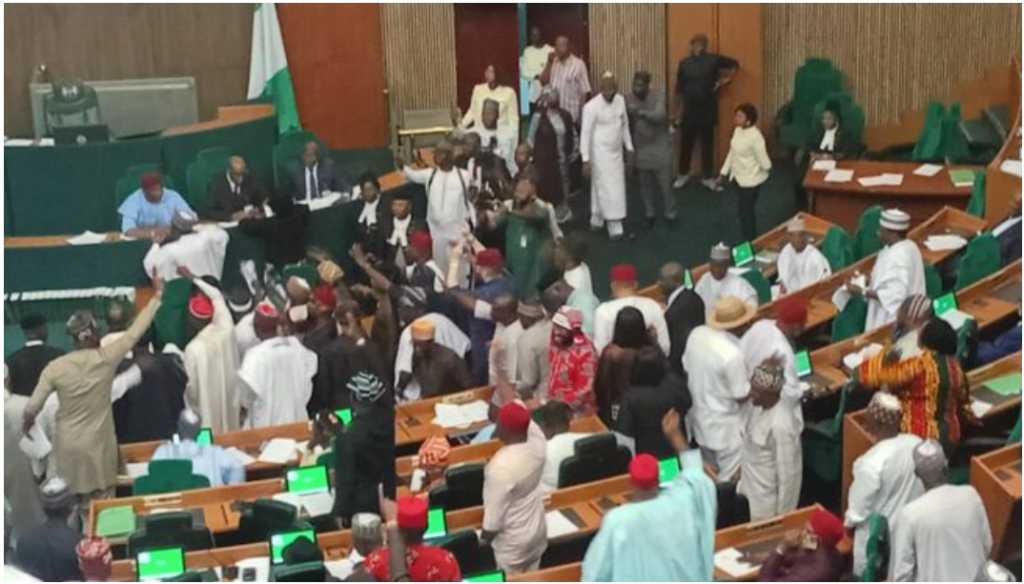
Lawmakers shout during a tense plenary session in the House of Representatives over the Electoral Act amendment.
Clause 60(3) at the centre of th
Clause 60(3) at the centre of the clash
At the heart of the confrontation lies Clause 60(3), which in the House’s earlier version mandated real-time electronic transmission of election results to the Independent National Electoral Commission’s Result Viewing Portal (IReV).
The Senate version removed the phrase “real-time,” retaining electronic transmission but allowing manual collation as fallback if technology fails.
For several lawmakers, rescinding the House position signalled a retreat from earlier safeguards.
Members rose from their seats.
Shouts intensified across the aisle.
Deputy Speaker Benjamin Kalu was momentarily prevented from proceeding.
Eventually, aggrieved members walked out of plenary.
Authority tested in open session
Voice votes are a recognised parliamentary procedure, with the presiding officer empowered to determine the outcome.
Yet in high-stakes debates, perception can rival procedure.
For lawmakers who shouted in objection, the ruling appeared to disregard chamber sentiment.
For the Speaker, it reflected constitutional authority vested in the chair.
The clash exposed tension between internal dissent and institutional control.
https://www.kapwing.com/e/69949ff40abd87e103e8fcb4
Video edited on Kapwing
Executive session, unresolved questions
In response to escalating protests, Abbas called for an executive session in an attempt to restore order and deliberate further.
Despite resistance, the House moved behind closed doors.
As of press time, the outcome of those deliberations remained unclear.
The rescission motion has now complicated harmonisation efforts between the House and Senate at a critical stage of the Electoral Act amendment process.
Ramadan timing and legislative recalibration
The confrontation unfolds alongside moves in the Senate to reconsider aspects of the amendment bill.
Senate Leader Opeyemi Bamidele cited technical inconsistencies and concerns that the 360-day notice requirement under Clause 28 could push elections into the Ramadan period.
Supporters describe reconsideration as corrective legislative action.
Critics warn that repeated reversals may erode reform certainty ahead of 2027.
Transmission language and election timing have become intertwined pressure points.
When legislative division shapes public trust
Scenes of shouting, walkouts and contested rulings do not automatically derail legislation.
But they influence how reform is perceived beyond the chamber.
If the House ultimately aligns with the Senate’s amended version, some will see recalibration.
If resistance hardens, harmonisation may stall further.
The House rowdy session over Electoral Act rescission may be remembered less for the motion itself than for the moment when dissent met authority in open plenary.
In electoral politics, such moments often echo long after the gavel falls.
This is IDNN. Independent. Digital. Uncompromising.
