
A Landslide Wrapped in Controversy
Governor Chukwuma Charles Soludo has coasted to a second term in Anambra State, securing victory across all 21 local government areas in what the Independent National Electoral Commission (INEC) described as a “peaceful and credible” exercise.
Yet, just hours after the declaration, the political atmosphere across Nigeria turned stormy. Opposition parties denounced the poll as “a cash-drenched bazaar” and warned that the brazenness of vote-buying seen in Anambra signaled deepening cracks in Nigeria’s electoral credibility ahead of the 2027 general elections.
INEC’s Returning Officer, Professor Edoba Omoregie, announced Soludo’s win with 422,664 votes, far ahead of APC’s Nicholas Ukachukwu (99,445 votes) and YPP’s Paul Chukwuma (37,753 votes). Labour Party’s George Moghalu and ADC’s John Nwosu trailed with 10,576 and 8,208 votes, respectively.
Outrage, Silence, and a Warning Shot for 2027
The African Democratic Congress (ADC) condemned the poll as “a cash-for-votes marketplace,” alleging that electoral officials and security agents watched passively as naira bundles exchanged hands.
“The exercise in Anambra was reduced to a cash-drenched spectacle,” said ADC spokesman Bolaji Abdullahi. “This undermines the very essence of democracy.”
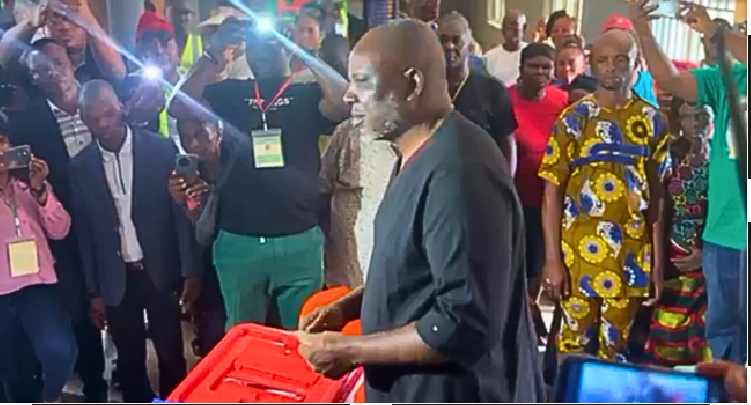
The Labour Party candidate, George Moghalu, also rejected the result, alleging that underage voters were allowed and that his party’s logo was missing on some ballots. “This election was an auction,” he told journalists.
The APC candidate, Nicholas Ukachukwu, accused thugs of intimidating his supporters and insisted that his team was “still gathering evidence of massive vote-buying.”
Observers noted that the overwhelming nature of Soludo’s victory — a clean sweep across all LGAs — echoes both his political dominance and the decay of opposition organisation in the Southeast.
Competing Narratives, Colliding Optics
President Bola Ahmed Tinubu congratulated Soludo, describing his victory as “an affirmation of visionary leadership,” and lauded INEC for conducting a peaceful election.
But the ADC and YPP called on the electoral commission to investigate allegations of vote trading and institutional inaction.
International observer Jim Oko, representing a UN-accredited group, rated the poll “very highly,” asserting that “everything was peacefully done, peacefully collated, peacefully announced.”
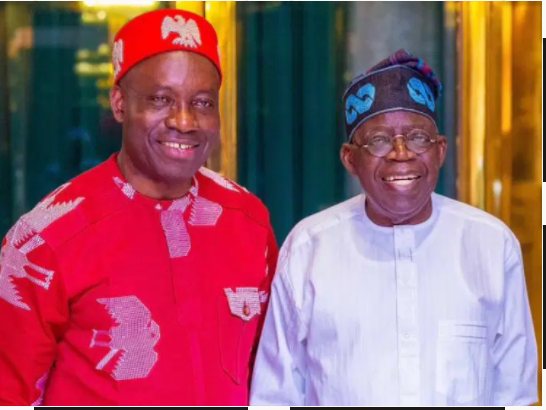
Soludo, in his victory speech, thanked INEC and President Tinubu for “ensuring a free and fair poll,” and declared:
“The people have spoken and their votes counted. This is the best election INEC has organised in Anambra so far.”
The Nigeria Governors’ Forum, in a joint message, congratulated Soludo for a “well-deserved victory,” calling it proof of his popularity and performance.
The Politics of Perception and Investment in Democracy
The Anambra outcome has reignited debates on the commodification of elections in Nigeria. Analysts warn that the growing role of money in voter decisions could distort investment perception, weaken institutional trust, and dampen youth participation.
Stakeholders now see Soludo’s second term not merely as a local victory, but a test of whether Nigeria’s democracy can still command credibility in global eyes.
From the banking halls of Awka to the corridors of Aso Rock, the question looms: Can Nigeria reform the ballot before 2027 becomes another auction?
