
Rights group seeks independent scrutiny of questionable voter-registration records as INEC works towards its previously announced December certification target.
By IDNN Politics & Governance Desk
The Socio-Economic Rights and Accountability Project (SERAP) has announced a lawsuit against the Independent National Electoral Commission (INEC) and the Nigeria Data Protection Commission (NDPC), seeking an independent investigation into suspected artificial intelligence-generated photographs and other irregularities in Nigeria’s preliminary voters’ register.
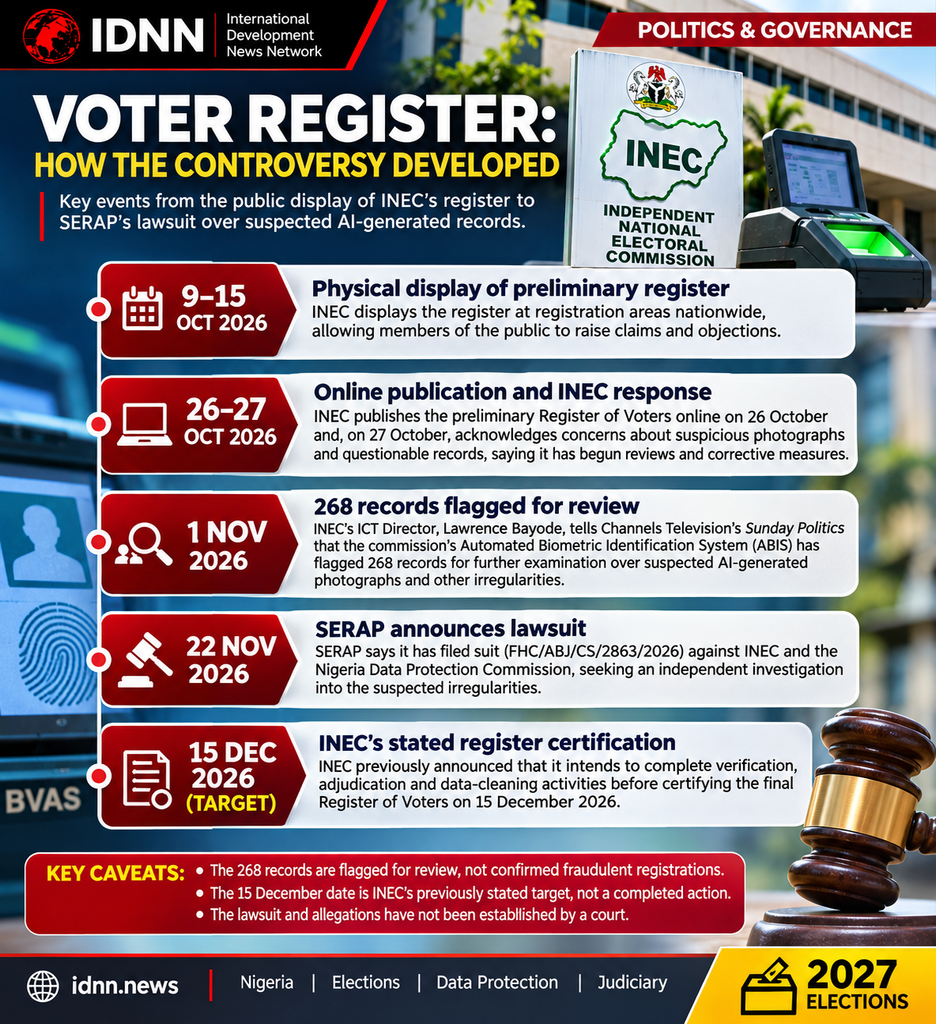
SERAP disclosed the legal action on Sunday, 22 November 2026, identifying the case as FHC/ABJ/CS/2863/2026 at the Federal High Court in Abuja.
The organisation wants the court to compel the NDPC to examine whether voters’ personal information was unlawfully accessed, altered or compromised, and whether the reported irregularities amount to violations of the Nigeria Data Protection Act 2023.
The lawsuit follows INEC’s earlier acknowledgement that questionable registration records, including photographs suspected of being artificially generated, had been identified in its preliminary register.
The allegations have not been established by a court. The filing of the lawsuit does not mean INEC officials have been found responsible for electoral fraud or data protection violations.
SERAP demands independent forensic investigation
According to SERAP’s account of the suit, the organisation is seeking an order of mandamus directing the NDPC to independently assess the reported irregularities and determine whether a formal investigation should be initiated.
SERAP also wants the regulator to obtain relevant registration documents, electronic records and other information held by INEC to establish the nature and extent of the suspected anomalies.
The organisation is seeking an examination of how questionable records entered the database, when they were created or altered, their geographical distribution and whether authorised access credentials were misused.
It also wants the NDPC to determine whether the incidents constitute a personal data breach under Section 65 of the Nigeria Data Protection Act.
SERAP argues that INEC’s internal review should not replace independent scrutiny by the country’s data protection regulator.
The requested orders are described in SERAP’s public statement. IDNN has not independently examined the authenticated court-stamped originating processes. Premium Times Nigeria
INEC flagged 268 records for examination
The controversy gained public attention after INEC published its preliminary Register of Voters online on 26 October 2026.
That followed the physical display of the register at registration areas nationwide between 9 and 15 October, during which members of the public could raise claims and objections.
INEC acknowledged concerns about suspicious photographs and questionable records on 27 October, saying it had begun reviewing the affected entries.
Speaking on Channels Television’s Sunday Politics programme on 1 November, INEC’s Director of Information and Communication Technology, Lawrence Bayode, disclosed that the commission’s Automated Biometric Identification System (ABIS) had flagged 268 records for further examination.
Bayode said INEC was investigating suspected AI-generated photographs and other registration irregularities, including possible misuse of registration procedures.
The 268 records represent entries flagged for review. They are not a confirmed count of fraudulent registrations or proven AI-generated voter identities. INEC • Channels Television
Not every AI-enhanced photograph is fraudulent
Bayode also drew a distinction between photographs generated entirely by artificial intelligence and genuine photographs enhanced using AI-enabled smartphone tools.
He explained that photographs improved by mobile-phone software would not automatically disqualify legitimate voters.
The commission’s concern includes records containing wholly artificial images and other questionable registration details that may require correction or removal.
The presence of AI-assisted image processing does not, by itself, establish voter impersonation, unlawful registration or deliberate manipulation.
INEC has said its verification process is intended to identify actual irregularities before the preliminary register becomes final. INEC • Channels Television
Data protection and election integrity under scrutiny
SERAP’s lawsuit extends the controversy beyond the accuracy of voter records to the safeguards protecting citizens’ personal information.
The organisation argues that the reported irregularities warrant independent examination of possible unlawful data processing, misuse of access credentials and failures to maintain appropriate security controls.
It has asked the court to compel the NDPC to consider corrective action and appropriate sanctions if violations are established.
SERAP also wants investigators to determine whether affected voters’ rights were compromised and whether any statutory notification obligations arose.
These remain allegations and legal arguments advanced by the organisation. No judicial finding establishing a data breach or assigning responsibility has been identified in the materials reviewed for this report. Premium Times Nigeria
December certification deadline raises questions
INEC previously announced that it intended to complete verification, adjudication and data-cleaning activities before certifying the final Register of Voters on 15 December 2026.
That date is the commission’s previously stated target, not confirmation that the process has been completed or that the timetable cannot change.
Outstanding questions include how many flagged records will ultimately be found irregular, whether additional cases will emerge and what independent regulatory scrutiny may reveal.
The outcome could also shape public confidence in the electoral register ahead of Nigeria’s 2027 general elections. Channels Television
What happens next?
SERAP’s 22 November statement said no hearing date had been fixed for the suit.
The materials reviewed for this report do not establish whether INEC or the NDPC has filed a formal response. Their positions on the specific reliefs sought therefore remain outstanding.
The next developments to watch are any court hearing notice, an official NDPC decision on the requested investigation and further disclosures from INEC concerning the records flagged by its biometric system.
For now, the established development is that SERAP has announced a legal challenge seeking independent examination of suspected voter-register irregularities.
Whether those irregularities constitute unlawful manipulation, a personal data breach or failures of institutional safeguards remains to be determined.
