
Reported October petrol inventories fell 8.2 days short of the 30-day benchmark, raising questions about national fuel supply resilience despite increased domestic deliveries and imports.
By IDNN Business Intelligence Desk
Petroleum storage and distribution infrastructureNigeria’s petrol stock coverage declined to 21.8 days in October 2026, according to regulatory figures reported by Naira Energies, falling below the reported 30-day benchmark despite increases in domestic petrol deliveries and imports.
Naira Energies, citing the October factsheet of the Nigerian Midstream and Downstream Petroleum Regulatory Authority (NMDPRA), reported on November 27 that petrol stock coverage had declined from 23.9 days in September.
IDNN calculations indicate a month-on-month reduction of approximately 8.8 per cent and a coverage shortfall of 8.2 days against the reported benchmark.
The development highlights an important challenge for Nigeria’s evolving petroleum industry: expanding domestic refining capacity does not automatically guarantee adequate national fuel reserves.
The reported figures do not, however, establish that petrol scarcity is imminent.
Nigeria’s Petrol Inventory Buffer Narrows
Stock coverage is an indicator of how long available petroleum inventories could meet consumption requirements at an assumed rate of demand without additional replenishment.
| Indicator | Stock coverage | Evidence status |
|---|---|---|
| Reported regulatory benchmark | 30 days | September NMDPRA documentation |
| September 2026 | 23.9 days | Primary regulatory documentation |
| October 2026 | 21.8 days | Reported regulatory data |
| October benchmark shortfall | 8.2 days | IDNN calculation |
Sources: NMDPRA September 2026 factsheet; October figures reported by Naira Energies and supporting media.
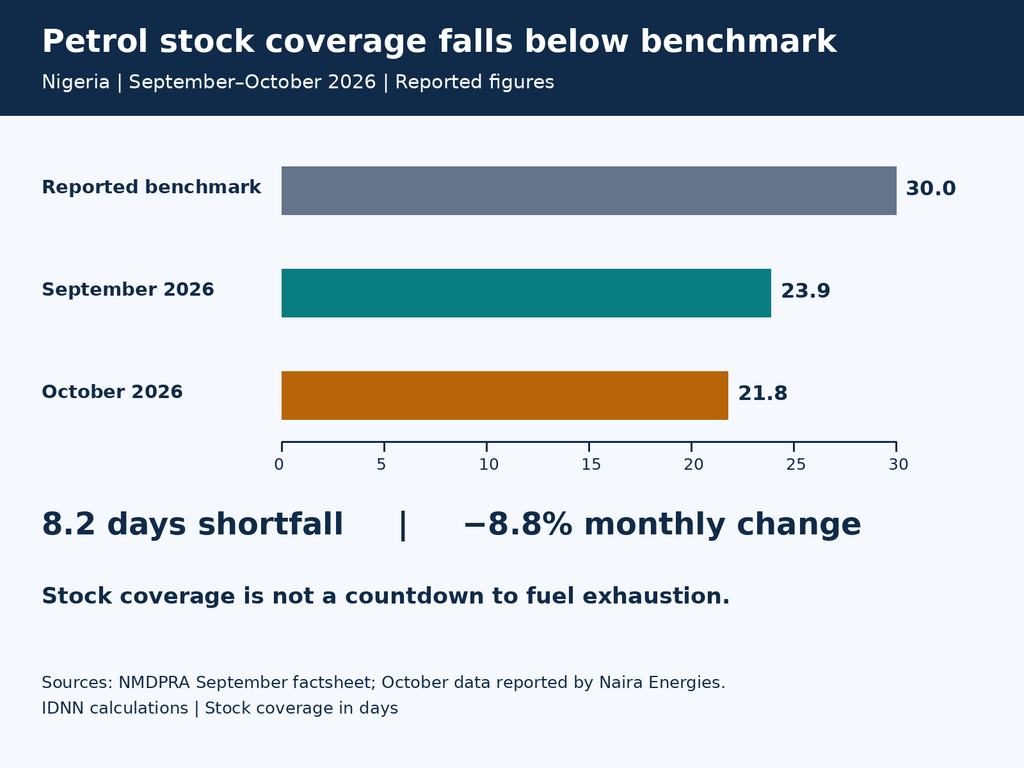
Reported petrol stock coverage declined from 23.9 days in September to 21.8 days in October 2026, below the reported 30-day benchmark.
Nigeria’s reported October petrol inventory coverage was equivalent to approximately 72.7 per cent of the benchmark.
The September NMDPRA factsheet provides direct regulatory documentation of the earlier inventory position and the benchmark. October figures are drawn from media reporting of the regulator’s subsequent factsheet.
The underlying legal provision establishing the benchmark has not been independently examined. Falling below it should therefore not be interpreted as an independently established statutory violation.
A smaller inventory buffer could reduce the flexibility available to the petroleum supply system when unexpected operational or logistical disruptions occur.
However, stock coverage is not a countdown to fuel exhaustion. Domestic production, imports and distribution continue to replenish available inventories.
Petrol Supply Increases but Stock Coverage Falls
The reported reduction in stock coverage occurred alongside an improvement in petrol receipts.
According to TheFact Daily’s November 20 report on the NMDPRA October factsheet, daily petrol receipts increased from 38.7 million litres in September to 46.9 million litres in October.
Domestic deliveries and imports both contributed to the increase.
| Petrol indicator | September 2026 | October 2026 |
|---|---|---|
| Total daily receipts | 38.7m litres | 46.9m litres |
| Domestic daily supply | 28.5m litres | 31.9m litres |
| Daily imports | 10.2m litres | 15.0m litres |
| Daily consumption | 44.4m litres | 46.5m litres |
Source: NMDPRA October figures as reported by TheFact Daily and supporting media. The original October factsheet has not been independently inspected.
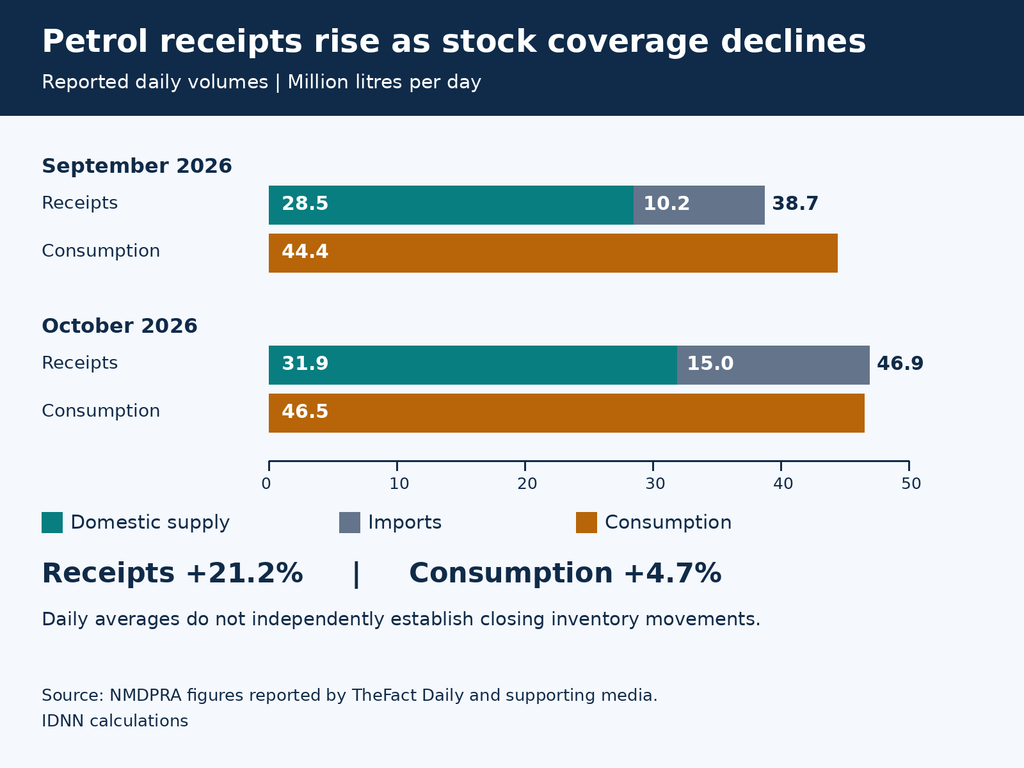
Reported daily petrol receipts increased to 46.9 million litres in October, comprising 31.9 million litres in domestic supply and 15 million litres in imports.
IDNN calculations indicate that daily petrol receipts increased by approximately 21.2 per cent, while reported daily consumption increased by approximately 4.7 per cent.
Domestic sources accounted for approximately 68 per cent of October petrol receipts, while imports contributed approximately 32 per cent.
Despite the increase in receipts, reported stock coverage declined.
The relationship between supply receipts, consumption and inventory coverage requires careful interpretation. Monthly average receipts and consumption figures do not, on their own, establish the movement in closing inventories.
A complete reconciliation would require opening and closing stock balances, the regulator’s inventory methodology and other relevant stock adjustments.
The available figures therefore establish a reported divergence between improving supply flows and declining inventory coverage, but do not fully explain its cause.
Domestic Refining Faces a Fuel Security Test
Nigeria’s expanding domestic refining capability represents an important change in the structure of its petroleum market.
However, national fuel security depends on more than installed processing capacity or refinery production volumes.
It also requires consistent domestic deliveries, adequate storage infrastructure, reliable transportation networks and sufficient contingency inventories.
Installed refining capacity represents potential production capability. Actual domestic deliveries provide a separate measure of the volume supplied to the Nigerian market.
Neither indicator independently establishes the adequacy of national petroleum reserves.
Refineries are commercial enterprises whose production and distribution decisions reflect domestic demand, operating requirements and market opportunities.
National fuel security requires coordination across producers, importers, petroleum marketers, storage operators and regulators.
The reported October stock figures therefore raise questions about the industry’s ability to translate increased refining activity into sustained supply resilience.
The available evidence does not establish that any individual refinery caused the decline in national petrol stock coverage.
Regulator Reportedly Plans Strategic Petroleum Reserves
Naira Energies reported that the NMDPRA is developing a national strategic petroleum stock programme targeting between 30 and 45 days of coverage.
According to the report, the proposed initiative was disclosed at the Business Intelligence Africa Summit in Lagos on November 26 by a representative of NMDPRA Chief Executive Rabiu Umar.
The programme would reportedly begin with selected petroleum depots before wider implementation.
A strategic petroleum reserve could provide an additional mechanism for responding to unexpected supply disruptions.
Its effectiveness would depend on how the reserves are financed, accumulated, maintained and released during emergencies.
The original regulatory announcement and implementation framework have not been independently inspected.
The available reporting does not establish a confirmed implementation timetable, funding structure or volume of petroleum products already committed to the programme.
The reported 30-to-45-day target must also be distinguished from the existing 30-day stock coverage benchmark.
The proposed reserve should therefore be treated as a reported policy initiative under development rather than an operational national emergency stockpile.
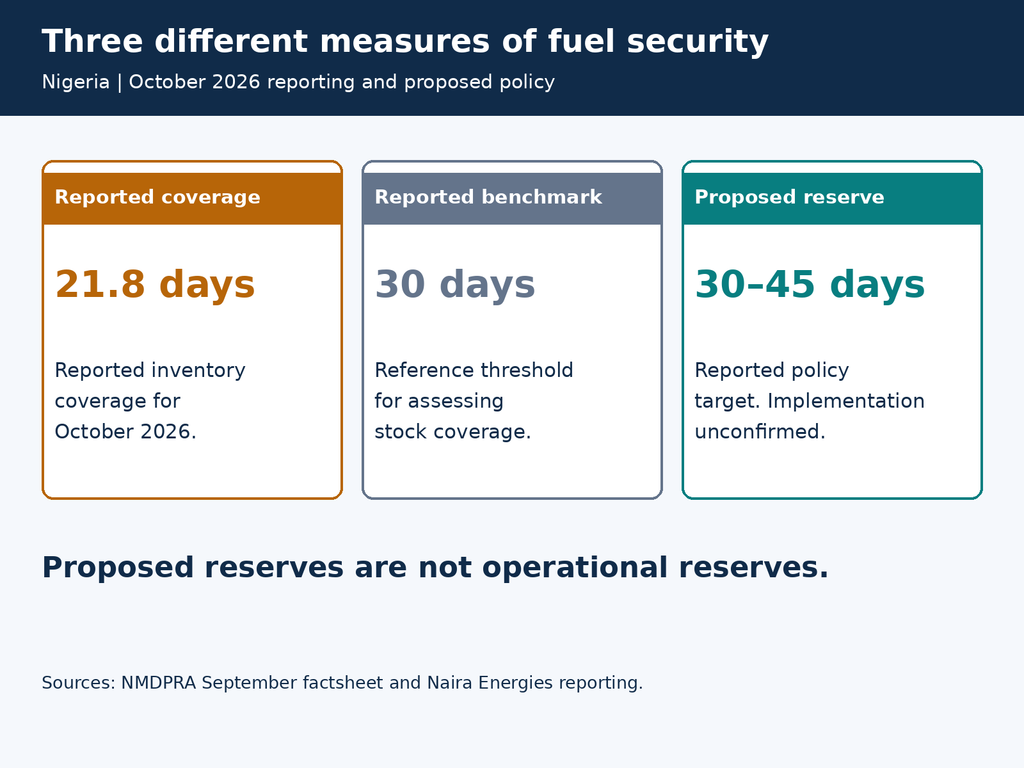
The reported strategic petroleum stock programme targets 30–45 days of coverage. Implementation remains unconfirmed.
What Lower Petrol Stock Coverage Means for Businesses
A narrower petroleum inventory buffer could increase the economy’s exposure to unexpected supply disruptions.
Businesses with significant transport, logistics and independent power-generation requirements may be particularly sensitive to interruptions in petroleum availability.
Potential transmission channels include:
- Transportation: Higher transportation and distribution expenses if supply disruptions occur.
- Operating expenses: Increased operating costs for businesses dependent on petrol-powered equipment.
- Commercial logistics: Pressure on commercial inventories and delivery schedules.
- External exposure: Greater exposure to international petroleum prices and foreign exchange conditions where imports remain necessary.
These are potential economic consequences, not confirmed outcomes attributable to October’s reported reduction in stock coverage.
The available figures do not establish that the inventory decline has caused nationwide petrol shortages or an increase in pump prices.
Consumers should also distinguish between national stock coverage and actual fuel availability at individual filling stations.
The Next Test: From Refining Capacity to Supply Resilience
Nigeria’s petroleum industry must increasingly be assessed not only by the quantity of fuel produced domestically but also by the reliability of supplies available to the domestic market.
The reported increase in October petrol receipts represents a positive development.
Nevertheless, reported inventory coverage remained below the benchmark despite improved supply flows.
The challenge for regulators and industry operators is to establish a sustainable balance between domestic production, commercial distribution, imports and contingency reserves.
Further regulatory documentation and evidence of implementation of the proposed strategic petroleum stock programme will be important indicators of progress.
For Nigeria, the next stage of petroleum-sector development is not simply greater refining capacity. It is a more resilient national fuel supply system.
