
Nigeria meets OPEC quota for fourth month as output remains below 2026 budget target
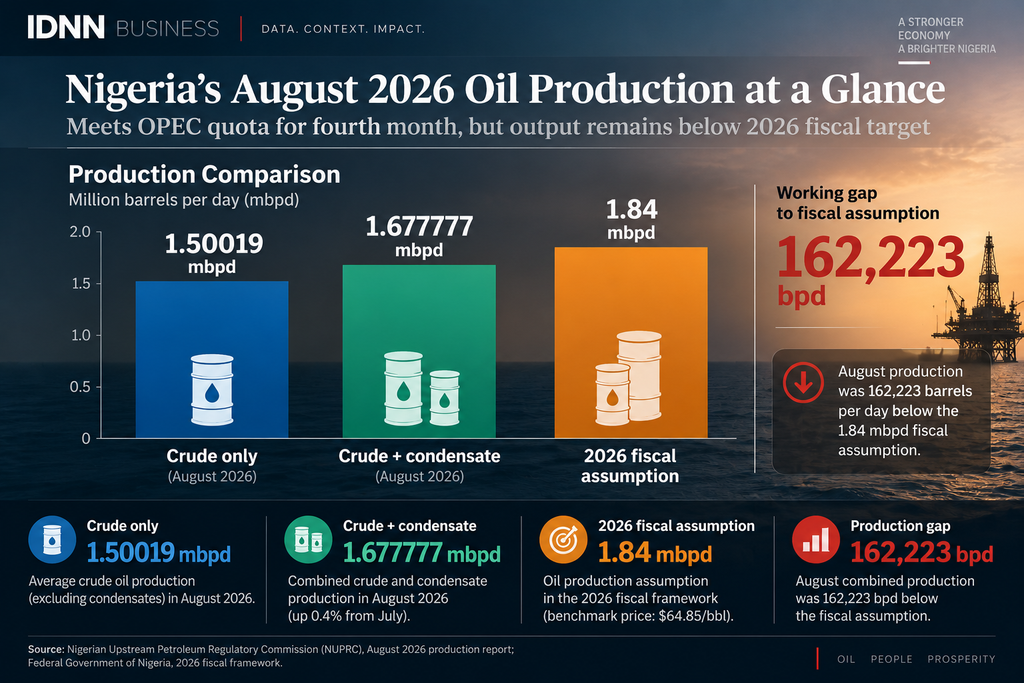
Nigeria produced 1.50019 million barrels of crude per day in August, meeting its OPEC quota for a fourth consecutive month. But combined crude and condensate output of 1.677777 million barrels per day remained below the 1.84 million-barrel-per-day assumption in the 2026 fiscal framework.
Nigeria met its Organisation of the Petroleum Exporting Countries crude oil production quota for a fourth consecutive month in August, while total oil output remained below the level assumed in the Federal Government’s 2026 fiscal framework.
The Nigerian Upstream Petroleum Regulatory Commission said average crude oil production, excluding condensates, stood at 1,500,190 barrels per day in August.
Combined crude oil and condensate production averaged 1,677,777 barrels per day, up 0.4 per cent from July.
The figures mean Nigeria again met its OPEC crude quota of about 1.5 million barrels per day, extending the run to four months.
OPEC target met, but fiscal target remains higher
Meeting the OPEC quota does not mean Nigeria has reached the production level underlying its 2026 budget.
The fiscal framework is based on oil production of 1.84 million barrels per day and an oil-price benchmark of $64.85 per barrel.
Measured against combined August crude and condensate output of 1.677777 million barrels per day, production was about 162,223 barrels per day below the fiscal assumption.
That distinction is important.
OPEC compliance measures Nigeria’s crude production against its organisation-assigned quota, while the fiscal benchmark is used in government revenue planning and is not presented here as an identical crude-only measure.
Bonny and Forcados lead terminal output
NUPRC said combined crude and condensate production ranged between 1.64 million and 1.71 million barrels per day during August.
Bonny recorded the highest average terminal and stream output at about 320,040 barrels per day, followed by Forcados at 317,400 barrels per day.
Qua Iboe averaged 171,720 barrels per day, while Escravos recorded about 131,710 barrels per day.
Sustaining output is now the bigger test
The August improvement was modest in percentage terms, but sustaining crude production around the OPEC ceiling marks a stronger operating position after years in which theft, infrastructure failures, operational disruptions and underinvestment constrained Nigerian output.
The economic question now is whether producers can maintain quota-level crude production while adding enough output to narrow the gap with the fiscal benchmark.
That matters because oil production remains one of the assumptions underpinning federal revenue expectations.
However, a production gap should not automatically be translated into an equivalent government revenue loss. Actual fiscal receipts also depend on oil prices, lifting volumes, ownership and entitlement structures, condensate treatment, production costs, taxes and other fiscal variables.
The August figures therefore show two things at once: Nigeria has sustained crude output at its OPEC quota for four consecutive months, but combined production remains below the level assumed in the 2026 budget framework.
The next test is whether September output can remain at or above the quota level while new and restored capacity pushes combined production closer to the government’s fiscal target.
Intelligence Watch
IDNN will track September crude and condensate production, terminal-level performance, outages, restoration activity and any change in Nigeria’s OPEC production allocation.
The key fiscal indicator is whether sustained production gains begin to close the gap between actual combined output and the 1.84 million-barrel-per-day assumption underpinning the 2026 fiscal framework.
