
- Nigeria will return to FTSE Russell’s Frontier Market classification on September 21 after the index provider maintained the upgrade following scrutiny of the country’s new T+1 settlement system.
Nigeria’s Frontier return remains on schedule
Nigeria will return to FTSE Russell’s Frontier Market classification on September 21 after the global index provider confirmed that the country’s reclassification remains on schedule following scrutiny of its new T+1 settlement system.
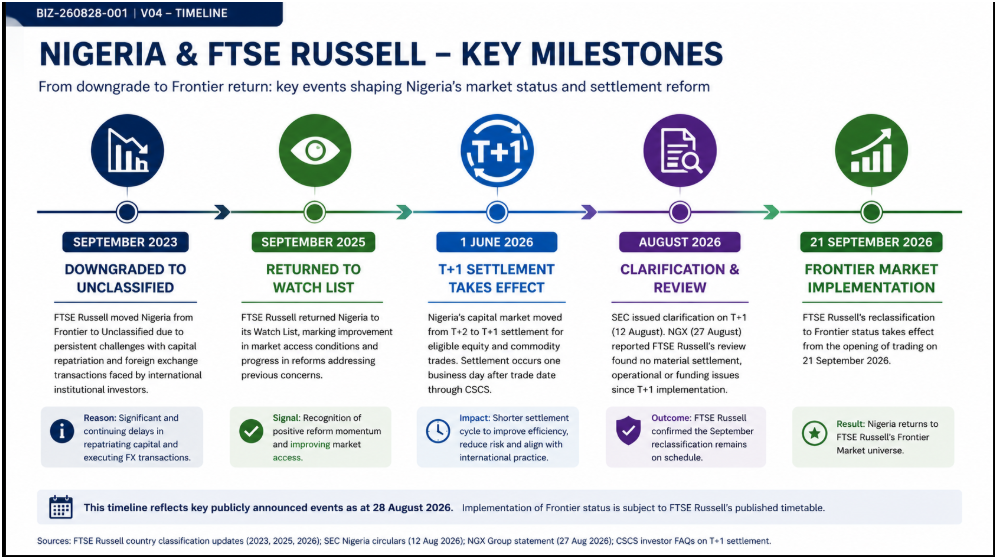
The decision restores Nigeria to the Frontier Market universe three years after FTSE Russell removed the country over persistent difficulties faced by international investors trying to repatriate capital and execute foreign-exchange transactions.
FTSE Russell confirmed in its 2026 interim review that Nigeria had met the five Quality of Markets criteria required for Frontier status, citing market feedback that earlier foreign-exchange queues had been cleared and international institutional investors were no longer experiencing material delays in repatriating capital.
The reclassification will take effect from the opening of trading on Monday, September 21, 2026.
T+1 raised a fresh market-access question
Nigeria’s return was subsequently subjected to another operational test after the capital market moved from T+2 to T+1 settlement on June 1.
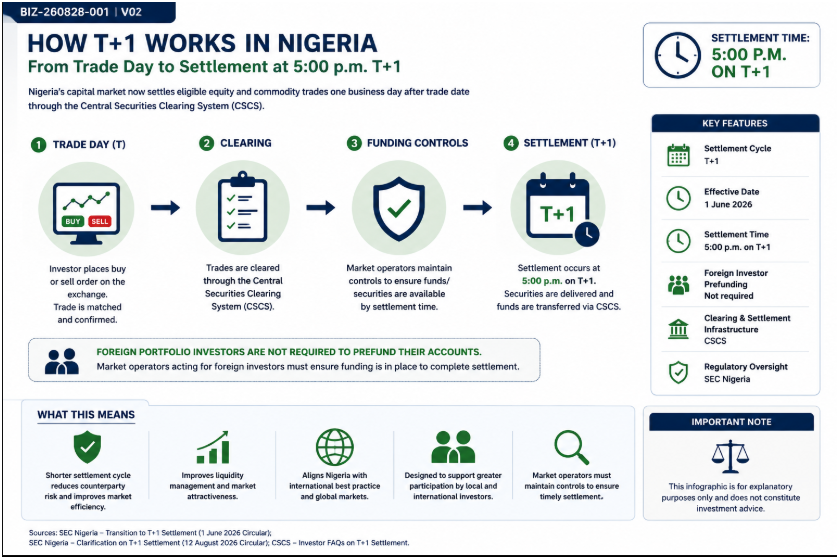
Under the new system, eligible equity and commodity trades cleared through the Central Securities Clearing System are settled one business day after the trade date.
The Securities and Exchange Commission said the shorter cycle was intended to improve market efficiency, reduce counterparty exposure, strengthen liquidity and align Nigeria more closely with international market practice.
But the shift raised concerns among international market participants about whether foreign portfolio investors could, in practice, be required to fund trades before settlement — an issue that could have weakened Nigeria’s accessibility to global institutional capital.
NGX Group said on August 27 that FTSE Russell had carried out a further assessment after those concerns emerged and had engaged with Nigerian regulators, market infrastructure providers and international investors.
According to NGX, FTSE Russell concluded that no material settlement, operational or funding problems had been observed since T+1 was introduced and confirmed that the September reclassification would proceed.
SEC says foreign investors do not have to prefund
A separate SEC clarification issued on August 12 addressed one of the central concerns directly.
The regulator said equities and commodities settled at CSCS reach settlement at 5 p.m. on T+1 and explicitly stated that foreign portfolio investors are not required to prefund their accounts.
Market operators acting for foreign investors must instead maintain controls that ensure funding is available in time to complete settlement.
That distinction matters because a formal or de facto prefunding requirement can increase operational friction for large international investors, particularly those trading across multiple markets and custody systems.
Key settlement facts
| Item | Position |
|---|---|
| Settlement cycle | T+1 |
| Effective date | June 1, 2026 |
| Settlement time | 5 p.m. on T+1 |
| Foreign investor prefunding | Not required |
| Market infrastructure | CSCS |
Why Frontier status matters
FTSE country classifications are used by international asset managers and benchmark-driven investors to assess whether markets meet minimum standards for accessibility, settlement, custody and capital movement.
Nigeria’s return therefore does not itself guarantee an immediate surge in foreign portfolio investment.
It does, however, remove an important classification barrier and puts Nigerian equities back within the investable Frontier Market framework used by FTSE Russell.
The stronger signal is the combination of three developments: improved foreign-exchange access, the clearing of reported repatriation constraints and the market’s ability, so far, to operate the faster T+1 settlement regime without material problems being identified in the assessment described by NGX.
A reversal of the 2023 downgrade
FTSE Russell moved Nigeria from Frontier to Unclassified status in September 2023 because international institutional investors were experiencing significant and continuing delays in repatriating capital and executing foreign-exchange transactions.
Nigeria was later returned to FTSE Russell’s Watch List before the index provider confirmed the planned upgrade.
The September 21 implementation will therefore mark a reversal from loss of investable-market status to renewed recognition as a Frontier Market.
What investors should watch next
The classification change should not be read as proof that every obstacle facing foreign investors has disappeared.
Foreign-exchange liquidity, settlement performance, repatriation, market depth and policy stability will continue to determine whether the formal improvement in market classification translates into sustained foreign capital participation.
For Nigeria, September 21 will be an important live test of whether improvements in market infrastructure and access can hold under renewed international investor scrutiny.
Intelligence Watch
Next catalyst: September 21, 2026 implementation of FTSE Frontier classification.
Watch variables:
Foreign portfolio flows
FX liquidity and repatriation
T+1 settlement failures or exceptions
Market turnover and breadth
Custodian feedback
FTSE implementation notices
SEC or NGX operational updates
