
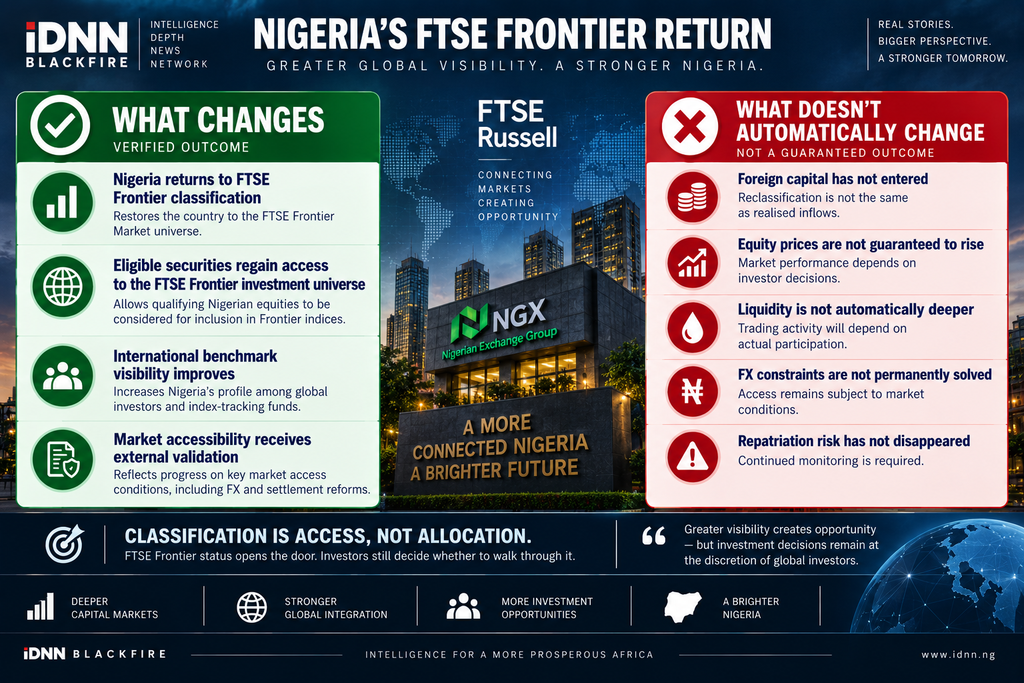
Nigeria returns to FTSE Russell’s Frontier Market classification on September 21 after improvements in market accessibility, but the upgrade does not itself guarantee foreign capital inflows
Nigeria will return to FTSE Russell’s Frontier Market classification when markets open on Monday, September 21, restoring the country to a global investment universe three years after foreign-exchange and capital-repatriation difficulties contributed to its move into unclassified status.
FTSE Russell has confirmed the reclassification after improvements in Nigeria’s market accessibility, while the Nigerian Exchange says the change remains on schedule following an additional review of the country’s new T+1 settlement cycle.
The decision is significant because FTSE’s Frontier indices are used as benchmarks and as the basis for index-tracking investment products.
But the classification change does not mean foreign investment has already entered Nigeria.
It improves the country’s position within an international investment framework. Whether that translates into meaningful capital inflows will depend on investor allocations, market liquidity, valuations, foreign-exchange conditions and the ability of international investors to move money into and out of the market.
Nigeria reverses its 2023 demotion
Nigeria was moved from Frontier to Unclassified status in September 2023 amid concerns about market accessibility, particularly difficulties affecting foreign-exchange transactions and the repatriation of capital by international investors.
FTSE Russell subsequently reported improvements in those conditions, including the clearing of FX queues and a reduction in material delays experienced by international institutional investors seeking to repatriate capital.
Those improvements supported the decision to restore Nigeria to Frontier status.
FTSE Russell formally confirmed that the reclassification would take effect from market open on September 21.
The decision therefore represents more than a change of label.
It indicates that one of the major global index providers now considers Nigeria sufficiently accessible to return to its Frontier classification framework.
Settlement concerns triggered another test
Nigeria still faced another test before implementation.
Following the Nigerian market’s transition from a T+2 to a T+1 settlement cycle on June 1, FTSE Russell conducted an additional assessment after market participants raised concerns that the new structure could create what amounted to a prefunding requirement for international institutional investors.
That issue matters because an investor may theoretically have access to a market while still facing operational obstacles that make executing and settling trades difficult.
NGX Group said the subsequent review involved engagement among the exchange, Securities and Exchange Commission, FTSE Russell and international market participants.
On August 27, NGX announced that FTSE Russell had confirmed the September reclassification would proceed after its assessment found no material settlement, operational or funding problems since implementation of T+1.
The September 21 transition is therefore moving ahead after both the broader market-access review and an additional test of Nigeria’s new settlement structure.
What Frontier status actually changes
FTSE Russell classifies equity markets according to factors affecting their accessibility to international investors.
Its Frontier Index Series covers eligible securities across Frontier markets and is designed for use as an investment benchmark and as the basis for index-tracking products.
Nigeria’s return therefore restores a route through which qualifying Nigerian equities can again become part of the FTSE Frontier investment universe.
That can increase visibility among international asset managers, benchmark-aware funds and investors whose mandates are structured around recognised index classifications.
It can also strengthen the ability of Nigerian companies and market authorities to present the country as an investable market within a globally recognised framework.
But classification is access, not allocation.
An index provider can make Nigeria eligible for a particular investment universe. It cannot compel a global portfolio manager to buy Nigerian shares.
The foreign-capital test starts after September 21
The more important question will emerge after implementation.
Does Frontier status produce sustained foreign participation?
Nigeria will have to demonstrate that the improvements which supported its reclassification survive real-world market pressure.
Foreign investors will continue to assess the depth and reliability of the FX market, the ability to repatriate proceeds, settlement efficiency, transaction costs, liquidity, corporate governance, policy stability and the valuations available on Nigerian equities.
Those considerations will help determine whether Nigeria’s renewed index visibility becomes actual deployed capital.
NGX has framed the next phase in similar terms, saying the opportunity is to translate increased international visibility into broader participation, deeper liquidity and more capital for Nigerian businesses.
That distinction is crucial.
Reclassification is confirmed. Capital inflow is an outcome still to be measured.
Nigeria has changed some of its market infrastructure
The return also follows a series of changes to Nigerian market infrastructure.
NGX moved the equities market to T+1 settlement in June, reducing the period between transaction and settlement.
Earlier in 2026, the exchange also expanded its trading window to run from 9:00 a.m. to 4:00 p.m. WAT, saying the change was intended to improve liquidity, price discovery and investor access.
FTSE Russell’s decision does not certify that every weakness in Nigeria’s capital market has disappeared.
NGX’s earlier assessment of the reclassification acknowledged areas still requiring development, including FX-market depth, transaction costs, derivatives availability and elements of custody and clearing infrastructure.
The September return should therefore be read as recognition of improved accessibility rather than proof that Nigeria has reached the market depth or infrastructure of an emerging or developed market.
A second global index provider is also watching Nigeria
Nigeria’s international classification story extends beyond FTSE Russell.
S&P Dow Jones Indices has placed Nigeria on its 2027 Country Classification Watchlist for possible movement from Standalone to Frontier Market status.
That is not an upgrade.
It means another major index provider is assessing whether changes in Nigeria’s market structure justify a future classification change.
Together, the developments increase international scrutiny of whether Nigeria’s recent market reforms are durable.
What happens on September 21
The FTSE reclassification becomes effective from the opening of trading on Monday.
The immediate story will be the technical implementation.
The larger Business Intelligence story begins afterwards: which Nigerian securities gain relevant index exposure, whether foreign trading activity changes, whether liquidity deepens, and whether capital can continue to move through the FX and settlement systems without the restrictions that contributed to Nigeria’s 2023 demotion.
Those are measurable outcomes.
Nigeria has won back its place in FTSE Russell’s Frontier Market classification.
It must now prove that restored access can translate into sustained investment.
