
Nigeria has opened 40 oil and gas blocks to investors in its 2026 licensing round, but the bigger economic test is whether successful bids translate into capital deployed, wells drilled and new production.
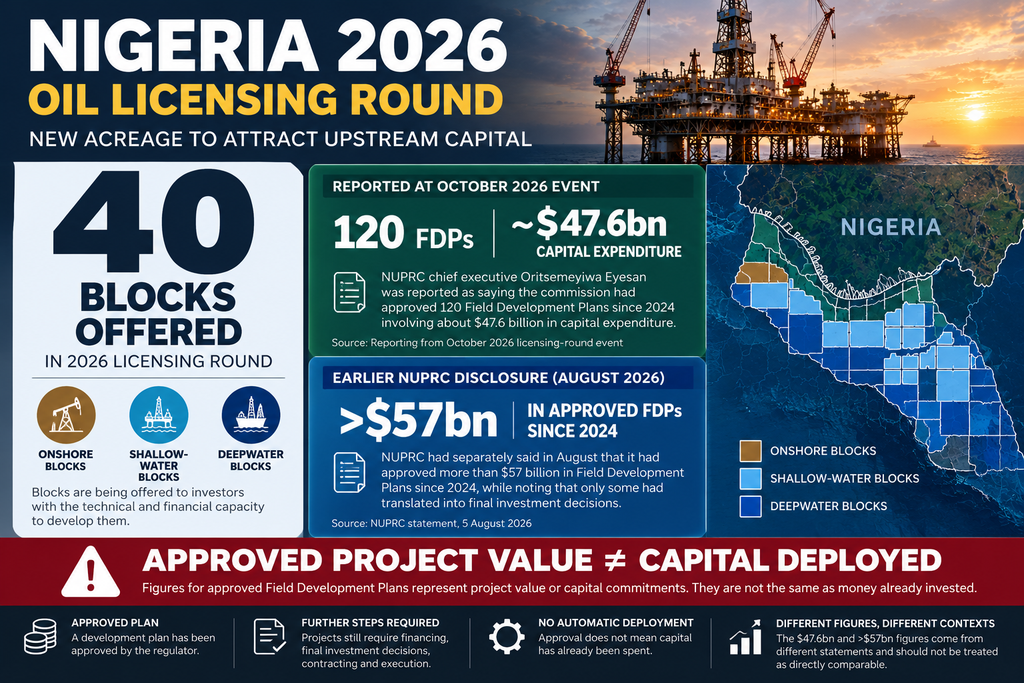
Nigeria has opened 40 oil and gas blocks to investors in its 2026 licensing round, launching another push for upstream capital as the government seeks to turn available acreage into new drilling, production and reserves.
The Nigerian Upstream Petroleum Regulatory Commission announced the round in Abuja, with assets spread across land, shallow-water and deepwater terrain.
But the bigger test will come after licences are awarded.
Nigeria has run successive licensing rounds in recent years, while the regulator has increasingly stressed that winning acreage must translate into investment decisions, rigs moving to fields and eventual production.
At the commercial bid conference for the 2025 licensing round, NUPRC chief executive Oritsemeyiwa Eyesan said investor confidence had to be matched by investment decisions, capital deployment, movement of rigs and new production.
The new 40-block offer therefore lands amid a broader regulatory push to move the upstream industry from licence acquisition towards development.
$47.6bn is not the same as money already deployed
Eyesan was reported as saying NUPRC had approved 120 Field Development Plans since 2024 involving about $47.6 billion in capital expenditure.
That figure should not be read as proof that $47.6 billion has already been invested in Nigerian projects.
An approved Field Development Plan can still require financing, a final investment decision, contracting and physical execution before the associated capital is fully deployed.
NUPRC had separately said in August that it had approved more than $57 billion in Field Development Plans since 2024, while noting that only some had translated into final investment decisions.
The difference between the reported $47.6 billion figure and NUPRC’s earlier figure of more than $57 billion means the numbers should not be treated as directly interchangeable without clarity on scope and reporting basis.
What matters for the economy is not simply the value attached to approved plans, but how much capital ultimately reaches projects and produces commercial output.
Previous round shows why winning a bid is only the start
The 2025 licensing round shows the gap between bidding success and actual development.
NUPRC said 143 companies submitted 200 bids for 37 of the 50 blocks originally offered, with 31 companies emerging as winners of 37 blocks.
Even then, the companies had not automatically received final awards.
The regulator said final awards would follow only after payment of the required signature bonuses and approval by the Minister of Petroleum Resources under the Petroleum Industry Act.
That distinction strengthens the central issue facing the 2026 round: a successful bid is not the same as a producing asset.
Investors face a tougher performance test
NUPRC has said it wants licensing rounds to become predictable and periodic, giving investors regular access to acreage while linking that access more firmly to performance.
The regulator had already signalled that the 2026 round would follow the conclusion of the preceding exercise.
The policy direction is increasingly clear: Nigeria wants to keep opening acreage to capital while demanding that licence holders convert awards into work programmes and production.
For investors, that creates a two-sided proposition.
The government is offering new opportunities across different terrains, but the value of those opportunities depends on regulatory predictability, commercial terms, access to finance and the ability to move projects through the development cycle.
Why the 2026 licensing round matters
Nigeria’s upstream challenge is no longer simply finding companies willing to bid for oil blocks.
The economic question is how quickly successful bidders can move through appraisal, financing, final investment decisions and development into commercially sustainable production.
That matters for government revenue, foreign-exchange earnings, local contracting, employment and the country’s ability to sustain crude and gas output over the longer term.
Global competition for that capital is also intense. Deepwater and frontier projects require large upfront expenditure, long development schedules and confidence that fiscal and regulatory terms will remain stable through the investment cycle.
The number to watch is not 40
Forty blocks make the announcement large.
They do not determine whether the round succeeds.
The meaningful indicators will come later: how many qualified bidders enter, how many blocks attract competitive bids, how many awards survive contracting conditions, how much approved capital reaches final investment decisions, how many rigs move and how much incremental production eventually reaches the market.
For the 2026 round, the commercial story starts with 40 blocks.
The economic result will be measured in capital actually deployed, wells actually drilled and oil and gas actually produced.
