
The gates where reform meets resistance
Protesters gathered once again at the National Assembly complex as harmonisation talks over the Electoral Act amendment stalled inside.
The NASS protest return over real-time transmission unfolded while conference committee members struggled to reconcile differences between the Senate and the House of Representatives on Clause 60(3).
Security personnel restricted entry as demonstrators demanded one outcome: restore the words “real-time.”
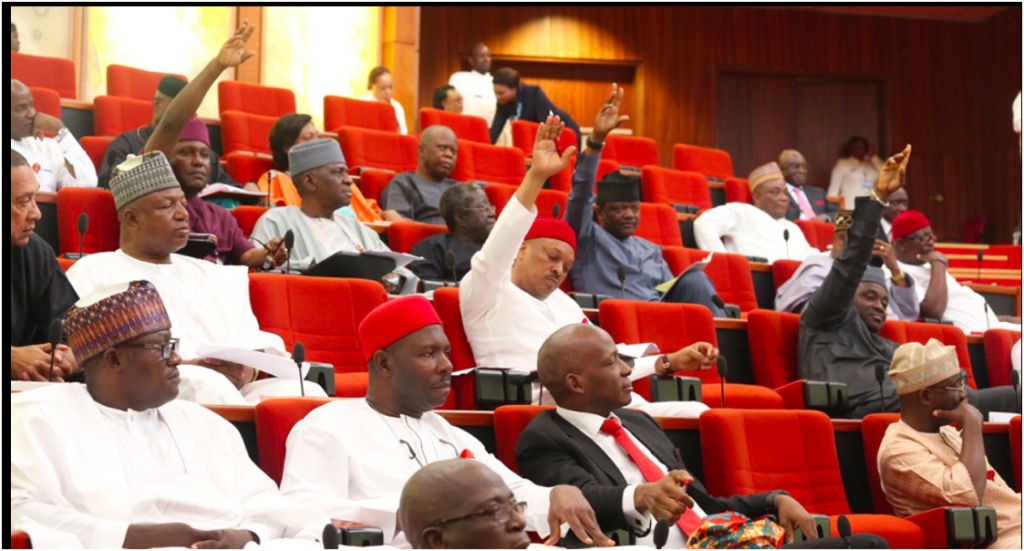
The negotiators now under spotlight
The pressure is no longer abstract.
The Senate version of the bill removed the phrase “real-time,” retaining electronic transmission but allowing flexibility in implementation. That amendment emerged from a chamber where Senate Chief Whip Tahir Monguno had moved to replace “transmission” language with more discretionary wording, a move that drew objection from senators including Enyinnaya Abaribe.
The harmonisation committee, chaired on the Senate side by Simon Bako Lalong, now carries the burden of reconciling the divergence.
Outside the chamber, protesters have effectively placed those negotiators under public scrutiny.

Civil society versus legislative discretion
Groups including Situation Room and ActionAid argue that electronic transmission without real-time upload weakens reform safeguards.
For activists, manual collation as fallback is not contingency planning — it is vulnerability.
Lawmakers defending flexibility cite connectivity constraints and implementation risks in remote areas.
The divide is therefore not simply ideological.
It is a contest between administrative caution and civic assurance.
Where power calculations intersect with perception
Clause 60(3) is now a test of institutional posture.
Restoring mandatory real-time transmission shifts the burden to infrastructure performance. Removing it shifts the burden to public trust management.
The NASS protest return over real-time transmission has inserted that calculation into open political space.
As plenary approaches, negotiators must now weigh not only technical feasibility but public optics.
When negotiation silence fuels public suspicion
As of press time, no senior member of the harmonisation committee had publicly addressed Monday’s protest.
That silence has widened the perception gap between legislative negotiation and civic expectation.
In electoral reform, perception often crystallises before law is finalised.
The NASS protest return over real-time transmission therefore represents more than street action.
It marks the moment when pressure moved from observers to decision-makers — and when Clause 60(3) became a visible test of institutional resolve ahead of 2027.
This is IDNN. Independent. Digital. Uncompromising.
