
The electoral commission says its review uncovered substantial registration irregularities ahead of the 2027 elections, while a discrepancy in the reported figures remains unresolved.
Nigeria’s Independent National Electoral Commission (INEC) says it has removed more than 1.6 million invalid voter registrations following a review of records collected during the 2025–2026 Continuous Voter Registration exercise.
The commission also identified 54 registration personnel across 10 states for investigation over suspected breaches of registration procedures.
INEC Chairman, Professor Joash Amupitan, announced the findings in Abuja on Monday, November 9, according to reports by TheCable, Premium Times and other Nigerian publications.
The announcement comes as preparations continue for the 2027 general elections, placing attention on the accuracy of Nigeria’s voter register and the safeguards intended to protect eligible voters.
However, figures attributed to the commission contain a numerical discrepancy requiring clarification.

What INEC’s Registration Figures Show
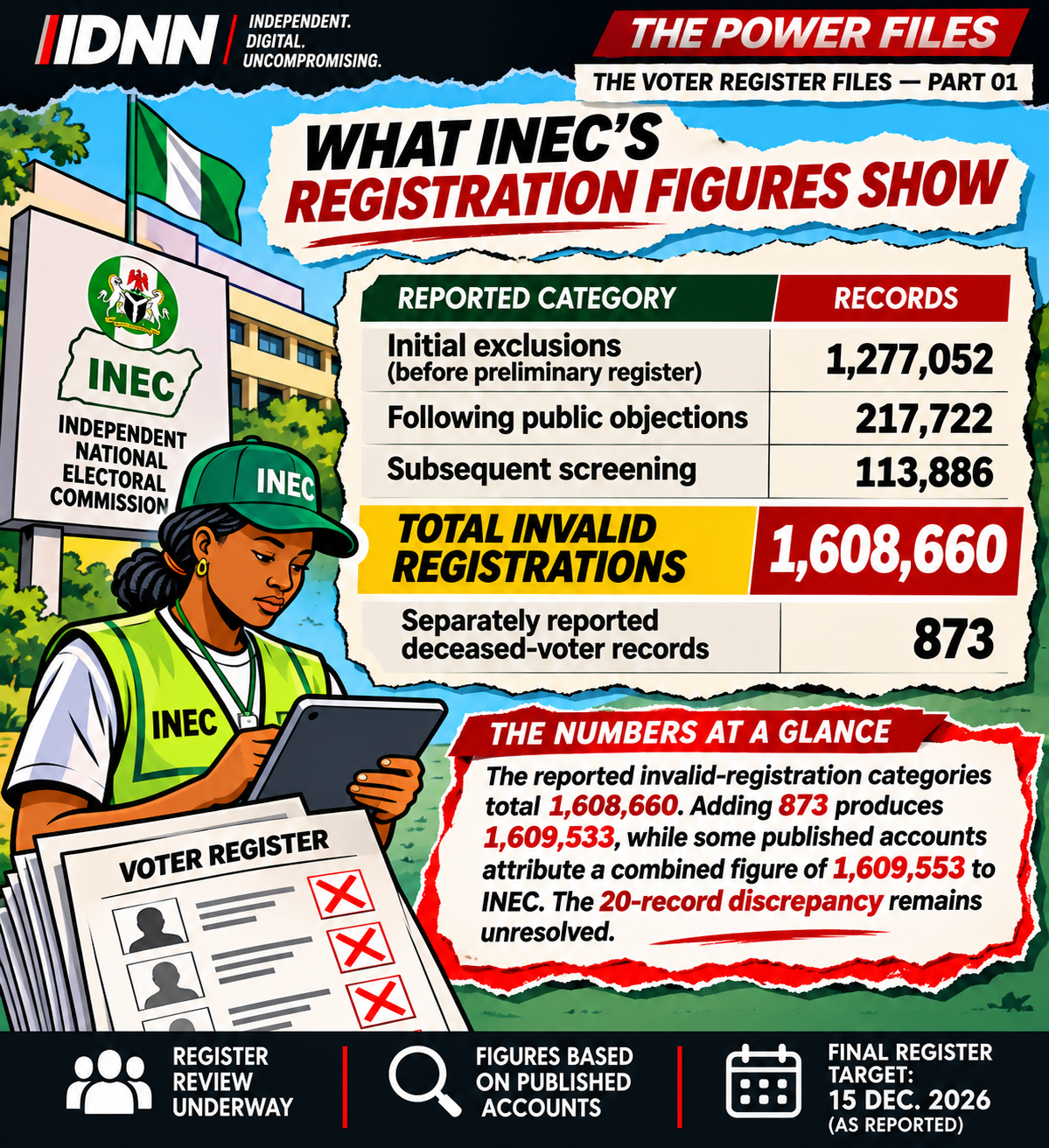
According to published accounts of the announcement, INEC reported removing 1,608,660 invalid registrations through several stages of examination.
The reported breakdown comprises:
- 1,277,052 records excluded before publication of the preliminary register.
- 217,722 records removed following public objections.
- 113,886 records identified through subsequent screening.
Together, these categories total 1,608,660.
The commission also reportedly removed 873 records belonging to verified deceased voters.
Several publications attributed a combined removal figure of 1,609,553 to INEC.
However, adding 873 to 1,608,660 produces 1,609,533 — a difference of 20 records.
The discrepancy does not establish which reported figure is incorrect or whether the categories were intended to be combined in that manner.
Clarification from INEC’s original statement is required before a definitive combined total can be established.
The central announcement remains that the commission reported removing more than 1.6 million invalid registrations.
How INEC Screened the Register
The review reportedly involved automated biometric screening, examination of suspicious records and consideration of objections raised during the public display of the preliminary register.
INEC’s Automated Biometric Identification System is designed to identify records requiring further examination.
A biometric flag does not automatically establish that a registration is invalid or fraudulent.
Additional checks may be required before officials determine whether a record should be retained or removed.
According to published accounts, 1,545,052 records were initially flagged for examination.
The commission also reportedly examined 268,000 cases associated with public objections, retaining 50,278 records cleared as valid.
The precise relationship between these screening figures and the final deletion categories remains subject to confirmation from INEC’s original briefing.
The distinction matters because registration screening must identify invalid records without incorrectly excluding eligible voters.
Fifty-Four Personnel Identified for Investigation
INEC also identified 54 registration personnel across 10 states for investigation over suspected procedural irregularities.
According to published reports, the commission indicated that disciplinary measures could follow, including possible prosecution where warranted.
The complete list of affected states has not been independently established by IDNN.
Neither has the current status of any formal disciplinary or criminal proceedings involving the personnel.
Being identified for investigation does not establish wrongdoing or criminal guilt.
The development nevertheless raises questions about supervision, compliance with registration procedures and safeguards intended to prevent irregular records from entering the system.
Establishing how the reported breaches occurred will require documentary evidence and responses from the relevant institutions.
Why the Clean-Up Matters for 2027
The accuracy of the voter register is central to election administration.
It determines which citizens are recognised as registered voters and supports preparations for polling operations.
Invalid or duplicate records can create administrative difficulties and undermine confidence in electoral processes.
Removing records confirmed to be invalid may improve the register’s accuracy.
However, the scale of the deletions does not independently establish that fraudulent votes were cast or that previous election results were affected.
The immediate question is whether INEC’s procedures can reliably distinguish invalid registrations from legitimate voter records.
That includes the effectiveness of biometric screening, manual review, public objections and supervisory oversight.
What Protections Exist for Eligible Voters?
The clean-up also raises questions about safeguards available to citizens whose registration records may be questioned or incorrectly excluded.
Eligible voters need reliable information about how to confirm their registration status and seek corrections through authorised procedures.
INEC’s current guidance on these processes will be important as preparations for the 2027 elections continue.
IDNN has not established that legitimate voters were wrongly removed during the latest exercise.
Any such claim would require documented cases and examination of the relevant records.
Transparent procedures for reviewing disputed registrations remain important to protecting legitimate voting rights.
Questions About Earlier Registration Exercises
Published accounts of INEC’s announcement also refer to irregular records associated with registration exercises conducted between 2011 and 2023.
The precise scope of those historical records and their relationship to the latest clean-up require further examination.
If confirmed, the historical dimension would raise questions about how registration controls have evolved and whether earlier weaknesses have been addressed.
Those questions warrant documentary investigation rather than conclusions based solely on the latest figures.
What Happens Next?
The November 9 announcement follows earlier stages of the Continuous Voter Registration exercise, including public display of preliminary records and examination of objections.
Several publications report that INEC expects to publish the final register on December 15, 2026.
The precise timetable remains subject to confirmation from the commission.
Further official information will also be needed on the investigation involving the 54 personnel and the procedures available to voters seeking corrections.
The next institutional update should clarify the numerical discrepancy, establish the revised register figures and explain the measures taken to address identified irregularities.
For voters, the immediate concern is whether their registration details remain accurate.
For electoral administrators, the accountability test is whether procedural weaknesses are identified, documented and corrected.
INEC’s reported clean-up is a significant development in preparations for the 2027 elections.
Its longer-term significance will depend on the accuracy of the revised register, the protection of eligible voters and the commission’s response to the irregularities it has identified.
