
The document that captures the first truth
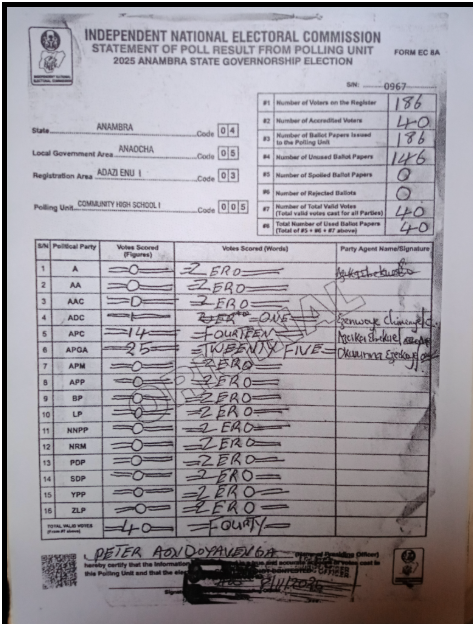
Form EC8A is the official result sheet completed at every polling unit in Nigeria after votes are counted.
Presiding officers record:
- Total accredited voters
- Votes scored by each party
- Rejected ballots
- Total valid votes
The form is signed by the presiding officer and countersigned by polling agents where present. Copies are distributed to party agents and posted publicly at the polling unit.
In legal terms, EC8A represents the earliest formal record of electoral outcome.
Why courts treat EC8A as foundational evidence
Election tribunals consistently rely on Form EC8A because it documents results at source before collation begins.
When disputes arise, courts compare:
- Figures recorded on EC8A
- Results declared at ward, local government, or state collation centres
- Uploaded digital copies on INEC’s Result Viewing Portal (IReV)
If discrepancies appear, EC8A often becomes the reference point for determining authenticity.
That is why alterations alleged at higher collation levels frequently circle back to the polling unit document.
How EC8A interacts with electronic transmission
Under Nigeria’s electoral framework, electronic transmission involves uploading results from polling units to INEC’s IReV portal.
However, the physical EC8A remains the statutory document.
In recent amendments, lawmakers introduced a clause allowing electronic transmission “as long as it does not fail,” while designating EC8A as the primary source where connectivity is unavailable.
This has renewed scrutiny over how and when the fallback to EC8A is activated.
The debate is not about whether EC8A exists.
It is about how decisively it should govern collation.

Where vulnerabilities have historically emerged
Most electoral disputes in Nigeria have not centred on vote counting at polling units. Instead, tensions have often arisen during result collation at ward and local government centres.
Advocates of strict electronic transmission argue that immediate uploads reduce the possibility of alteration between polling unit declaration and higher-level collation.
Others counter that uneven telecommunications infrastructure makes a rigid real-time mandate impractical.
In both arguments, EC8A sits at the centre—either as safeguard or as fallback.
Why understanding EC8A matters now
Form EC8A explained is not a technical footnote; it is the legal anchor of Nigeria’s electoral chain.
As harmonisation talks continue over transmission clauses ahead of the 2027 elections, clarity on the role of EC8A will shape how disputes are interpreted and resolved.
If fallback triggers remain loosely defined, litigation may pivot on whether reliance on EC8A was justified.
If clearly structured, the document may reinforce electoral transparency rather than undermine it.
The sheet itself is simple.
The legal weight it carries is not.
This is IDNN. Independent. Digital. Uncompromising.
