
🟥 ADC names Amupitan, demands INEC leadership overhaul
The African Democratic Congress (ADC) has demanded the immediate resignation or sack of the Chairman of the Independent National Electoral Commission (INEC), Professor Joash Amupitan, SAN, accusing the electoral body of actions that could tilt Nigeria toward a one-party political system.
The demand, made at a press conference in Abuja led by David Mark, marks a significant escalation in opposition rhetoric and places the electoral umpire at the centre of a widening political confrontation.
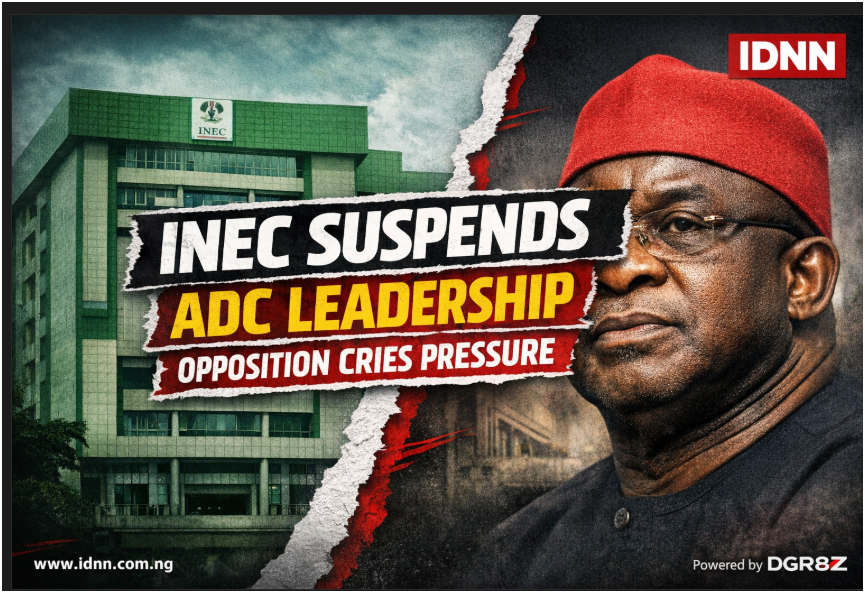
🟨 “We no longer have confidence” — David Mark leads charge
ADC National Chairman David Mark delivered the party’s most direct institutional challenge yet:
“We demand the immediate resignation or sack of the INEC Chairman, Professor Amupitan, and all the National Commissioners. We no longer have confidence in them. We are convinced that they are incapable of conducting any credible election.”
The statement was delivered alongside several prominent opposition figures, amplifying the political weight of the demand.
🟧 Bolaji Abdullahi: “This is how one-party states are built”
ADC National Publicity Secretary Bolaji Abdullahi framed the development as part of a broader political pattern:
“This is how one-party states are built — not overnight, but through systematic weakening of opposition space.”
He added:
“When we say there is a plan to make one candidate dominant in 2027, people think it is conspiracy. It is not.”
These remarks shift the narrative from procedural disagreement to systemic concern.

🟦 What triggered the demand: INEC derecognition of ADC factions
The controversy stems from INEC’s decision to suspend recognition of rival ADC leadership factions and remove party leadership details from its official records.
The move effectively froze the party’s internal structure and elevated what had been an internal dispute into a national institutional issue.
ADC argues that this action weakened its operational capacity at a critical political moment.
🟪 What the Court of Appeal said — and why it matters
INEC has maintained that its actions were guided by a Court of Appeal ruling which directed all parties to maintain the status quo pending determination of the substantive suit at the Federal High Court.
This legal directive is now the central point of dispute.
ADC contends that INEC misinterpreted the meaning of “status quo,” while the commission insists it acted to uphold the rule of law and avoid future judicial reversals.
🟫 The legal battle behind the crisis
The underlying dispute involves competing claims to ADC leadership, including a suit filed by a party stakeholder seeking judicial recognition as national chairman.
With the substantive case still pending, the Court of Appeal’s directive effectively paused all changes — leaving INEC to interpret and apply that order in real time.
🟨 INEC response: “Attack on institutional independence”
INEC has rejected calls for the chairman’s removal, describing them as an attempt to undermine its constitutional independence.
The commission maintains that:
- its actions are based strictly on legal directives
- its role is to interpret and implement court orders
- its independence must be protected from political pressure
This response reframes the dispute as one between institutional authority and political demand.

08112935565, 08161558757
🟥 Why this matters: electoral credibility and 2027 positioning
The ADC’s demand reflects a broader concern among opposition actors that:
- political realignments may be narrowing competition
- institutional decisions could shape electoral outcomes
- trust in the electoral process must be secured early
The issue is no longer just about ADC — it is about how Nigeria’s electoral system is perceived ahead of the next major election cycle.
If the dispute deepens, the confrontation between ADC and INEC could evolve into a defining test of electoral neutrality, judicial influence, and political balance in Nigeria’s democracy.
