
🟥 ADC Rejects INEC Interpretation — ‘We Will Proceed’
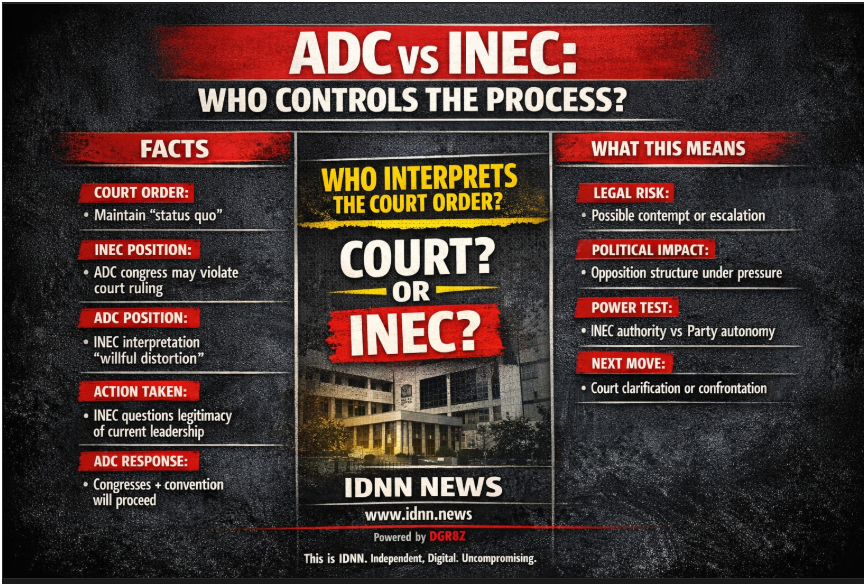
The African Democratic Congress has rejected the position of the Independent National Electoral Commission, describing its interpretation of a Court of Appeal directive as a “willful distortion” and insisting it will proceed with its congresses and national convention.
In a statement by its National Publicity Secretary, Bolaji Abdullahi, the party said INEC had no authority to determine the meaning of the court’s instruction to maintain the status quo.
“The determination of the status quo lies with the courts, not INEC,” the party said, signalling a direct challenge to the Commission’s position.
INEC had warned that conducting congresses under the disputed leadership structure could violate the Court of Appeal directive and undermine the legal process.
🟨 Court Order at the Centre — Competing Interpretations Drive Crisis
At the heart of the ADC INEC congress crisis is a Court of Appeal ruling directing parties to maintain the status quo — a phrase now subject to sharply conflicting interpretations.
The Court of Appeal order did not explicitly spell out operational restrictions, leaving room for differing legal readings.
While INEC interprets the directive as a freeze on actions under a contested leadership, the ADC argues that no court has expressly barred it from conducting internal activities.
The dispute exposes a legal grey area — one that could ultimately require further judicial clarification.
🟦 Compliance vs Autonomy — Institutional Authority Under Strain
For the Independent National Electoral Commission, the issue is rooted in compliance with judicial orders and preservation of due process.
By its reading, proceeding with congresses could compromise the integrity of the legal process tied to the leadership dispute.
For the ADC, however, the issue is framed as a defence of internal party autonomy and a rejection of regulatory overreach.
This clash between electoral oversight and party independence now defines the trajectory of the confrontation.
🟥 Opposition Dynamics in Focus — Beyond Procedure to Power
Beyond legal interpretation, the ADC INEC congress crisis reflects deeper political currents within Nigeria’s opposition landscape.
The dispute comes at a time of internal recalibration across parties, where leadership control, alliances, and strategic positioning ahead of future elections remain fluid.
Analysts say the outcome of the standoff could influence:
- legitimacy of party leadership structures
- boundaries of electoral oversight
- conduct of internal party democracy
What appears procedural is increasingly political.
🟨 The Consequence Curve — A Test of Control
This is not just a legal dispute. It is a test of who controls party power.
If INEC’s interpretation prevails, it could reinforce the Commission’s authority over party processes during legal disputes.
If the ADC proceeds without consequence, it may signal limits to regulatory power and embolden other parties to challenge oversight.
For now, the ADC INEC congress crisis remains unresolved — but it has already opened a critical question at the heart of Nigeria’s electoral system: where authority truly lies.
🟥 This is IDNN. Independent. Digital. Uncompromising.
