
Nigeria’s central bank is prioritising price stability over further monetary easing, keeping monetary policy restrictive despite easing inflation and continuing concerns over borrowing costs.
IDNN Business Intelligence Desk
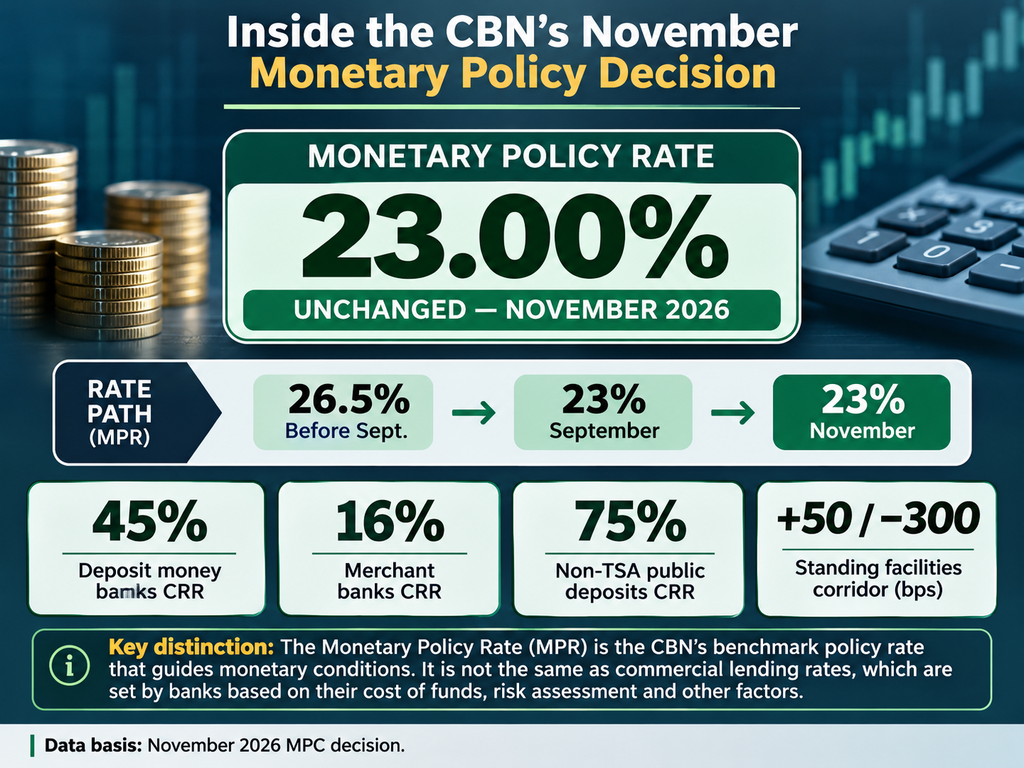
The Central Bank of Nigeria (CBN) has retained its benchmark interest rate at 23 per cent, resisting further monetary easing despite five consecutive months of declining headline inflation.
The decision follows September’s 350-basis-point reduction in the benchmark rate from 26.5 per cent to 23 per cent.
The decision, taken at the 308th Monetary Policy Committee (MPC) meeting held on November 23 and 24, reflects the apex bank’s determination to consolidate progress against inflation amid persistent domestic and international economic risks.
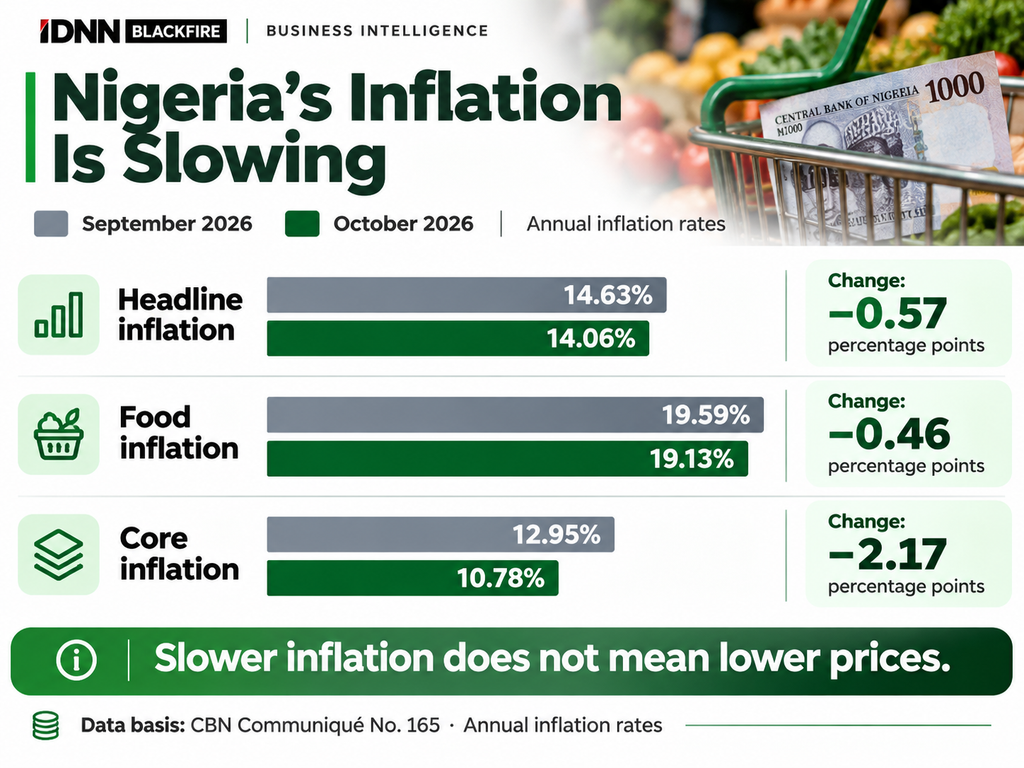
Nigeria’s annual headline inflation declined to 14.06 per cent in October 2026, compared with 14.63 per cent in September, according to the CBN.
However, food inflation remains substantially higher at 19.13 per cent, highlighting the continuing pressure on household purchasing power.
For businesses seeking affordable financing and households struggling with living costs, the central bank’s decision underscores an uncomfortable economic reality: improving macroeconomic indicators do not automatically translate into immediate financial relief.
CBN Maintains Restrictive Monetary Conditions
Alongside retaining the Monetary Policy Rate at 23 per cent, the committee retained its standing facilities corridor and cash reserve requirements.
The policy settings are as follows:
| Policy instrument | November 2026 |
|---|---|
| Monetary Policy Rate | 23% |
| Deposit money banks CRR | 45% |
| Merchant banks CRR | 16% |
| Non-TSA public sector deposits CRR | 75% |
| Standing facilities corridor | +50/-300 bps |
Source: Central Bank of Nigeria.
The measures signal that the CBN remains unwilling to loosen monetary conditions aggressively while inflation risks persist.
Although the benchmark rate does not directly determine every commercial lending rate, it influences financing conditions throughout the economy.
Businesses dependent on bank credit for production, expansion and working capital consequently remain exposed to restrictive monetary conditions.
Inflation Is Slowing — But Prices Are Still Rising
The inflation figures contained in the MPC communiqué point to a broad moderation in annual price increases.
| Inflation measure | September 2026 | October 2026 |
|---|---|---|
| Headline inflation | 14.63% | 14.06% |
| Food inflation | 19.59% | 19.13% |
| Core inflation | 12.95% | 10.78% |
Source: CBN Monetary Policy Communiqué No. 165.
The decline in headline inflation represents an improvement of 0.57 percentage points, while core inflation recorded a more substantial reduction of 2.17 percentage points.
The CBN associated the improvement with exchange-rate stability, its monetary policy measures and seasonal improvements in agricultural supply.
However, declining annual inflation does not necessarily mean that goods are becoming cheaper.
It means that the general price level is increasing more slowly than before on a year-on-year basis. Households may therefore continue to experience considerable financial pressure, particularly where income growth has failed to keep pace with accumulated price increases.
Economic Activity Expands Despite Financing Constraints
The central bank also reported that Nigeria’s composite Purchasing Managers’ Index increased from 53.0 points in September to 53.2 points in October, indicating continued expansion in surveyed business activity.
Gross external reserves stood at $54.02 billion as of November 17, equivalent, according to the CBN, to 10.26 months of goods and services import coverage.
Both indicators provide some grounds for confidence in economic stability.
Nevertheless, stronger external buffers and expanding business activity do not demonstrate that affordable credit has returned to manufacturers, small businesses or consumers.
IDNN Intelligence Watch
- Inflation: Whether the moderation in annual price increases continues.
- Credit: Whether commercial borrowing conditions improve.
- Foreign exchange: Sustainability of exchange-rate stability.
- Food security: Weather-related disruption and seasonal supply pressure.
- Energy: Implementation of the CBN–NNPC agreement.
- Next policy catalyst: February 2027 MPC meeting.
The effectiveness of Nigeria’s monetary stabilisation strategy will increasingly be measured by whether these improvements translate into stronger investment, productive employment and sustainable purchasing power.
Global Energy and Domestic Spending Risks Remain
The MPC identified international energy-market disruptions, adverse weather conditions, festive-season expenditure and election-related spending as potential sources of renewed inflationary pressure.
Higher international energy costs could complicate domestic price stability, while adverse weather conditions could disrupt agricultural production and food supply.
Increased spending could also strengthen demand at a time when policymakers are still attempting to contain inflation.
The central bank welcomed a memorandum of understanding with the Nigerian National Petroleum Company Limited intended to improve foreign-exchange inflows and support energy-sector financing.
The expected benefits remain dependent on implementation. The agreement itself does not establish that additional foreign currency or project financing has already been secured.
The Next Test: From Stability to Economic Relief
The MPC is scheduled to reconvene on February 22 and 23, 2027.
Before then, inflation figures, commercial lending conditions, exchange-rate stability and developments in energy markets will offer important indications of whether Nigeria can sustain its disinflation trend.
For the CBN, the immediate challenge remains preventing renewed price instability.
For businesses and households, the more pressing question is when monetary stability will translate into affordable financing, improved purchasing power and tangible economic opportunity.
Nigeria’s inflation trajectory is improving. The next challenge is ensuring that the benefits extend beyond the headline statistics.
Primary sources
CBN Monetary Policy Communiqué No. 165
CBN Monetary Policy Decisions Register
