
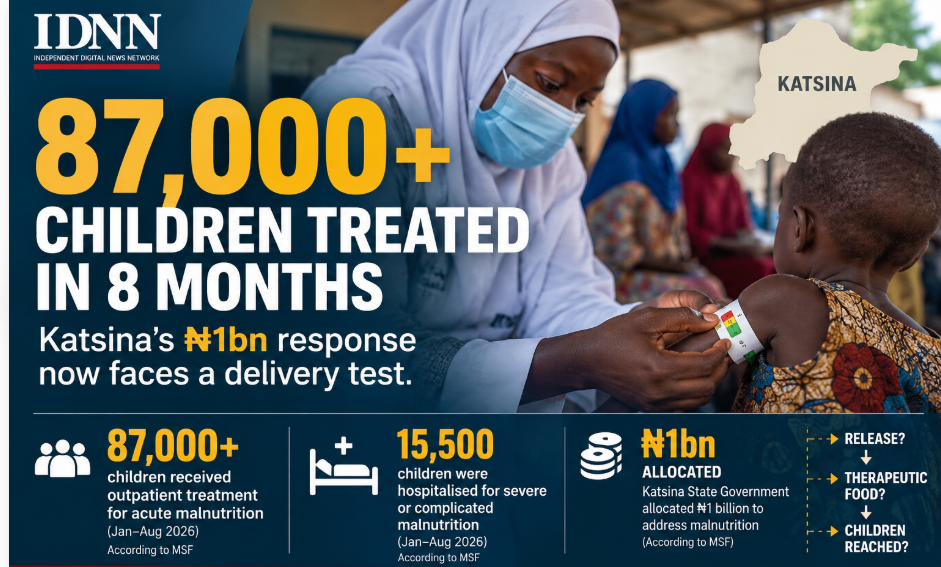
More than 87,000 children received outpatient treatment for acute malnutrition in Katsina State between January and August 2026, according to Médecins Sans Frontières, underscoring the scale of a nutrition crisis that remains severe despite a decline from last year.
Nearly 15,500 children were also hospitalised for severe or complicated malnutrition during the same period, MSF said.
The figures do not represent every malnourished child in Katsina. They reflect children treated through MSF-supported services and therefore show the pressure on those facilities rather than statewide prevalence.
But even within that limit, the burden remains stark: tens of thousands of children required therapeutic feeding in just eight months.
Numbers fall, crisis remains
MSF said it treated more than 95,000 children for acute malnutrition during the corresponding period in 2025, compared with more than 87,000 this year.
Hospital admissions also declined from about 16,500 to nearly 15,500.
The organisation linked part of that reduction to improved agricultural harvests, increased humanitarian intervention and better security in some communities, including areas where displaced families had returned and resumed farming.
Those explanations remain MSF’s assessment and do not establish how much each factor contributed to the decline.
For affected families, the more immediate reality is that the caseload is still measured in tens of thousands of children.
MSF has repeatedly identified food insecurity, inflation, insecurity, displacement, disease outbreaks and poor access to healthcare as factors worsening childhood malnutrition across northern Nigeria.
Severe cases remain a concern
MSF has also raised concern over children arriving with kwashiorkor, a severe form of malnutrition that may involve swelling and skin changes and can be difficult for caregivers to identify early.
The organisation has opened a specialised unit within its Katsina inpatient therapeutic feeding centre for such cases.
It did not provide a separate figure showing how many of the children treated between January and August had kwashiorkor.
That gap matters.
The headline treatment figure shows how many children reached care. It does not show how many remain undiagnosed, how early families are reaching treatment or how many households cannot access services at all.
₦1bn commitment faces delivery test
MSF said the Katsina State Government allocated ₦1 billion to address malnutrition, particularly for therapeutic food, doubling an earlier allocation.
It also said UNICEF had committed to mobilising a matching amount through its Child Nutrition Fund.
The available evidence does not establish how much of the state’s ₦1 billion allocation has actually been released, spent or converted into therapeutic food delivered to treatment centres.
It also does not establish that UNICEF’s proposed matching contribution has been fully mobilised.
That creates the next accountability test.
An allocation is not the same as a release. A release is not the same as delivery. And delivery must ultimately be measured against whether vulnerable children can obtain treatment when they need it.
MSF said Katsina’s network of ambulatory treatment centres has expanded substantially, reaching roughly 400 centres by 2026, while government and humanitarian interventions have helped increase treatment capacity.
Yet the organisation continues to warn about funding constraints and shortages of ready-to-use therapeutic food, while reductions in international humanitarian assistance have added pressure to nutrition programmes.
A wider northern emergency
Katsina is not isolated.
Across MSF nutrition projects in seven northern states, the organisation reported treating 225,778 children through outpatient programmes and another 57,999 in inpatient facilities between January and August.
MSF has linked malnutrition across northern Nigeria to food insecurity, weak healthcare access, disease outbreaks and insecurity, reinforcing that treatment alone cannot resolve the conditions driving children into feeding centres.
The lower treatment numbers recorded in Katsina this year may offer some relief compared with 2025.
They are not evidence that the crisis is over.
The harder measure will be what happens next: whether announced funds are released, whether therapeutic food reaches treatment centres consistently, whether families can reach those centres early — and whether fewer children need emergency nutritional care in the first place.
