
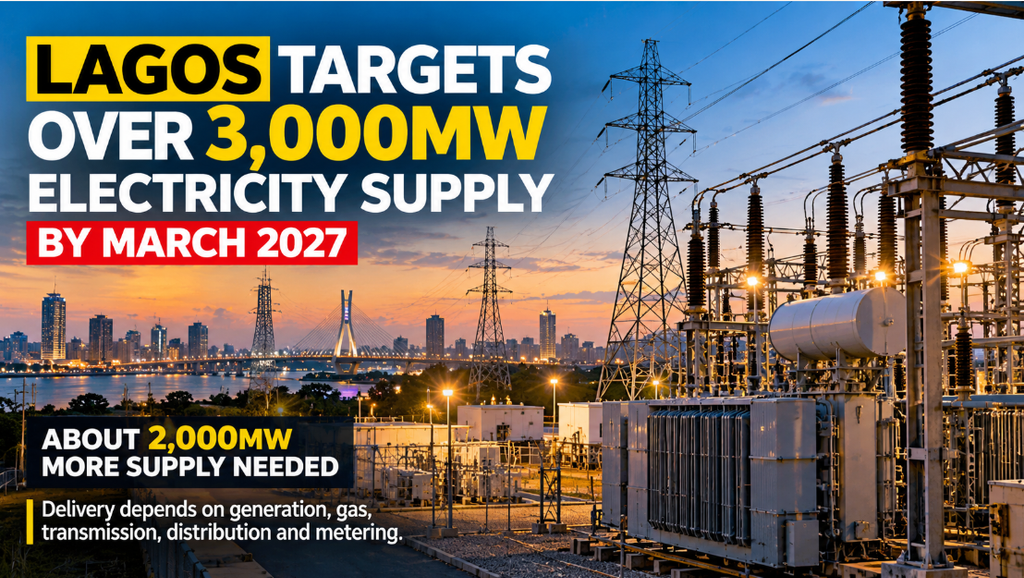
Lagos targets more than 3,000MW electricity supply by March 2027
The Lagos State Government says it aims to increase electricity supply in the state from a government-described level of below 1,000 megawatts to more than 3,000MW by March 2027.
The target was announced by Governor Babajide Sanwo-Olu, represented by Deputy Governor Obafemi Hamzat, at the Lagos Business School Africa Energy Conference.
The state says achieving the target would require about 2,000MW of additional electricity supply.
That figure is a planning gap, not evidence that the additional capacity has already been secured, commissioned or delivered to consumers.
Lagos outlines multiple supply sources
The state says it plans to draw additional electricity from a combination of the national grid, independent power projects, embedded generation, energy hubs, power barges and energy traders.
The approach reflects Lagos’s high residential, commercial and industrial electricity demand.
But additional generation alone will not determine whether consumers receive better service.
Electricity also has to move through transmission and distribution networks, reach metered customers and remain available reliably.
Infrastructure remains the delivery test
The government has identified generation, transmission, distribution, gas supply, metering and network infrastructure as critical to meeting the target.
Those dependencies create the main accountability test.
A project can add nominal capacity without improving supply to homes and businesses if transmission bottlenecks, distribution constraints or fuel shortages prevent that electricity from reaching consumers.
Likewise, more electricity entering the system does not automatically mean fewer outages or longer hours of supply.
What the target means for consumers
For residents and businesses, the practical test will be whether the planned increase translates into measurable improvements.
That means tracking how much additional capacity is actually contracted, how much is commissioned and how much is ultimately delivered through the network.
It also means watching whether metering expands, whether infrastructure upgrades keep pace and whether reliability improves.
The material reviewed by IDNN does not establish that the target will lead to lower tariffs, uninterrupted supply or the elimination of blackouts.
March 2027 becomes the accountability deadline
The target gives Lagos a clear timeline against which progress can be measured.
By March 2027, the key questions will be how much new capacity is operational, whether network infrastructure can carry it and how much reaches consumers.
Until then, the more than 3,000MW figure remains a government target rather than a delivered result.
The accountability test is straightforward: how much of the planned additional electricity will actually be operational and reaching Lagos homes and businesses by March 2027?
