
Nigeria’s main labour federation has demanded a return to 2024 petrol-price levels, fresh minimum-wage negotiations and implementation of outstanding agreements. A contemporaneous government announcement outlines an NNPC Retail margin concession and a proposed ₦1,350 wholesale-cost ceiling, but nationwide pump-price relief has not been established.
ABUJA, October 9, 2026 — The Nigeria Labour Congress has given the Federal Government two weeks to reduce petrol prices and begin renegotiating the national minimum wage, adding pressure over living costs as the administration outlines measures intended to cushion consumers against higher fuel prices.
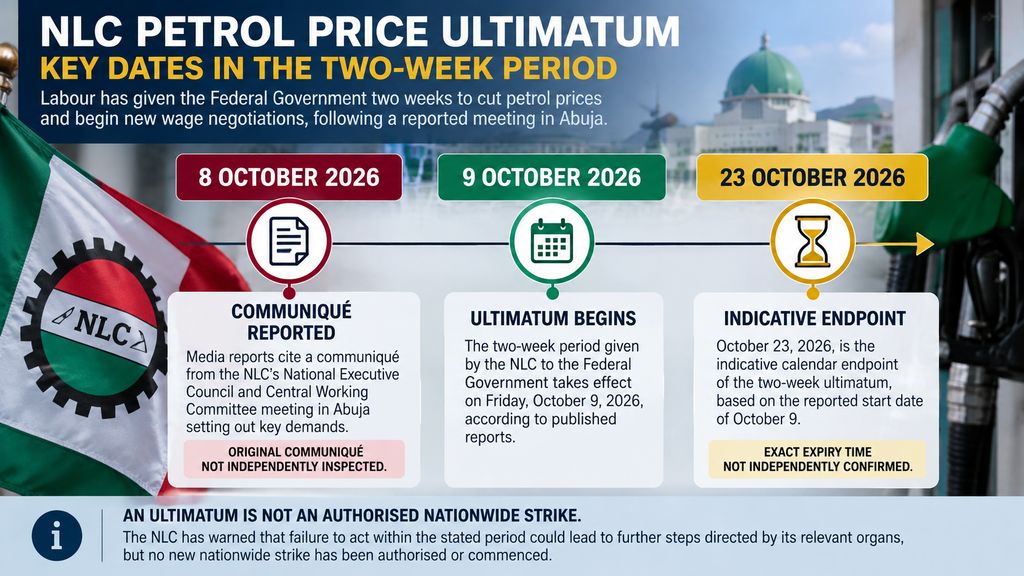
The ultimatum, which took effect on Friday, October 9, was reported following a joint meeting of the NLC’s National Executive Council and Central Working Committee in Abuja.
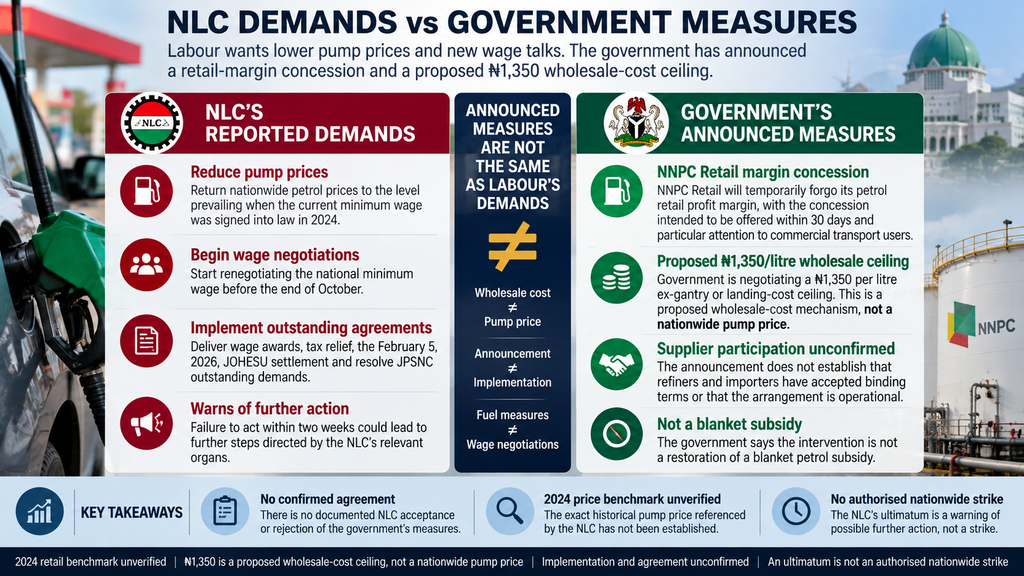
According to media reports citing a communiqué signed by NLC President Joe Ajaero, the labour federation wants petrol prices reduced nationwide to the level prevailing when the current national minimum wage was signed into law in 2024.
The NLC also wants negotiations on a new minimum wage to begin before the end of October, alongside implementation of outstanding labour agreements and additional relief for workers.
The original signed communiqué has not been independently inspected in this editorial review. The demands and timing are drawn from corroborating published accounts.
Separately, a State House statement signed on October 8 and displayed on the Presidency’s website on October 9 outlined a temporary NNPC Retail margin concession and negotiations over a proposed ₦1,350-per-litre wholesale-cost ceiling.
The announcement was made in the same period as the labour ultimatum. It has not been established as a negotiated response to the NLC’s specific demands.
Neither the announcement nor the ultimatum establishes that nationwide petrol pump prices have fallen or that a new nationwide strike has been authorised.
What the NLC is demanding
The reported two-week ultimatum begins on October 9, making October 23 the indicative calendar endpoint. The precise expiry time has not been independently confirmed.
The NLC’s demands extend beyond petrol prices.
The labour federation wants the government to begin renegotiating the national minimum wage before the end of October, arguing that rising living costs have eroded workers’ purchasing power.
It has also called for tax relief and wage awards, implementation of the February 5, 2026, settlement involving the Joint Health Sector Unions and Assembly of Healthcare Professionals, and resolution of outstanding demands involving the Joint Public Sector Negotiating Council.
These demands combine immediate cost-of-living relief with longer-running disputes over wages and public-sector agreements.
Published accounts of the communiqué say the NLC warned that failure to act within the stated period could lead to further steps directed by its relevant organs.
That warning does not establish that the federation has authorised or commenced a new nationwide strike.
Why the 2024 petrol-price benchmark matters
The union’s petrol demand is more specific than a general call for cheaper fuel.
It wants pump prices returned to the level prevailing when the current national minimum wage was signed into law in 2024.
The exact comparable historical pump-price benchmark has not been established in this editorial review.
A defensible comparison requires verification of the relevant signing date, price category, geographic coverage and corresponding retail observations.
It would be misleading to substitute a January 2024 average, an unrelated retail quotation or the government’s current wholesale-cost proposal without that verification.
Until the historical and current retail figures are reconciled, the size of the price reduction demanded by the NLC cannot responsibly be calculated.
What the government actually announced
A State House statement signed on October 8, 2026, and displayed on the Presidency’s website on October 9 outlined measures intended to cushion consumers against petrol-price volatility.
The government announced that NNPC Retail would temporarily forgo its petrol retail profit margin, with the concession intended to be offered within 30 days and particular attention to commercial transport users.
The announcement also described negotiations over a proposed ₦1,350-per-litre ex-gantry or landing-cost ceiling.
That figure concerns a proposed wholesale-cost mechanism. It is not a verified nationwide pump price.
The government described a possible arrangement under which refiners and importers could temporarily carry costs above the proposed ceiling and potentially recover them later if market conditions permit.
The announcement does not establish that affected suppliers have accepted binding terms, that the arrangement is operational or who would ultimately bear any unrecovered costs.
The State House also used an illustrative ₦1,300 landing-cost example when explaining possible NNPC Retail at-cost sales. That illustration should not be interpreted as an established retail price.
The government said the intervention was not a restoration of a blanket petrol subsidy.
The distinction between an announced measure and actual implementation is central: neither supplier participation nor nationwide retail-price relief has been demonstrated by the announcement alone.
Does the announcement meet labour’s demands?
The government’s announcement addresses some of the economic pressures underlying the NLC’s ultimatum, particularly high petrol costs.
But the government’s measures and the union’s demands are not interchangeable.
The NLC is demanding a nationwide pump-price reduction to a specific historical level.
The government has announced a retail-margin concession and negotiations over a proposed wholesale-cost stabilisation mechanism.
Those steps do not establish that filling-station prices have returned to the 2024 benchmark.
Nor does the fuel announcement, by itself, satisfy the NLC’s separate demands concerning minimum-wage negotiations, wage awards, tax relief and outstanding settlements.
No direct response from the NLC accepting or rejecting the specific State House package has been obtained or documented in this editorial review.
No direct government response addressing the NLC’s full October ultimatum has been obtained or documented here.
No request for comment to either party is recorded as having been sent in this editorial review. Their positions are presented from attributed public statements and published reporting, not from a documented direct exchange with IDNN.
Whether the two sides subsequently reach an agreement, open formal wage talks or revise the petrol measures remains a matter for further reporting.
What is at stake for businesses and households?
Petrol prices affect transport costs and the operating expenses of businesses dependent on road distribution, generators and frequent travel.
For workers, rising transport costs can reduce the purchasing power of wages even when nominal earnings remain unchanged.
The NLC’s demands reflect its stated concern about the adequacy of workers’ incomes under higher living costs.
For businesses, uncertainty over future fuel costs can complicate logistics, budgeting and pricing decisions.
Verified pump-price reductions could ease some of these pressures, although the size and distribution of any benefit would depend on where, when and for whom lower prices became available.
Industrial action, if subsequently authorised and widely observed, could disrupt some economic activity.
That remains a conditional risk, not a verified outcome of the present ultimatum.
This report does not claim that a new nationwide NLC strike is underway, or assign economic losses to industrial action that has not been established.
What happens before the deadline?
The immediate questions are whether the government confirms a timetable for minimum-wage negotiations, whether the announced petrol measures become operational and whether labour regards any government action as sufficient.
The original signed NLC communiqué, the precise 2024 petrol-price benchmark and direct responses from the relevant parties remain verification priorities.
Any subsequent decision by the NLC’s authorised organs to begin industrial action would require separate confirmation.
The reported two-week period points to October 23 as an indicative endpoint, without establishing a precise expiry hour.
For now, the central economic test is clear: labour is demanding measurable retail-price relief and action on wages, while the government has announced petrol-cost measures whose nationwide retail impact remains unverified.
Intelligence Watch
IDNN Business Intelligence will monitor formal NLC decisions, direct government and labour responses, minimum-wage negotiation dates, NNPC Retail implementation, supplier participation and verified petrol pump-price movements.
The key indicators are documented agreements, comparable retail-price changes, confirmed wage-negotiation steps and any formally authorised industrial action.
