
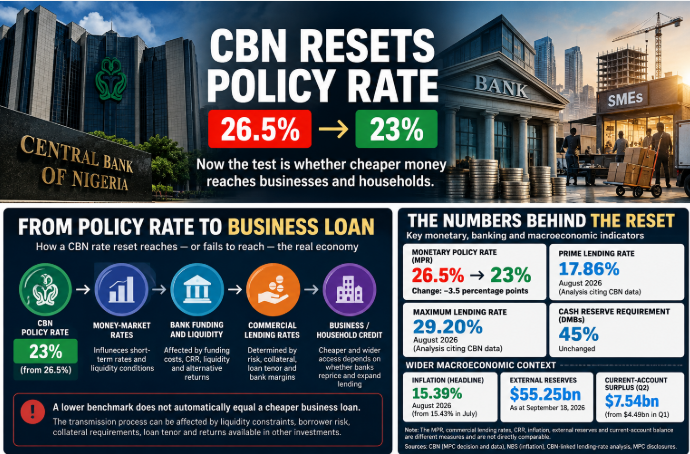
Nigeria’s central bank has lowered its benchmark monetary policy rate by 350 basis points, but the bigger test for companies and households is whether the reset translates into lower borrowing costs across commercial banks.
CBN resets policy rate to 23% as businesses push banks for cheaper loans
Nigeria’s central bank has lowered its benchmark monetary policy rate by 350 basis points, but the bigger test for companies and households is whether the reset translates into lower borrowing costs across commercial banks.
The Central Bank of Nigeria has reset its Monetary Policy Rate to 23 per cent from 26.5 per cent, opening a new debate over how quickly — and how far — the change will feed through to loans for Nigerian businesses and households.
CBN Governor Olayemi Cardoso announced the decision at the end of the Monetary Policy Committee’s 307th meeting in Abuja.
The committee also recalibrated its standing facilities corridor to +50/-300 basis points around the MPR, while retaining the Cash Reserve Requirement at 45 per cent for deposit money banks and 16 per cent for merchant banks.
The CBN, however, said the move should not be read as a shift away from its prevailing monetary-policy stance.
Cardoso described it as a reset and recalibration intended to improve monetary-policy transmission after a widening gap developed between the MPR and prevailing interbank rates. He said monetary conditions would remain restrictive for as long as necessary.
That distinction puts the transmission mechanism — rather than the headline change in the benchmark alone — at the centre of what happens next.
Businesses want the reset to reach borrowers
Private-sector groups welcomed the lower benchmark but said the decision would matter little if commercial lending rates remained prohibitive.
Lagos Chamber of Commerce and Industry President Leye Kupoluyi said monetary-policy adjustment needed to be accompanied by measures that reduce lending risks and improve companies’ ability to borrow and repay.
The Association of Small Business Owners of Nigeria also called for banks to reduce rates on existing loans, arguing that borrowers should benefit when monetary conditions move downward just as they face higher costs when rates rise.
The Centre for the Promotion of Private Enterprise said high financing costs had constrained working capital, investment and production across the real economy.
The Nigeria Employers’ Consultative Association similarly cautioned that a lower policy rate would not automatically produce cheaper commercial credit.
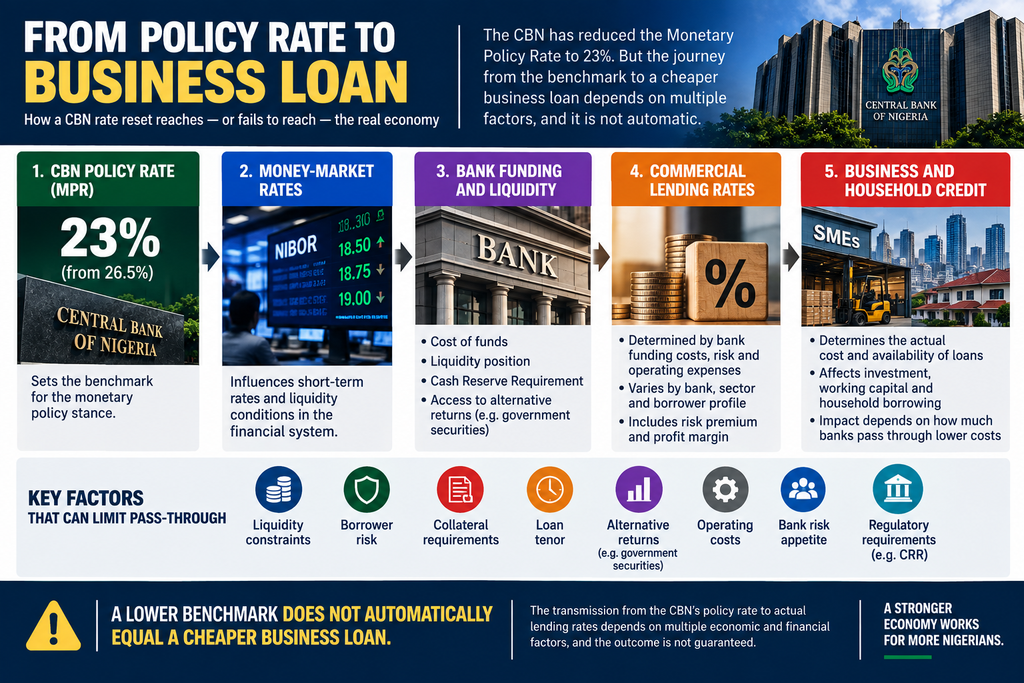
That caution matters because a policy-rate change and a business loan are separated by banks’ funding costs, liquidity conditions, collateral requirements, borrower risk, loan tenor and the returns lenders can earn elsewhere.
CBN research has historically identified interest-rate, bank-credit and exchange-rate channels among the mechanisms through which monetary policy affects the wider Nigerian economy, while other central-bank research has found that changes in policy and interbank rates do not necessarily pass through uniformly across market rates.
Lending costs remain the real test
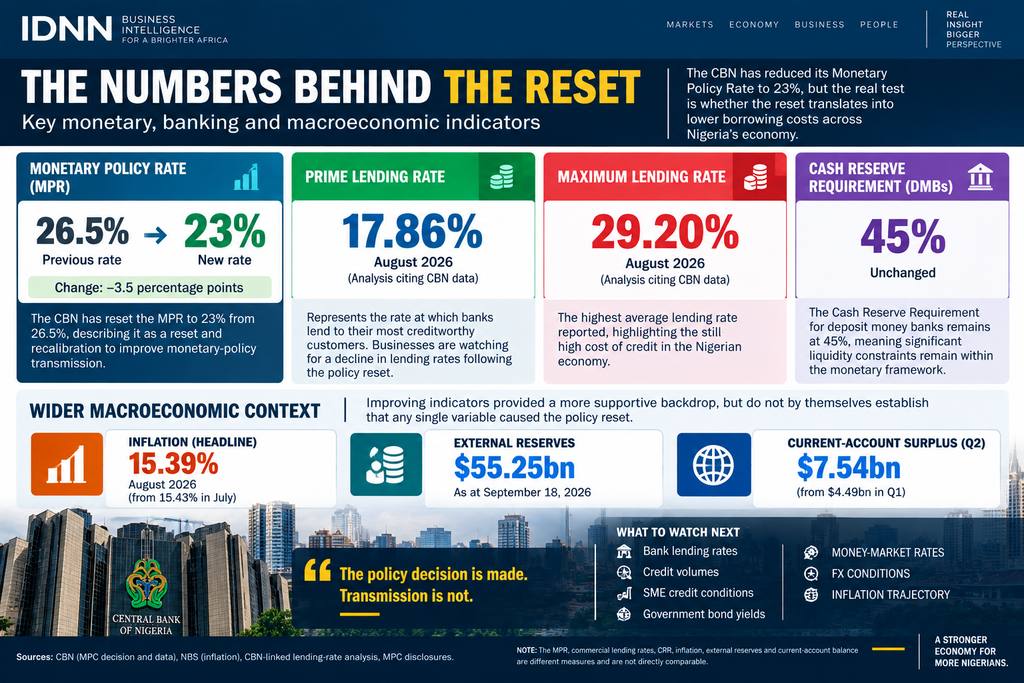
Recent analysis citing CBN data put the prime lending rate at 17.86 per cent and the maximum lending rate at 29.20 per cent in August.
Those figures underline why businesses are focused on what happens after the MPC announcement rather than on the 23 per cent benchmark alone.
For manufacturers and other companies with long investment cycles, even a substantial shift in the policy benchmark may have limited immediate effect if commercial loan pricing, collateral conditions and access to credit do not change.
The CBN also left the CRR for deposit money banks at 45 per cent, meaning significant liquidity constraints remain within the monetary framework.
The next evidence test will therefore be measurable: whether banks reprice new and existing credit, whether prime and maximum lending rates begin falling, and whether businesses outside the largest corporate borrowers gain greater access to finance.
Inflation and external conditions improved ahead of reset
The MPC decision came against a backdrop of improving inflation and external-sector indicators.
Headline inflation eased to 15.39 per cent in August from 15.43 per cent in July, while Cardoso also pointed to stronger foreign-exchange conditions and external buffers in describing the changing macroeconomic environment.
According to figures disclosed around the MPC meeting, gross external reserves stood at about $55.25 billion on September 18, while the current-account surplus rose to $7.54 billion in the second quarter, from $4.49 billion in the first.
Those figures strengthened the broader macroeconomic backdrop to the decision, but they do not by themselves establish that any single variable caused the reset.
Government borrowing costs could also be affected
The transmission question extends beyond private-sector loans.
Lower monetary rates can put downward pressure on yields in the fixed-income market, potentially affecting the cost at which the Federal Government raises domestic debt.
But that effect has not yet been established from the current evidence.
Yields had already been moving before the latest MPC decision, which means any subsequent movement must be measured against the pre-MPC trend rather than attributed automatically to the policy reset.
If government securities continue to offer attractive risk-adjusted returns, banks could still prefer sovereign instruments to riskier SME lending.
Conversely, sustained declines in sovereign yields could strengthen the incentive to extend more credit into the productive economy.
Neither outcome is established yet.
The policy decision is made. Transmission is not.
The MPC has changed the operating benchmark.
What remains unproven is whether that change will materially reduce the cost of money for Nigerian companies and households.
For businesses already carrying expensive debt, the immediate questions are whether banks will reprice existing facilities, how quickly new loan rates change, and whether SMEs gain meaningful access to credit rather than watching the benefits remain concentrated among large borrowers.
For the CBN, the same questions will test whether its recalibrated benchmark has restored the transmission mechanism it says needed repair.
The bank’s next MPC meeting is scheduled for 23–24 November 2026.
Between now and then, the strongest evidence will not be another policy statement.
It will be what happens to lending rates, credit volumes, government yields and the actual price of money in the Nigerian economy.

Niger Republic Declares Hausa Official Language, Turns Page on French Influence