
- Nigeria’s attempt to rebuild its football administration has moved beyond domestic agitation and into direct engagement with the highest level of the global game.
FIFA President Gianni Infantino has called for stronger structures and clearer development pathways following talks with a Nigerian delegation led by National Sports Commission Chairman Shehu Dikko at FIFA House in Zurich.
The discussions covered institutional, governance and developmental issues, alongside areas where FIFA could further support football development in Nigeria.
That makes the Zurich engagement more than another courtesy meeting.
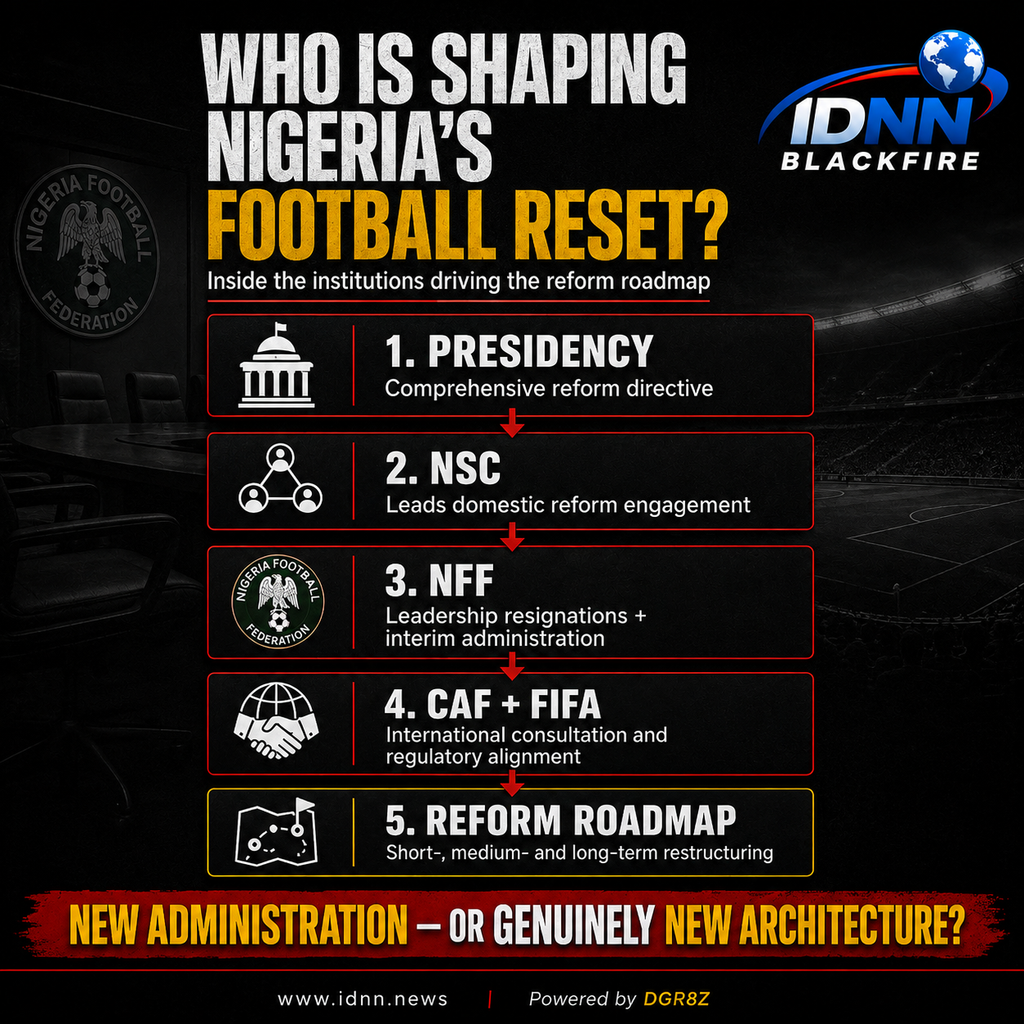
It comes after President Bola Tinubu ordered a comprehensive reform of Nigerian football covering governance, administration, stakeholder representation, development pathways, domestic competitions and accountability — a directive that was quickly followed by the resignation of the Nigeria Football Federation’s principal leadership.
The sequence has transformed what had been a long-running argument over Nigerian football into an active institutional reconstruction process.
Zurich Takes the Reform Battle Beyond Abuja
The Nigerian delegation to FIFA included Dikko, NSC Director-General Bukola Olopade, former NFF president and former FIFA Council member Amaju Pinnick, acting NFF General Secretary Emmanuel Ikpeme and NFF Director of Legal Services Okey Obi.
Their meeting with Infantino followed the resignation of NFF president Ibrahim Gusau, general secretary Mohammed Sanusi and members of the federation’s executive committee.
According to the NFF, FIFA subsequently accepted the resignations, while engagements involving Nigerian sports authorities, the NFF administration, CAF and FIFA continued towards a roadmap for comprehensive reforms.
The stated objective is to develop short-, medium- and long-term measures capable of producing an inclusive new football administration in a stable environment.
That is the critical shift.
Nigeria is no longer debating only whether something must change.
The argument has moved to what replaces the old structure, how that transition is managed and what safeguards stop the same institutional weaknesses from returning under different names.
“Stronger Structures” — But What Does That Mean in Practice?
Infantino’s language matters because his emphasis was not simply on winning more football matches.
The FIFA president spoke about institutional, governance and developmental issues, stronger structures and pathways capable of creating more opportunities for young people.
For Nigerian football, those are loaded words.
The pressure surrounding the NFF has extended well beyond results on the pitch. Governance, administration, development pathways and the effectiveness of football institutions have repeatedly come under scrutiny, while poor national-team outcomes intensified demands for change.
The reform question therefore stretches from the boardroom to grassroots development.
Who governs Nigerian football — and under what accountability?
How are domestic competitions and talent pathways rebuilt?
And perhaps most importantly:
How does Nigeria prevent institutional failure from surviving another change of personnel?
The NFF Resignations Changed the Equation
The August 27 resignation of the federation’s leadership dramatically accelerated the reform process.
Gusau and other executive members stepped aside amid growing pressure over Nigerian football’s direction, creating an unusual leadership transition at a time when the federation had been approaching another elective cycle.
An interim administrative structure has since emerged around the NFF secretariat while consultations continue.
That leaves the reform process balancing two pressures:
Urgency and legitimacy.
Nigeria needs a functioning football administration.
But moving rapidly without an agreed framework, broad stakeholder inclusion and alignment with international football statutes could simply exchange one governance crisis for another.
Dikko has said the reforms will be pursued in accordance with relevant rules, regulations and statutes.
That commitment may prove as important as whatever names eventually emerge to lead the next NFF.
FIFA Engagement Is Powerful — But It Is Not the Finish Line
There will be temptation to treat the Zurich meeting as proof that Nigeria’s football reform battle has already received international endorsement.
That goes beyond what has been established.
What is clear is engagement.
FIFA is involved in discussions with Nigerian football authorities and CAF about the emerging roadmap, while Infantino has publicly emphasised stronger structures, governance and development.
That gives the reform process international institutional weight.
It does not remove the hard work that must happen inside Nigeria.
A new structure will eventually have to demonstrate that it can improve governance, strengthen domestic competitions, create credible development pathways, support national teams and establish accountability while retaining legitimacy under football’s international rules.
Zurich can help shape the framework.
It cannot fix Nigerian football from Switzerland.
The Real Test Begins After the Meeting
For years, Nigerian football debates have repeatedly returned to familiar frustrations: governance disputes, administrative battles, development gaps and the uncomfortable distance between the country’s enormous talent pool and its institutional results.
This reform process now has something previous arguments often lacked.
There is a presidential reform directive.
There has been a leadership reset at the NFF.
CAF and FIFA are engaged.
And the president of world football has publicly placed stronger structures and development pathways at the centre of the conversation.
That creates an opportunity.
It also dramatically raises the stakes.
If the process produces stronger institutions, better competitions, credible development pathways and an inclusive football administration, this period could eventually be remembered as a genuine turning point.
If it ends only with a new group occupying familiar positions, then Nigerian football will have changed the occupants without changing the architecture.
Infantino has placed stronger structures on the table.
Nigeria must now demonstrate what those words mean in practice.
The question is no longer whether Nigerian football needs reform. It is whether this process can finally build institutions stronger than the individuals who occupy them.
