
Dangote Raises Alarm Over Resistance Inside Nigeria’s Fuel Market System
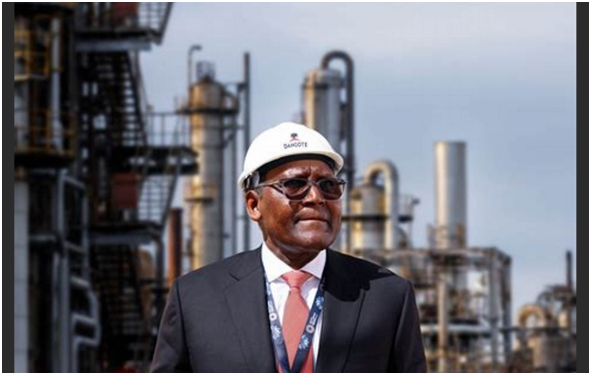
The Dangote fuel power battle has intensified after officials linked to the Dangote Refinery warned about what they described as resistance from entrenched interests benefiting from Nigeria’s long-standing fuel import structure.
The comments have reignited national debate over whether Nigeria’s transition toward local refining dominance is colliding with powerful commercial and institutional networks tied to the country’s decades-old petroleum import economy.
Speaking amid growing downstream sector tensions, representatives connected to the refinery argued that structural resistance against domestic refining reform remains strong despite repeated promises of energy-sector transformation.
“There are people who have benefited enormously from the import system over the years and naturally will resist any change that threatens that structure,” a refinery-linked official said during recent industry discussions.
The remarks immediately escalated the atmosphere surrounding the refinery’s evolving relationship with NNPC Limited and broader downstream market actors.
🟨 Nigeria’s Fuel Economy Is Entering A Dangerous Power Transition
For decades, Nigeria relied heavily on imported refined petroleum products despite being one of Africa’s largest crude oil producers.
That dependence created an enormous ecosystem involving:
- import allocations
- subsidy structures
- shipping contracts
- foreign exchange demand
- depot influence
- fuel distribution control
The emergence of the Dangote Refinery has now disrupted that historical structure at an unprecedented scale.
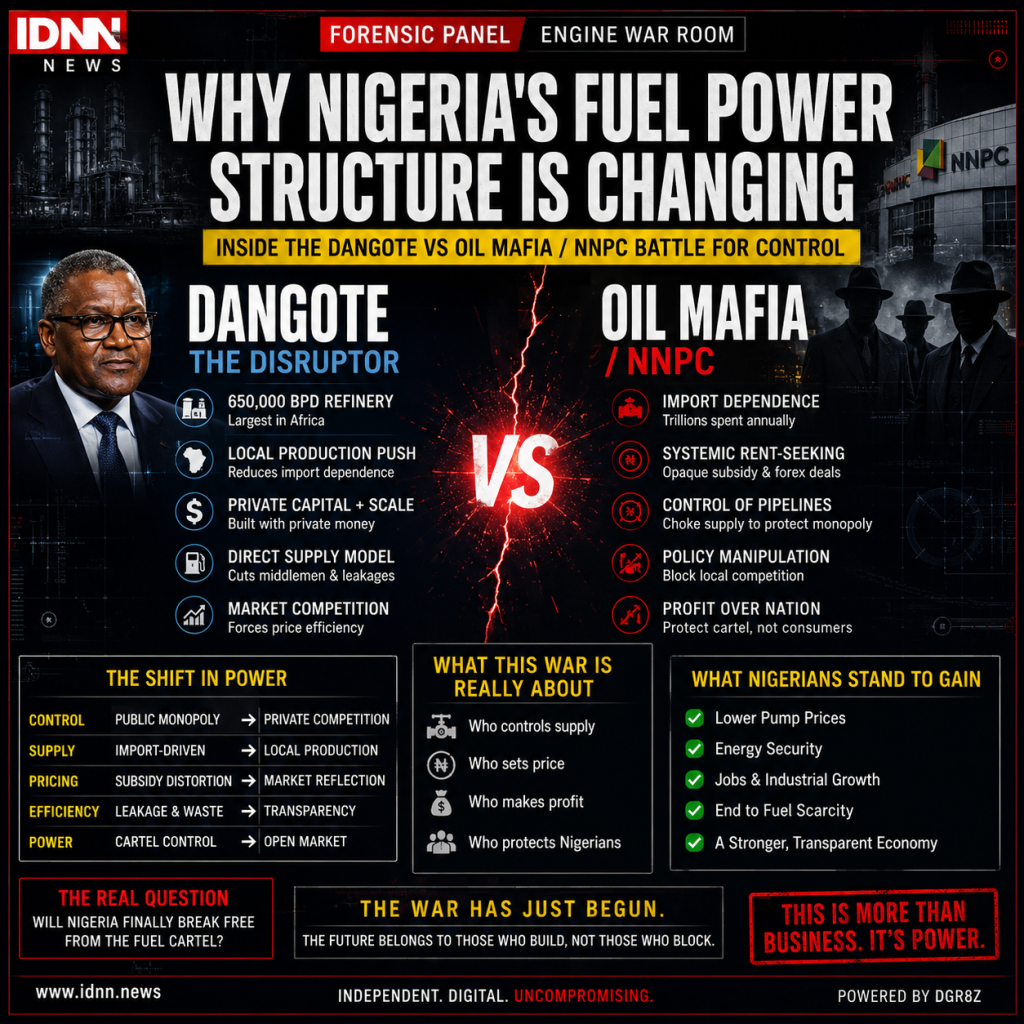
Supporters of the refinery project argue that local refining could:
- reduce import dependence
- ease foreign exchange pressure
- stabilize fuel supply
- strengthen energy security
- reposition Nigeria as a refining hub
But critics within the downstream sector continue raising concerns about:
- market concentration
- pricing leverage
- competition balance
- supply control
- transparency
That conflict is increasingly transforming the Dangote fuel power battle into a broader struggle over who controls Nigeria’s post-subsidy fuel economy.
🔴 NNPC Remains The Central Power Node In Nigeria’s Energy Structure
The role of NNPC remains critical because the corporation continues to sit at the center of Nigeria’s petroleum architecture through:
- crude supply arrangements
- fuel distribution systems
- strategic energy coordination
- import transition management
- national supply stability
Industry analysts say every major development involving the Dangote Refinery now immediately affects:
- fuel pricing calculations
- foreign exchange demand
- inflation expectations
- investor confidence
- downstream competition
That explains why the evolving tensions between refinery interests, import stakeholders, and NNPC are now being watched far beyond the energy sector alone.
🟨 The “Oil Mafia” Narrative Is Resonating Because Public Distrust Already Exists
The phrase “oil mafia” has increasingly gained traction in public discussions because many Nigerians believe powerful interests historically benefited from inefficiencies surrounding:
- fuel imports
- subsidy regimes
- refinery failures
- supply instability
- forex dependence
That perception has deepened over years of:
- recurring fuel scarcity
- fluctuating petrol prices
- subsidy controversies
- refinery delays
- national energy uncertainty
Supporters of refinery-led reform now argue that resistance to local refining dominance may not simply be commercial competition.
They argue it reflects a larger struggle between:
👉 old import-era power structures
👉 and a new refining-driven fuel economy
But energy analysts also caution that emotional narratives must still be balanced with transparent regulation and competitive safeguards to avoid new monopoly fears emerging from the transition itself.
🔴 Nigeria’s Energy Independence Dream Is Now Facing Its Biggest Stress Test
The deeper national issue is no longer whether Nigeria can refine fuel locally.
The issue is whether the country can successfully transition away from an import-dependent fuel structure without triggering:
- supply instability
- pricing shocks
- elite conflict
- regulatory uncertainty
- downstream market disruption
For consumers, the core concern remains simple:
Will local refining actually reduce fuel costs and improve long-term stability?
For investors, the bigger question is whether Nigeria’s energy reforms can survive institutional tension and competing power interests without policy reversals.
That is why the Dangote fuel power battle is increasingly being viewed not merely as an industry disagreement — but as a defining struggle over the future control of Nigeria’s energy economy
