
🟥 Promise Collapses — Power Supply Remains Stuck at Crisis Levels
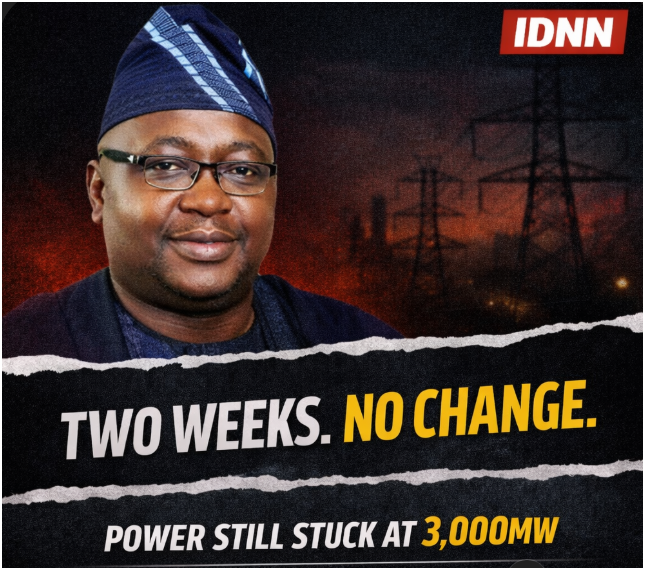
The Nigeria power crisis has intensified after the Minister of Power, Adebayo Adelabu, failed to deliver on a widely publicised two-week pledge to improve electricity supply, leaving national generation effectively unchanged.
Grid output continues to fluctuate between 3,000 and 4,000 megawatts — a fraction of the over 20,000MW required to meet demand in a country of more than 200 million people.
The missed deadline has triggered renewed scrutiny of government assurances, with analysts warning that short-term promises are colliding with long-standing structural weaknesses.
🟨 A Broken Power Chain — And a System Locked in Blame Cycle
At the centre of the Nigeria power crisis lies a deeply fractured electricity value chain — one defined by a persistent blame cycle between generation companies (GenCos), distribution companies (DisCos), and transmission authorities.
GenCos argue that liquidity constraints and unpaid debts limit their ability to increase output, citing billions owed by DisCos and government agencies. DisCos, in turn, point to weak infrastructure, energy theft, and tariff constraints as barriers to efficient distribution and revenue recovery.
Transmission failures compound the crisis, with the national grid frequently unable to evacuate available power, creating a bottleneck that renders even incremental generation gains ineffective.
“The sector is trapped in a payment and performance standoff,” said a Lagos-based energy analyst, noting that each segment of the value chain continues to shift responsibility without systemic resolution.

08112935565, 08161558757
🟥 Data Tells the Story — Nigeria’s Power Gap Remains Stark
The scale of the crisis becomes clearer when placed against basic demand metrics.
- Estimated national demand: 20,000MW+
- Actual generation: 3,000–4,000MW
- Power availability per capita: among the lowest globally
In practical terms, this translates into chronic shortages, with grid collapses and fluctuations remaining a recurring feature of Nigeria’s electricity landscape.
Industry data indicates that Nigeria has experienced multiple grid disturbances in recent months, reinforcing concerns about the fragility of the system.
🟨 Economic Pain Deepens — Businesses and Households Pay the Price
For businesses and households, the consequences are immediate and severe.
Small and medium-sized enterprises now depend heavily on diesel and petrol generators, with fuel costs significantly increasing operating expenses. In many cases, energy accounts for one of the largest cost components for businesses, forcing price hikes that ripple across the economy.
Households face a similar burden, dealing with erratic power supply, rising electricity tariffs, and the growing necessity of alternative power sources.
“We run generators almost all day. The cost is unbearable,” said a small business owner in Abuja, reflecting a sentiment widely shared across the country.
🟥 Government Assurances vs System Reality — A Widening Trust Gap
The failure of the minister’s two-week timeline has sharpened the gap between official assurances and operational realities within the power sector.
While the promise was positioned as a quick intervention to stabilise supply, sector experts argue that Nigeria’s electricity challenges are deeply structural, requiring long-term investment, regulatory consistency, and coordinated reforms across all segments of the value chain.
“You cannot solve a decades-old infrastructure deficit with short-term timelines,” an energy consultant stated, highlighting the mismatch between expectations and capacity.
🟨 What Happens Next — A System Under Pressure
With generation stagnant and systemic inefficiencies unresolved, attention is now shifting to the government’s next steps.
Key pressure points include:
- Resolving liquidity issues affecting GenCos
- Expanding transmission capacity
- Improving DisCo efficiency and revenue collection
- Strengthening regulatory enforcement
Until these structural constraints are addressed, the Nigeria power crisis is expected to persist — regardless of short-term policy announcements.
🟥 Consequence: A Crisis That Threatens Economic Stability
If current conditions continue, analysts warn of deeper economic consequences — including reduced industrial productivity, higher inflation driven by energy costs, and declining investor confidence in Nigeria’s infrastructure capacity.
The failure of immediate interventions underscores a broader reality: without systemic reform, Nigeria’s power crisis will remain a defining constraint on economic growth.
This is IDNN. Independent. Digital. Uncompromising.
