
🟥 Opposition Storms INEC — “Democracy Must Not Be Killed”
A coalition of opposition leaders under the African Democratic Congress staged a high-impact protest at the headquarters of the Independent National Electoral Commission in Abuja, demanding the immediate resignation or removal of its chairman, Joseph Amupitan, over allegations of partisanship and constitutional overreach.
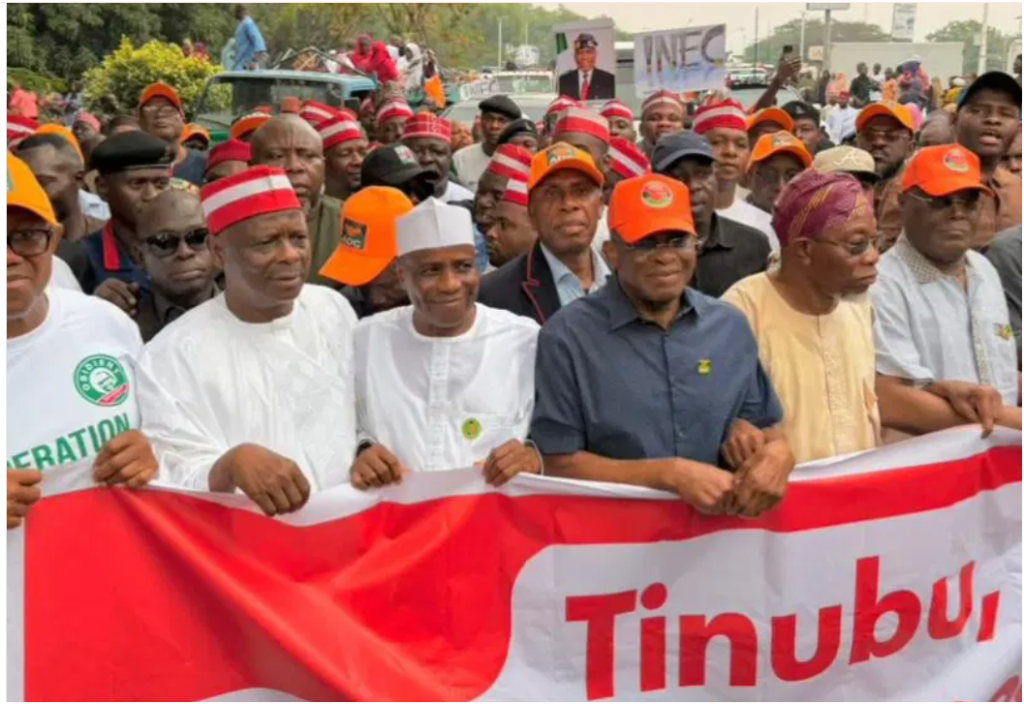
The protest, tagged #OccupyINEC, drew prominent political actors including Atiku Abubakar, Peter Obi, David Mark, and Rabiu Kwankwaso, alongside hundreds of supporters who marched through Abuja despite steady rainfall.
Placards bearing messages such as “Save Democracy,” “Let the Opposition Breathe,” and “INEC Must Recognise Mark-Led ADC” reflected rising distrust toward the electoral body as tensions continue to build ahead of the 2027 elections.
🟨 Institutional Clash Deepens — Who Controls Electoral Authority?
At the centre of the ADC protest INEC chairman removal crisis is a widening dispute over the commission’s handling of the party’s leadership crisis and its interpretation of a court directive.
Opposition leaders accused INEC of abandoning neutrality and crossing constitutional boundaries by attempting to interpret judicial pronouncements — a role strictly reserved for the courts.
“Your conduct amounts to a serious constitutional breach,” the party declared, accusing the commission of stepping beyond its legal mandate.
What is unfolding is no longer an isolated protest, but an early convergence of opposition forces testing both institutional limits and electoral ground ahead of 2027.
🟥 Demands Escalate — Resignation, Apology, and Legal Action Threatened
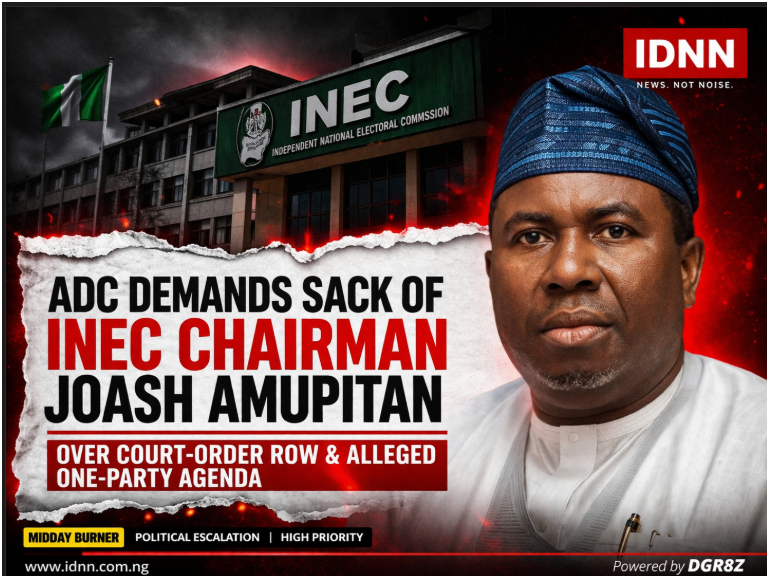
Protest leaders outlined a series of demands directed at INEC leadership, including:
- Immediate resignation or constitutional removal of the chairman
- Withdrawal of what the party described as “offensive correspondence”
- Formal apology to the ADC
- Commitment to non-interference in party affairs
The party warned that failure to comply would trigger judicial action and coordinated civic mobilisation nationwide.
“The integrity of Nigeria’s democracy cannot and will not be sacrificed,” the ADC stated.
🟨 Political Heavyweights Signal United Front Against One-Party State
Beyond the immediate dispute, the protest revealed a broader political alignment among opposition figures ahead of the 2027 elections.
Speaking during the demonstration, Peter Obi framed the protest as a defence of democratic values:
“We say no to a one-party system. Nigerians must rise to defend democracy.”
Similarly, Atiku Abubakar described the action as a stand against perceived electoral bias and authoritarian drift.
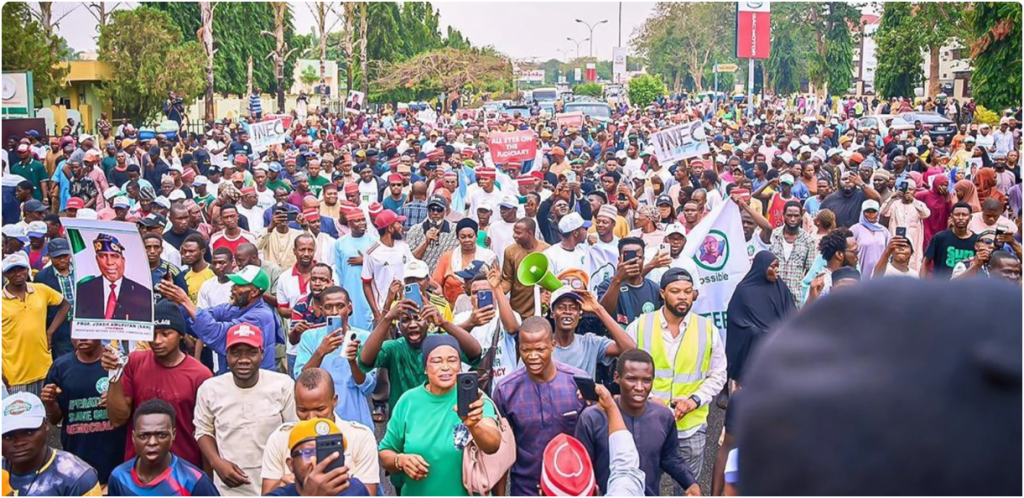
🟥 Crowd Expands — Protest Shifts From Party Action to National Signal
What began as a party-driven demonstration quickly evolved into a broader civic mobilisation, with participants from multiple political backgrounds joining the march.
Observers noted that the scale and diversity of turnout reflected rising national concern over electoral credibility, particularly as preparations for the 2027 elections gather pace.
Despite the charged atmosphere, the protest remained largely peaceful, with security operatives maintaining a visible presence around the commission’s headquarters.
🟨 System Under Pressure — Electoral Credibility Enters the Arena
The ADC protest INEC chairman removal crisis has now moved beyond partisan disagreement into a defining institutional test.
This confrontation now moves beyond party politics into a direct test of Nigeria’s electoral credibility, with legal battles, institutional trust, and the 2027 election trajectory all now directly at stake.
This is IDNN. Independent. Digital. Uncompromising.
