
When time becomes the battlefield
For years, Nigerian basketball absorbed governance strain with little public confrontation. League inconsistency, administrative fatigue, and stalled development persisted quietly. That calm has broken — not because the problems are new, but because the calendar now matters.
As the expected 2026 election window draws closer, disputes once dormant have returned with force. When institutions begin to argue over when power should change hands, it signals that timing has moved from procedure to strategy.

The office that anchors the clock
At the centre of the current debate is Musa Kida, who has served as Nigeria Basketball Federation president since 2017. His leadership weathered the disputed 2022 congress, a period that fractured the federation and left domestic legitimacy questions unresolved even as operations continued.
Today, Kida’s continued presence has become the reference point around which competing interpretations of the election calendar are being constructed — and contested. Supporters argue that constitutional process, not public agitation, should determine timing. Critics counter that ambiguity now protects incumbency advantage.

The denial that sharpened scrutiny
In recent weeks, officials aligned with the current board have publicly rejected claims of tenure elongation. Rather than closing the matter, the denials intensified attention.
For critics, the issue is not simply whether elongation is occurring, but why the debate surfaced so sharply now. Governance timelines attracted little urgency in earlier years. Their sudden prominence suggests that control of the calendar has become politically consequential.
In power contests, denial is often not an end point. It is an accelerant.
Voices from inside the system
One of the most prominent board-level voices in the renewed debate is Samuel Ahmedu, a senior NBBF board member and FIBA Africa Zone 3 President. Ahmedu has raised concerns about structural weakness and the inconsistent domestic league, arguing that Nigerian basketball has stagnated under the current arrangement.

While many stakeholders acknowledge the substance of these criticisms, sceptics question their timing. Similar structural challenges existed years earlier, when board-level urgency was less visible. Election proximity has reframed long-standing problems as immediate governance failures.
Another influential board figure, Olumide Oyedeji, has called for restraint and warned against character assassination. His intervention highlights a deeper tension: criticism emerging from within the very structure under scrutiny.

To critics, this creates contradiction rather than clarity. Why now? The timing of the agitations from the aforementioned board members draws furrowed brows.
WHY NOW ? WHATS THE PLAN ?
The actor outside the boardroom
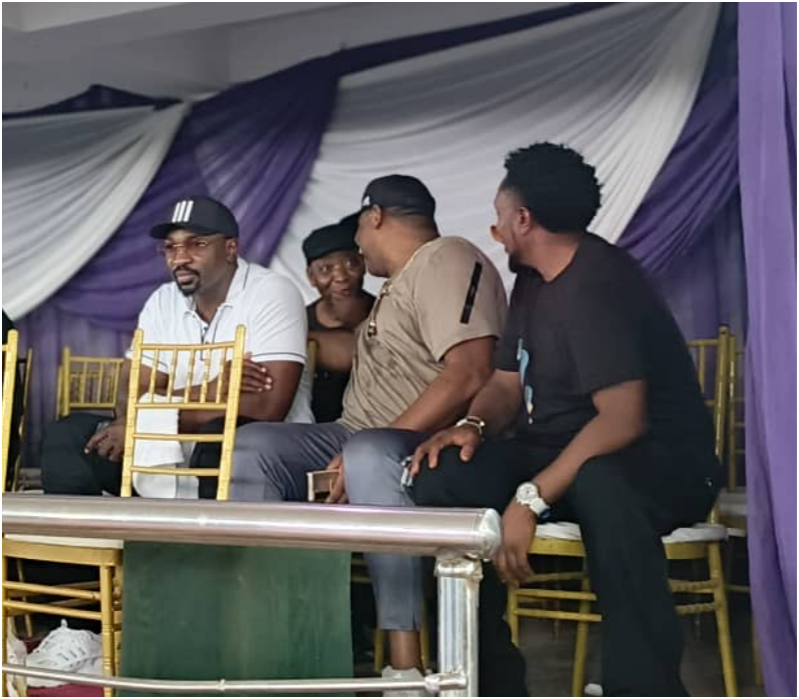
Beyond formal structures, external pressure has intensified. Igoche Mark, a central figure in the 2022 leadership split, remains outside the current board but firmly within the conversation.
Mark’s influence does not derive from office. It comes from stakeholder mobilisation, historical investment in the grassroots and National level (MARK D BALL) and there is the legitimacy pressure. Supporters and stakeholders argue that his distance from board decisions shields him from responsibility for the administrative inertia currently. Critics view his restraint as strategic positioning.
Whatever it is, his aura is like that of a king in waiting
In a clock-driven contest, remaining outside the system can be power.
IGOCHE :THE ONE?
Why the calendar is the real prize
Election timing in Nigerian sports governance determines far more than dates. It shapes:
- which state associations are active and eligible,
- who controls accreditation and congress logistics,
- how incumbency advantage is preserved or neutralised, and
- whether alternative figures have time to consolidate support.
Calls for urgency and appeals for stability are therefore not opposites. They are competing strategies. One compresses the field. The other protects it.
What bends if the clock bends
If election timelines become negotiable under narrative pressure, institutional certainty erodes. Sponsors hesitate. Development planning stalls. Authority weakens.
More critically, leadership transitions risk becoming negotiated settlements rather than transparent processes — a cycle Nigerian basketball knows too well.
The risk ahead
As 2026 approaches, the struggle over timing will intensify. Whether the federation emerges with renewed legitimacy or slips back into fragmentation may depend less on who wins the next election than on whether the clock itself remains governed by rules rather than rivalry.
IDNN interrogates process, timing, and consequence.
Leadership outcomes remain the responsibility of institutions, not headlines.
This is IDNN. Independent. Digital. Uncompromising.
